Department of Human Anatomy, College of Medicine and Health Sciences, Hawassa University, Hawassa, Ethiopia.
Department of Human Anatomy, College of Medicine and Health Sciences, University of Gondar, Gondar, Ethiopia.
PLoS One. 2023 Jan 18;18(1):e0278461. doi: 10.1371/journal.pone.0278461. eCollection 2023.
Pelvic organ prolapse (POP) is the descent of the vaginal wall, cervix, uterus, bladder, and rectum downward into the vaginal canal. It occurs owing to the weakness of the structures supporting and keeping pelvic organs in anatomic position. Prolapse occurs due to exposure to risk factors; women in developing countries are highly predisposed to the risk factors of the prolapse. No study assesses POP in Southern Ethiopia.
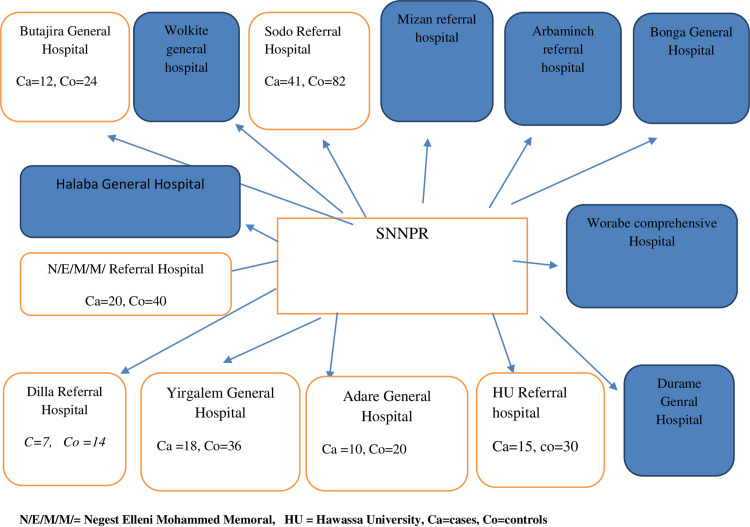
A case-control study design was employed in 369 participants (123 cases and 246 controls) of seven randomly selected Public Hospitals of Southern Ethiopia from February-June, 2020, using a structured questionnaire. All patients diagnosed with prolapse (stage I- IV) were included as cases; patients free of prolapse (stage 0) were taken as controls after physicians had performed a diagnosis and vaginal examination. Bivariate and multivariable logistic regression analyses were performed using SPSS.
In this study, after adjusting for covariates, age of the women ≥ 45 years (AOR = 5.33, 95% CI: 1.47, 9.05), underweight (AOR= 4.54, 95% CI: 1.4, 15.76), low income (AOR = 2.5, 95% CI:1.14, 5.59), parity ≥5 (AOR = 5.2, 95% CI: 2.2, 12.55), assisted vaginal delivery (AOR= 4, 95% CI: 1.55, 11.63), instrumental delivery (AOR= 3.5, 95% CI:1.45, 84), sphincter damage and vaginal tear (AOR = 3.2, 95% CI:1.44,7.1), carrying heavy loads (AOR= 2.5, 95% CI:1.2, 5.35), and prolonged labor ≥24 hours (AOR = 3.3, 95% CI:1.12, 97) were significant associated factors of prolapse. The odds of developing prolapse is lower among women attended school. Most(84.55%) of the women with prolapse were delayed for the treatments and only surgical interventions were done as treatments. Most of them claimed lack of social support, lack of money, and social stigma as the main reasons for the delay in seeking treatments.
Older age, low educational status, underweight, low income, higher parity, assisted vaginal delivery, prolonged labor, sphincter damage, and carrying heavy loads were significant associated factors of POP. It is better to screen older age women by doing campaigns against the prolapse. Also, responsible bodies should work on raising awareness of women as well as awareness of the community about the prolapse through expanding health education. Moreover, informing women to practice pelvic muscle training daily, raising women's income to empower them, and help of family members to reduce carrying an overload of mothers are recommended.
盆腔器官脱垂(POP)是阴道壁、宫颈、子宫、膀胱和直肠向下进入阴道管的下降。它是由于支撑和保持盆腔器官在解剖位置的结构薄弱引起的。脱垂是由于暴露于危险因素引起的;发展中国家的妇女极易受到脱垂的危险因素的影响。在埃塞俄比亚南部没有研究评估 POP。
2020 年 2 月至 6 月,采用病例对照研究设计,在埃塞俄比亚南部的 7 家随机选定的公立医院对 369 名参与者(123 例病例和 246 例对照)进行了研究。所有被诊断为脱垂(I-IV 期)的患者均被纳入病例组;在医生进行诊断和阴道检查后,无脱垂(0 期)的患者被视为对照组。使用 SPSS 进行单变量和多变量逻辑回归分析。
在这项研究中,在调整了协变量后,年龄≥45 岁的妇女(AOR=5.33,95%CI:1.47,9.05)、体重不足(AOR=4.54,95%CI:1.4,15.76)、低收入(AOR=2.5,95%CI:1.14,5.59)、产次≥5(AOR=5.2,95%CI:2.2,12.55)、辅助阴道分娩(AOR=4,95%CI:1.55,11.63)、器械分娩(AOR=3.5,95%CI:1.45,84)、括约肌损伤和阴道撕裂(AOR=3.2,95%CI:1.44,7.1)、负重(AOR=2.5,95%CI:1.2,5.35)和产程延长≥24 小时(AOR=3.3,95%CI:1.12,97)是脱垂的显著相关因素。接受过学校教育的妇女发生脱垂的可能性较低。大多数(84.55%)脱垂妇女的治疗被延迟,仅进行手术干预作为治疗。她们大多数人声称缺乏社会支持、缺乏资金和社会耻辱感是她们延迟寻求治疗的主要原因。
年龄较大、教育程度较低、体重不足、收入较低、产次较高、辅助阴道分娩、产程延长、括约肌损伤和负重是 POP 的显著相关因素。最好通过开展反对脱垂的运动来筛查年龄较大的妇女。此外,责任机构应通过扩大健康教育,努力提高妇女和社区对脱垂的认识,增强妇女的意识。此外,建议妇女每天进行骨盆肌肉训练,提高妇女收入,增强她们的权能,并帮助家庭成员减少母亲的负担。