Faculty of Chemistry, University of Wrocław, 14 F. Joliot-Curie, 50-383 Wrocław, Poland.
Departamento de Química Inorgánica, Universidad de Granada, Av. Fuentenueva S/N, 18071 Granada, Spain.
Mater Horiz. 2023 Apr 3;10(4):1301-1308. doi: 10.1039/d2mh01202b.
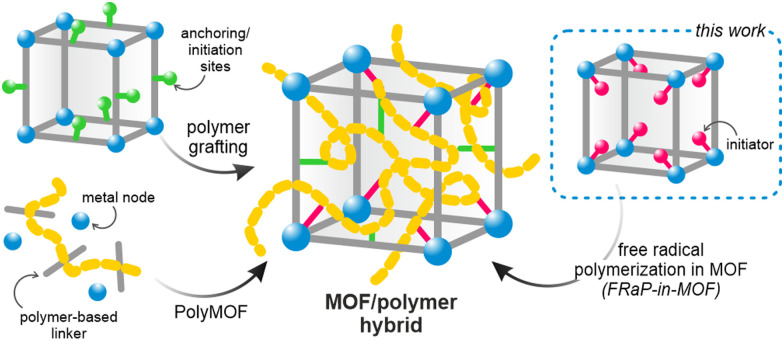
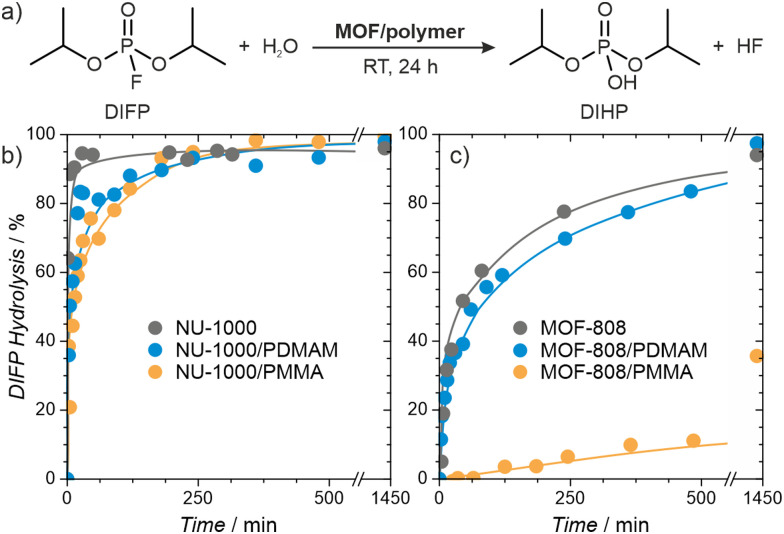
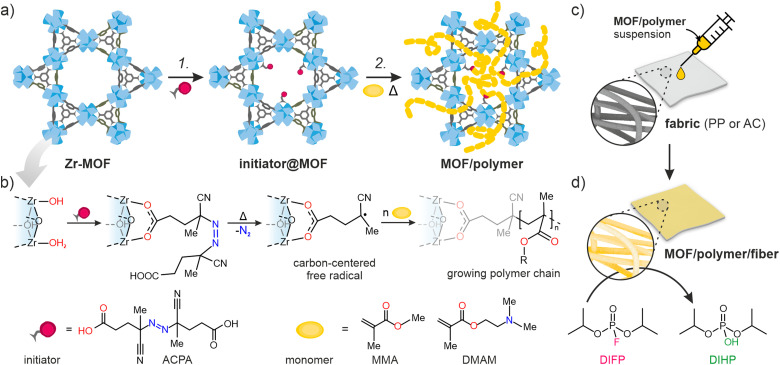
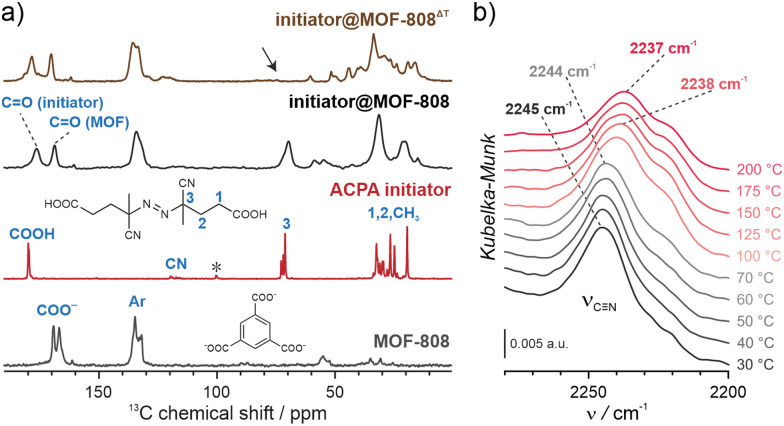
We use the free radical polymerization initiator 4,4'-azobis(cyanovaleric acid) coordinated to the open metal sites of metal-organic frameworks (MOFs) to give rise to highly uniform MOF/polymer hybrids. We demonstrate this strategy on two robust zirconium MOFs (NU-1000 and MOF-808), which are the most effective catalysts for degradation of chemical warfare nerve agents. The resulting hybrid materials maintain their hydrolytic catalytic activity and have substantially improved adhesion to polypropylene and activated carbon textile fibers, yielding highly robust MOF/polymer/textile hybrid systems. These composites are suitable for the green production of active protective clothing and filters capable of detoxifying organophosphorus warfare agents.
我们使用自由基聚合引发剂 4,4'-偶氮双(氰基戊酸)与金属-有机骨架(MOFs)的开放金属位配位,从而得到高度均匀的 MOF/聚合物杂化材料。我们在两种坚固的锆 MOFs(NU-1000 和 MOF-808)上验证了这种策略,它们是降解化学战剂神经毒剂最有效的催化剂。所得的杂化材料保持其水解催化活性,并与聚丙烯和活性炭纤维具有显著改善的附着力,从而产生高度坚固的 MOF/聚合物/纤维混合系统。这些复合材料适合于绿色生产能够解毒有机磷战剂的活性防护服和过滤器。