Department of Mechanics and Engineering Science, and Beijing Innovation Center for Engineering Science and Advanced Technology, College of Engineering, Peking University, 100871, Beijing, China.
Tianjin Key Laboratory of Epigenetics for Organ Development of Premature Infants, Fifth Central Hospital of Tianjin, Tianjin, 300450, China.
Adv Sci (Weinh). 2023 Mar;10(9):e2206153. doi: 10.1002/advs.202206153. Epub 2023 Jan 19.
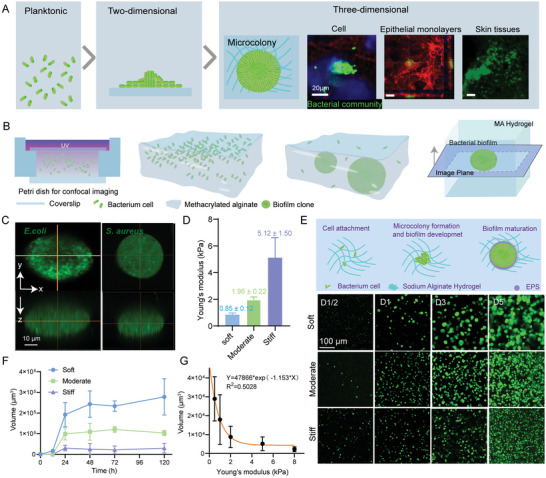
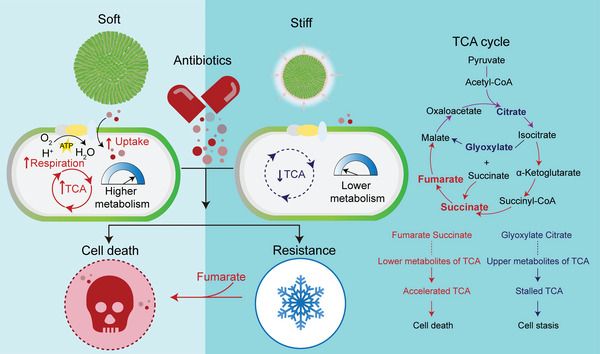
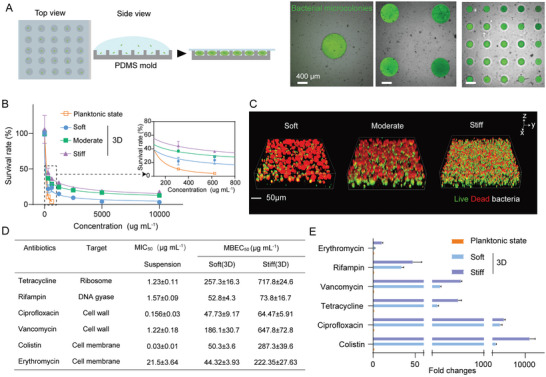
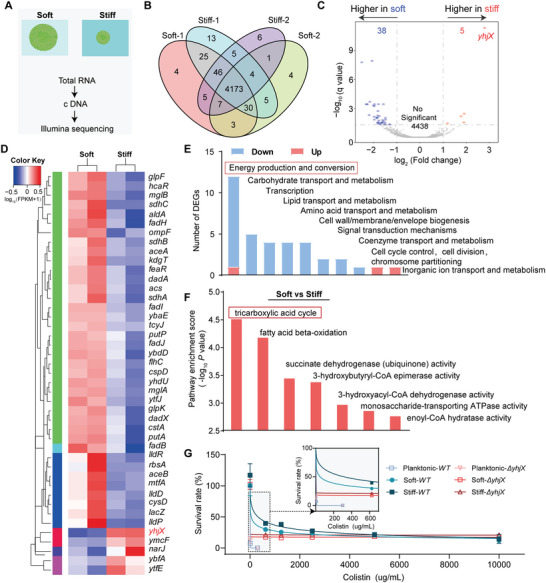
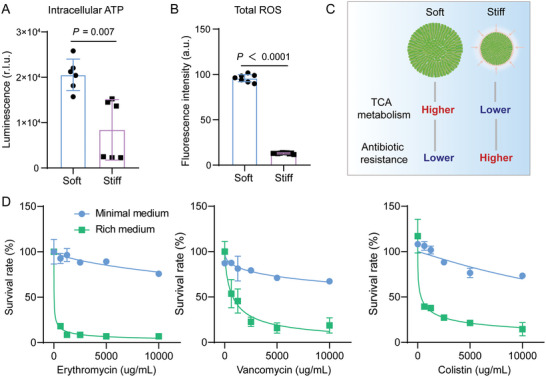
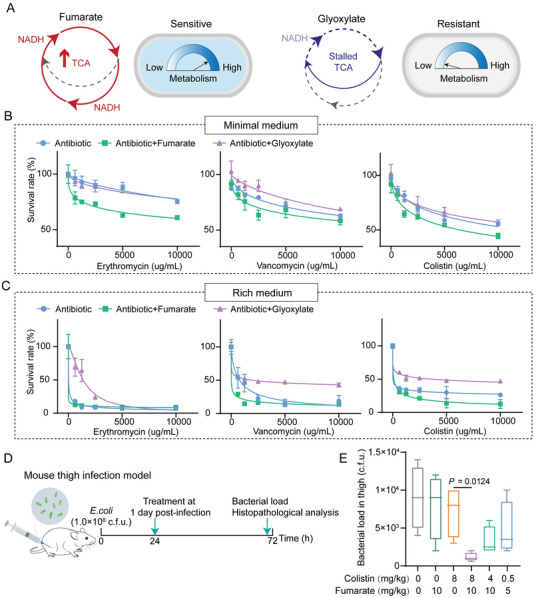
As a major cause of clinical chronic infection, microbial biofilms/microcolonies in host tissues essentially live in 3D-constrained microenvironments, which potentially modulate their spatial self-organization and morphodynamics. However, it still remains unclear whether and how mechanical cues of 3D confined microenvironments, for example, extracellular matrix (ECM) stiffness, exert an impact on antibiotic resistance of bacterial biofilms/microcolonies. With a high-throughput antibiotic sensitivity testing (AST) platform, it is revealed that 3D ECM rigidities greatly modulate their resistance to diverse antibiotics. The microcolonies in 3D ECM with human tissue-specific rigidities varying from 0.5 to 20 kPa show a ≈2-10 000-fold increase in minimum inhibitory concentration, depending on the types of antibiotics. The authors subsequently identified that the increase in 3D ECM rigidities leads to the downregulation of the tricarboxylic acid (TCA) cycle, which is responsible for enhanced antibiotic resistance. Further, it is shown that fumarate, as a potentiator of TCA cycle activity, can alleviate the elevated antibiotic resistance and thus remarkably improve the efficacy of antibiotics against bacterial microcolonies in 3D confined ECM, as confirmed in the chronic infection mice model. These findings suggest fumarate can be employed as an antibiotic adjuvant to effectively treat infections induced by bacterial biofilms/microcolonies in a 3D-confined environment.
作为临床慢性感染的主要原因,宿主组织中的微生物生物膜/微菌落本质上生活在三维受限的微环境中,这些微环境可能调节它们的空间自组织和形态动力学。然而,目前尚不清楚三维受限微环境的机械线索(例如细胞外基质 (ECM) 硬度)是否以及如何对细菌生物膜/微菌落的抗生素耐药性产生影响。利用高通量抗生素药敏测试 (AST) 平台,研究人员发现三维 ECM 的硬度极大地影响了它们对各种抗生素的耐药性。在硬度与人组织特异性硬度从 0.5 到 20 kPa 不等的三维 ECM 中的微菌落,最低抑菌浓度增加了约 2-10,000 倍,具体取决于抗生素的类型。作者随后确定,三维 ECM 硬度的增加导致三羧酸 (TCA) 循环的下调,这是增强抗生素耐药性的原因。此外,研究表明延胡索酸作为 TCA 循环活性的增强剂,可以减轻升高的抗生素耐药性,从而显著提高抗生素对三维受限 ECM 中细菌微菌落的疗效,在慢性感染小鼠模型中得到了证实。这些发现表明,延胡索酸可以作为一种抗生素佐剂,有效地治疗三维受限环境中由细菌生物膜/微菌落引起的感染。