Oztekin Faruk, Katar Oguzhan, Sadak Ferhat, Yildirim Muhammed, Cakar Hakan, Aydogan Murat, Ozpolat Zeynep, Talo Yildirim Tuba, Yildirim Ozal, Faust Oliver, Acharya U Rajendra
Faculty of Dentistry, Department of Endodontics, Firat University, Elazig 23119, Turkey.
Department of Software Engineering, Firat University, Elazig 23119, Turkey.
Diagnostics (Basel). 2023 Jan 7;13(2):226. doi: 10.3390/diagnostics13020226.
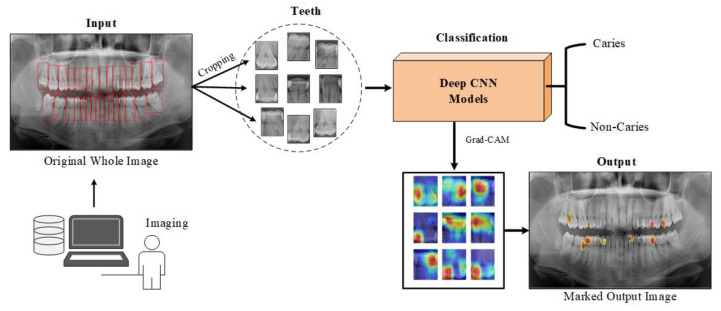
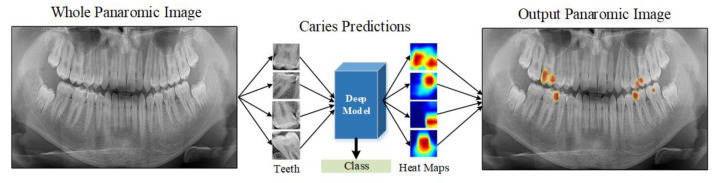
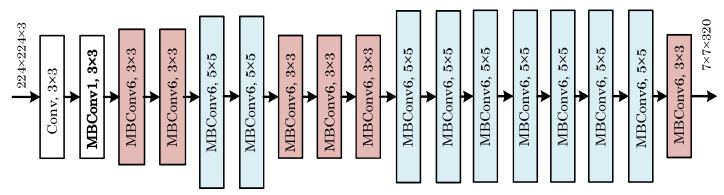
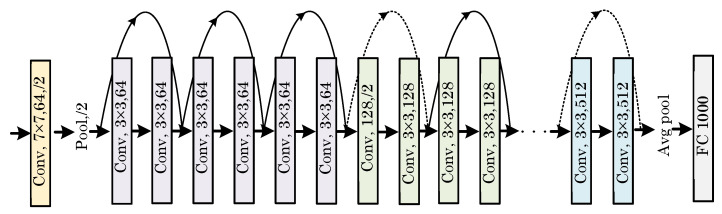
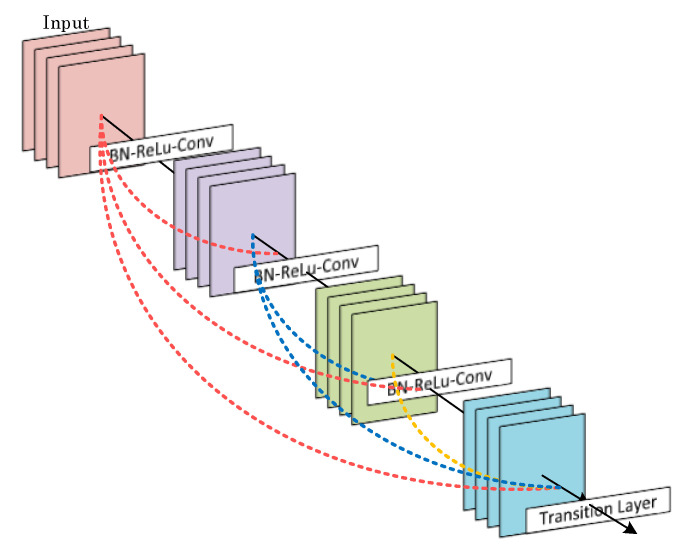
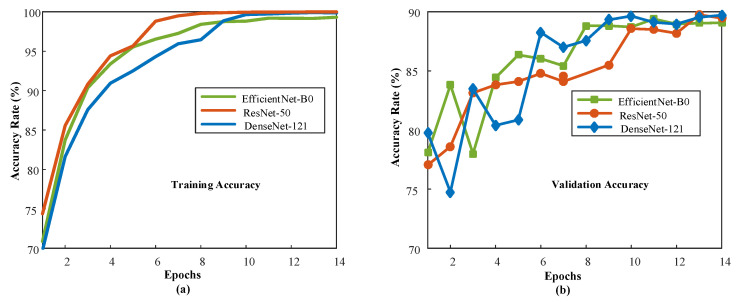
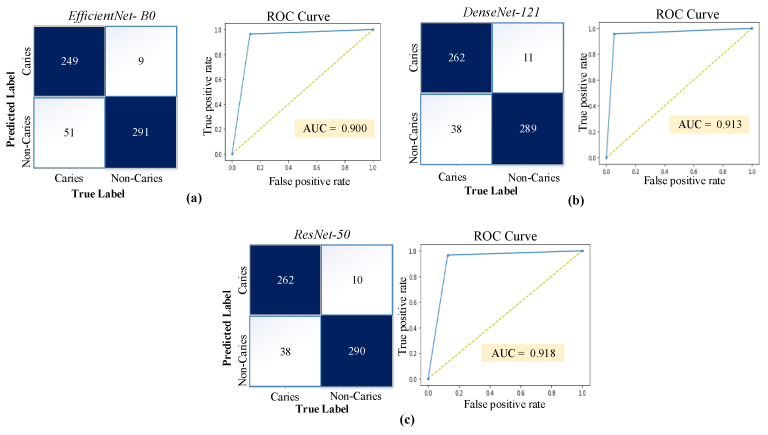
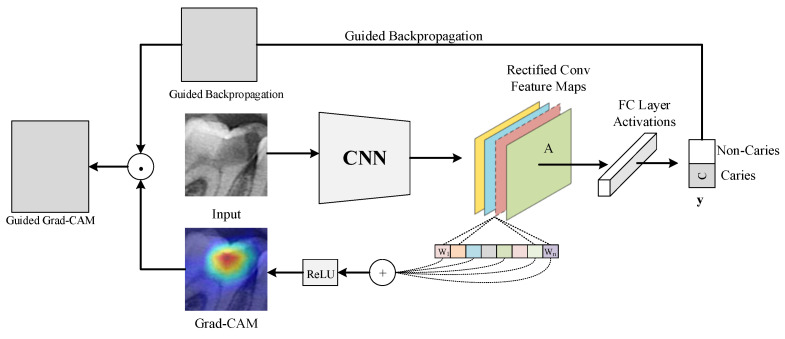
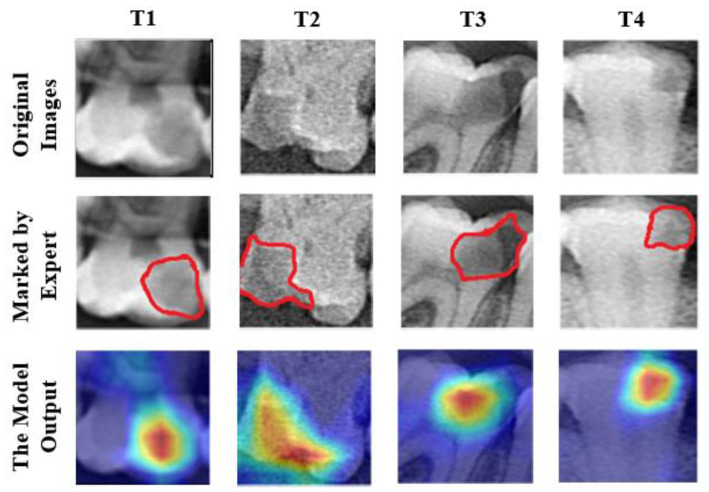
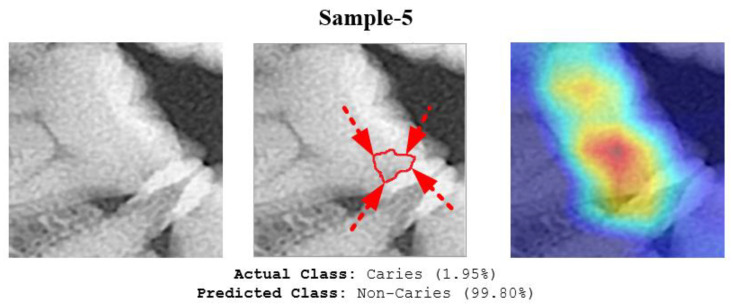
Dental caries is the most frequent dental health issue in the general population. Dental caries can result in extreme pain or infections, lowering people's quality of life. Applying machine learning models to automatically identify dental caries can lead to earlier treatment. However, physicians frequently find the model results unsatisfactory due to a lack of explainability. Our study attempts to address this issue with an explainable deep learning model for detecting dental caries. We tested three prominent pre-trained models, EfficientNet-B0, DenseNet-121, and ResNet-50, to determine which is best for the caries detection task. These models take panoramic images as the input, producing a caries-non-caries classification result and a heat map, which visualizes areas of interest on the tooth. The model performance was evaluated using whole panoramic images of 562 subjects. All three models produced remarkably similar results. However, the ResNet-50 model exhibited a slightly better performance when compared to EfficientNet-B0 and DenseNet-121. This model obtained an accuracy of 92.00%, a sensitivity of 87.33%, and an F1-score of 91.61%. Visual inspection showed us that the heat maps were also located in the areas with caries. The proposed explainable deep learning model diagnosed dental caries with high accuracy and reliability. The heat maps help to explain the classification results by indicating a region of suspected caries on the teeth. Dentists could use these heat maps to validate the classification results and reduce misclassification.
龋齿是普通人群中最常见的口腔健康问题。龋齿会导致剧痛或感染,降低人们的生活质量。应用机器学习模型自动识别龋齿可实现早期治疗。然而,由于缺乏可解释性,医生常常对模型结果不满意。我们的研究试图用一种可解释的深度学习模型来解决这个问题,以检测龋齿。我们测试了三种著名的预训练模型,EfficientNet-B0、DenseNet-121和ResNet-50,以确定哪种模型最适合龋齿检测任务。这些模型将全景图像作为输入,生成龋齿-非龋齿分类结果和热图,热图可直观显示牙齿上的感兴趣区域。使用562名受试者的全全景图像评估模型性能。所有三种模型产生的结果非常相似。然而,与EfficientNet-B0和DenseNet-121相比,ResNet-50模型表现略好。该模型的准确率为92.00%,灵敏度为87.33%,F1分数为91.61%。目视检查表明,热图也位于有龋齿的区域。所提出的可解释深度学习模型诊断龋齿具有很高的准确性和可靠性。热图通过指示牙齿上疑似龋齿的区域,有助于解释分类结果。牙医可以使用这些热图来验证分类结果并减少错误分类。