
足球运动中的敏捷技能、速度、平衡能力和纵跳摸高表现:有听力障碍与无听力障碍球员的比较
Agility Skills, Speed, Balance and CMJ Performance in Soccer: A Comparison of Players with and without a Hearing Impairment.
作者信息
Yapici Hakan, Soylu Yusuf, Gulu Mehmet, Kutlu Mehmet, Ayan Sinan, Muluk Nuray Bayar, Aldhahi Monira I, Al-Mhanna Sameer Badri
机构信息
Department of Coaching Education, Faculty of Sport Sciences, Kirikkale University, Kirikkale 71450, Turkey.
Department of Physical Education and Sports, Faculty of Sport Sciences, Tokat Gaziosmanpasa University, Tokat 60250, Turkey.
出版信息
Healthcare (Basel). 2023 Jan 13;11(2):247. doi: 10.3390/healthcare11020247.
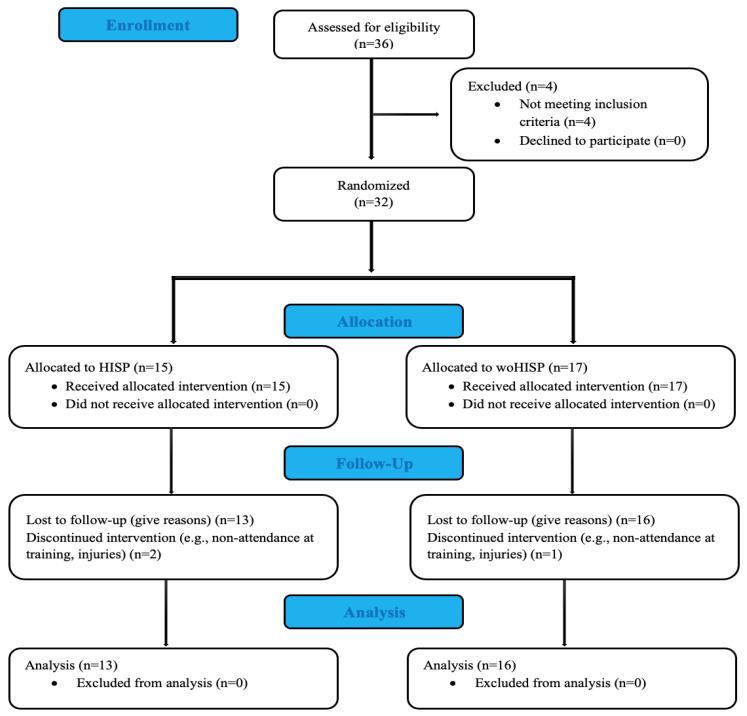
This study investigates the differences in agility, speed, jump and balance performance and shooting skills between elite hearing-impaired national team soccer players (HISP) and without-hearing-impairment elite soccer players (woHISP). Players were divided into two groups, the HISP group (n = 13; 23.5 ± 3.1 years) and the woHISP group (n = 16; 20.6 ± 1.4 years), and were tested in three sessions, seven apart, for metrics including anthropometrics, speed (10 m, 20 m and 30 m), countermovement jump (CMJ), agility (Illinois, 505, zigzag), T test (agility and shooting skills), and balance. The results showed that 30 m, 20 m and 10 m sprint scores, agility/ skills (sec), shooting skills (goals), zigzag, Illinois, and 505 agility skills, and countermovement jump scores were significantly lower among players with hearing impairments (p < 0.05). There were no significant T test differences between HISP and woHISP (p > 0.05). The HISP showed right posterolateral and posteromedial, and left posterolateral and posteromedial scores that were lower than the woHISP group (p < 0.05). Anterior scores were not significantly different between each leg (p > 0.05). In conclusion, the HISP group showed higher performance scores for speed (10 m, 20 m and 30 m), CMJ, agility (Illinois, 505, zigzag) and T test (sec and goals), but not balance. Hearing-impaired soccer players are determined by their skill, training, and strategy, not their hearing ability.
本研究调查了精英听力受损国家足球队员(HISP)与无听力受损的精英足球运动员(woHISP)在敏捷性、速度、跳跃、平衡能力和射门技巧方面的差异。球员被分为两组,即HISP组(n = 13;23.5 ± 3.1岁)和woHISP组(n = 16;20.6 ± 1.4岁),并在三个时间段进行测试,每个时间段间隔七天,测试指标包括人体测量学、速度(10米、20米和30米)、反向纵跳(CMJ)、敏捷性(伊利诺伊测试、505测试、折线跑)、T测试(敏捷性和射门技巧)以及平衡能力。结果显示,听力受损球员的30米、20米和10米短跑成绩、敏捷性/技巧(秒)、射门技巧(进球数)、折线跑、伊利诺伊测试、505敏捷性技巧以及反向纵跳成绩均显著较低(p < 0.05)。HISP组和woHISP组之间的T测试没有显著差异(p > 0.05)。HISP组的右后外侧和后内侧以及左后外侧和后内侧得分低于woHISP组(p < 0.05)。每条腿的前侧得分在两组之间没有显著差异(p > 0.05)。总之,HISP组在速度(10米、20米和30米)、CMJ、敏捷性(伊利诺伊测试、505测试、折线跑)和T测试(秒数和进球数)方面表现出较高的成绩,但在平衡能力方面并非如此。听力受损的足球运动员是由他们自身的技术、训练和策略决定的,而非听力能力。
 Zotero 插件