Yang Bin, Wu Xinfeng, Hao Jingxin, Liu Tuoyu, Xie Lisheng, Liu Panpan, Li Jinghao
College of Material Science and Engineering, Central South University of Forestry and Technology, Changsha 410004, China.
College of Furniture and Art Design, Central South University of Forestry and Technology, Changsha 410004, China.
Polymers (Basel). 2023 Jan 6;15(2):295. doi: 10.3390/polym15020295.
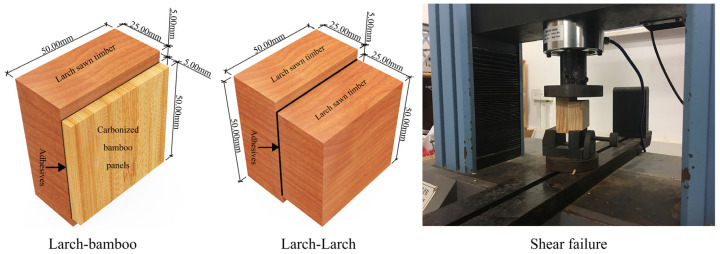
For glulam bonding performance assessment, the traditional method of manually measuring the wood failure percentage (WFP) is insufficient. In this paper, we developed a rapid assessment approach to predicate the WFP based on deep-learning (DL) techniques. bamboo/Larch laminated wood composites bonded with either phenolic resin (PF) or methylene diphenyl diisocyanate (MDI) were used for this sample analysis. Scanning of bamboo/larch laminated wood composites that have completed shear failure tests using an electronic scanner allows a digital image of the failure surface to be obtained, and this image is used in the training process of a deep convolutional neural networks (DCNNs).The result shows that the DL technique can predict the accurately localized failures of wood composites. The findings further indicate that the UNet model has the highest values of MIou, Accuracy, and F1 with 98.87%, 97.13%, and 94.88, respectively, compared to the values predicted by the PSPNet and DeepLab_v3+ models for wood composite failure predication. In addition, the test conditions of the materials, adhesives, and loadings affect the predication accuracy, and the optimal conditions were identified. The predicted value from training images assessed by DL techniques with the optimal conditions is 4.3%, which is the same as the experimental value measured through the traditional manual method. Overall, this advanced DL method could significantly facilitate the quality identification process of the wood composites, particularly in terms of measurement accuracy, speed, and stability, through the UNet model.
对于胶合木的粘结性能评估,传统的手动测量木材破坏率(WFP)的方法并不充分。在本文中,我们基于深度学习(DL)技术开发了一种快速评估方法来预测WFP。使用酚醛树脂(PF)或二苯基甲烷二异氰酸酯(MDI)粘结的竹材/落叶松层压木复合材料用于此样本分析。使用电子扫描仪对已完成剪切破坏试验的竹材/落叶松层压木复合材料进行扫描,可以获得破坏表面的数字图像,该图像用于深度卷积神经网络(DCNN)的训练过程。结果表明,DL技术可以准确预测木材复合材料的局部破坏。研究结果进一步表明,与PSPNet和DeepLab_v3 +模型预测木材复合材料破坏的数值相比,UNet模型的MIou、准确率和F1值最高,分别为98.87%、97.13%和94.88。此外,材料、胶粘剂和载荷的测试条件会影响预测精度,并确定了最佳条件。在最佳条件下,通过DL技术评估训练图像得到的预测值为4.3%,与通过传统手动方法测量的实验值相同。总体而言,这种先进的DL方法通过UNet模型可以显著促进木材复合材料的质量识别过程,特别是在测量精度、速度和稳定性方面。