Department of Software Engineering, University of Szeged, 13 Dugonics Square, 6720 Szeged, Hungary.
Department of Computer Algorithms and Artificial Intelligence, University of Szeged, 2 Árpád Square, 6720 Szeged, Hungary.
Sensors (Basel). 2023 Jan 14;23(2):958. doi: 10.3390/s23020958.
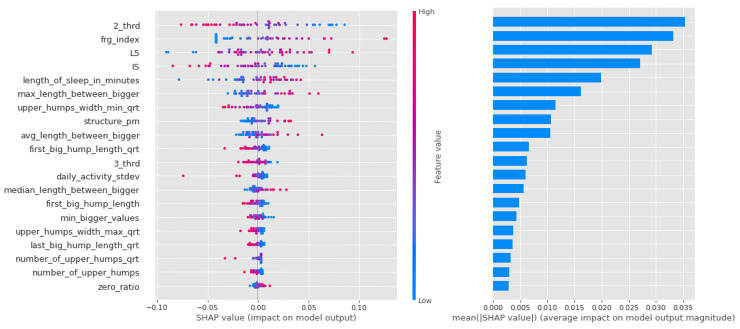
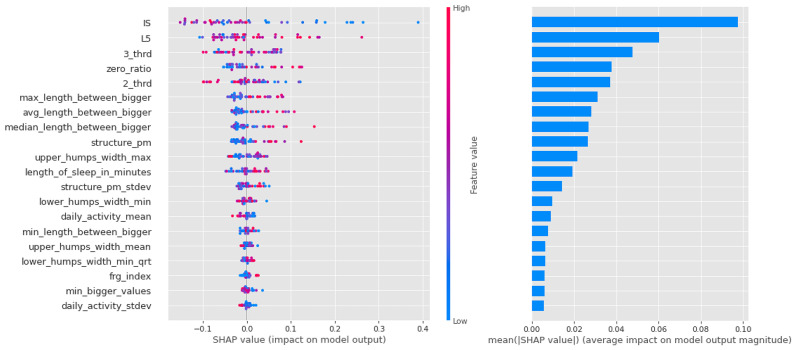
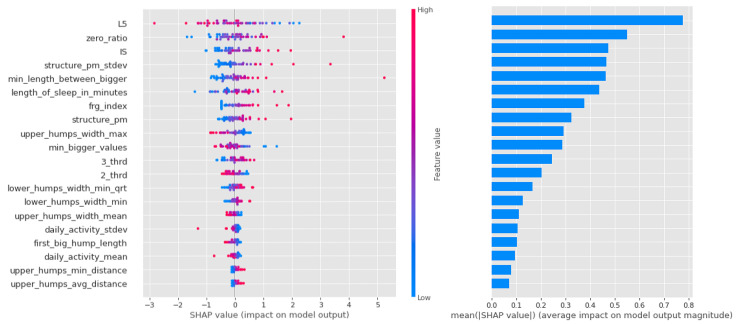
(1) Background and Goal: Several studies have investigated the association of sleep, diurnal patterns, and circadian rhythms with the presence and with the risk states of mental illnesses such as schizophrenia and bipolar disorder. The goal of our study was to examine actigraphic measures to identify features that can be extracted from them so that a machine learning model can detect premorbid latent liabilities for schizotypy and bipolarity. (2) Methods: Our team developed a small wrist-worn measurement device that collects and identifies actigraphic data based on an accelerometer. The sensors were used by carefully selected healthy participants who were divided into three groups: Control Group (C), Cyclothymia Factor Group (CFG), and Positive Schizotypy Factor Group (PSF). From the data they collected, our team performed data cleaning operations and then used the extracted metrics to generate the feature combinations deemed most effective, along with three machine learning algorithms for categorization. (3) Results: By conducting the training, we were able to identify a set of mildly correlated traits and their order of importance based on the Shapley value that had the greatest impact on the detection of bipolarity and schizotypy according to the logistic regression, Light Gradient Boost, and Random Forest algorithms. (4) Conclusions: These results were successfully compared to the results of other researchers; we had a similar differentiation in features used by others, and successfully developed new ones that might be a good complement for further research. In the future, identifying these traits may help us identify people at risk from mental disorders early in a cost-effective, automated way.
(1) 背景和目标:多项研究已经调查了睡眠、昼夜节律和昼夜节律与精神疾病(如精神分裂症和双相情感障碍)的存在和风险状态之间的关系。我们的研究目标是检查活动记录仪测量结果,以确定可以从中提取的特征,以便机器学习模型能够检测出精神分裂症和双相情感障碍的潜在潜伏性。 (2) 方法:我们的团队开发了一种小型腕戴式测量设备,该设备可根据加速度计收集和识别活动记录仪数据。传感器由精心挑选的健康参与者使用,他们分为三组:对照组 (C)、环性情感障碍因子组 (CFG) 和阳性精神分裂症特质因子组 (PSF)。从他们收集的数据中,我们的团队执行了数据清理操作,然后使用提取的指标生成被认为最有效的特征组合,以及用于分类的三种机器学习算法。 (3) 结果:通过进行训练,我们能够根据 Shapley 值识别出一组轻度相关的特征及其重要性顺序,根据逻辑回归、轻梯度提升和随机森林算法,Shapley 值对检测双相情感障碍和精神分裂症有最大影响。 (4) 结论:这些结果与其他研究人员的结果成功进行了比较;我们在其他人使用的特征方面有类似的差异,并成功开发了可能是进一步研究的良好补充的新特征。将来,识别这些特征可能有助于我们以具有成本效益的自动化方式早期识别出有精神障碍风险的人。