Department of Infectious Diseases, Taizhou Hospital of Zhejiang Province Affiliated to Wenzhou Medical University, Linhai, Zhejiang, Taiwan.
Department of Family Medicine, Chang Gung Memorial Hospital, Taoyuan City, Taiwan, China.
Hum Vaccin Immunother. 2023 Dec 31;19(1):2168936. doi: 10.1080/21645515.2023.2168936. Epub 2023 Jan 22.
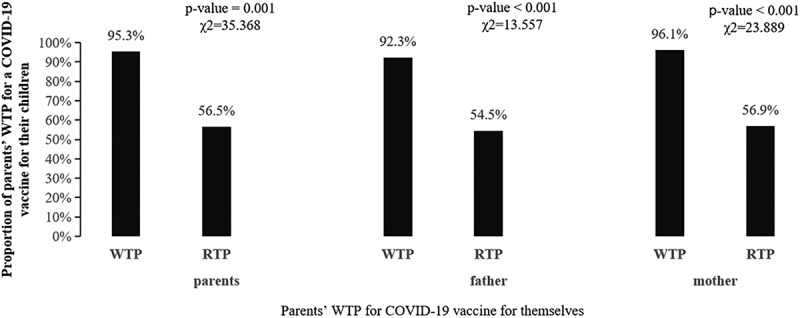
Most COVID-19 studies aim to assess factors influencing willingness to pay for vaccines between the public and medical staff. However, few studies focus on parents' willingness to pay for their children's COVID-19 vaccine. The current study aimed to assess parents' willingness to pay for their children's vaccination against COVID-19 and its influencing factors. This population-based cross-sectional study used a self-administered questionnaire. The inclusion criterion was parents with at least one child younger than 18 years. The final analysis included 384 valid data points. A total of 89.1% of the parents indicated that they are willing to pay for their children's vaccination against COVID-19. Among them, both fathers' and mothers' willingness to pay for their children's COVID-19 vaccine was 89.6%. The mean and median willingness to pay were% would pay for their children. Excluding other confounding factors, willingness to pay for the COVID-19 vaccine for themselves and hesitation to vaccinate their children were significantly associated with parents' willingness to pay for their children's COVID-19 vaccine. We found that 89.1% of the parents in Taiwan would pay for their children's COVID-19 vaccine. Parents' willingness to pay for themselves and hesitation to vaccinate their children were associated with willingness to pay. Reducing hesitation about vaccines and developing policies for vaccine payment may have a positive impact on willingness to pay for vaccines and promoting COVID-19 vaccination.
大多数 COVID-19 研究旨在评估公众和医务人员对疫苗接种的支付意愿的影响因素。然而,很少有研究关注父母对其子女 COVID-19 疫苗的支付意愿。本研究旨在评估父母对其子女接种 COVID-19 疫苗的支付意愿及其影响因素。这是一项基于人群的横断面研究,使用了自我管理的问卷。纳入标准是至少有一名 18 岁以下子女的父母。最终分析包括 384 个有效数据点。共有 89.1%的父母表示愿意为其子女接种 COVID-19 疫苗。其中,父亲和母亲都愿意为其子女接种 COVID-19 疫苗的比例为 89.6%。愿意支付的平均和中位数意愿为%将为其子女支付。在排除其他混杂因素后,自己对 COVID-19 疫苗的支付意愿和对子女接种疫苗的犹豫与父母对子女 COVID-19 疫苗的支付意愿显著相关。我们发现,台湾有 89.1%的父母愿意为其子女接种 COVID-19 疫苗。父母对自己的支付意愿和对子女接种疫苗的犹豫与支付意愿有关。减少对疫苗的犹豫并制定疫苗支付政策可能对疫苗接种的支付意愿和促进 COVID-19 疫苗接种产生积极影响。