Zhang Junrun, Dong Dawei, Zeng You, Yang Bing, Li Fangze, Chen Xuefang, Lu Jingchong, Guan Min, He Niu, Qiao Hongyu, Li Keshen, Xu Anding, Huang Li'an, Zhu Huili
Department of Neurology and Stroke Center, The First Affiliated Hospital of Jinan University, Jinan University, Guangzhou, China.
Clinical Neuroscience Institute, The First Affiliated Hospital of Jinan University, Jinan University, Guangzhou, China.
Front Aging Neurosci. 2023 Jan 5;14:1071377. doi: 10.3389/fnagi.2022.1071377. eCollection 2022.
Stress hyperglycemia is common in critical and severe diseases. However, few studies have examined the association between stress hyperglycemia and the functional outcomes of patients with anterior circulation stroke, after mechanical thrombectomy (MT), in different diabetes status. This study therefore aimed to determine the relationship between stress hyperglycemia and the risk of adverse neurological functional outcomes in anterior circulation stroke patients with and without diabetes after MT.
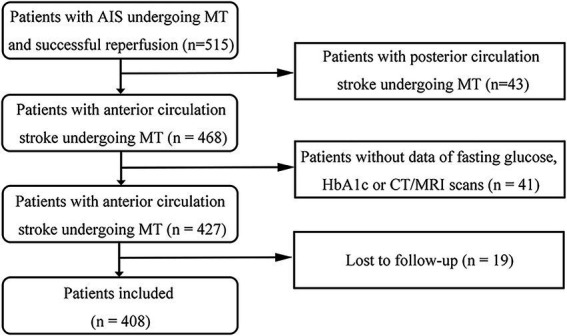
Data of 408 patients with acute anterior circulation stroke treated with MT through the green-channel treatment system for emergency stroke at the First Affiliated Hospital of Jinan University between January 2016 and December 2020 were reviewed retrospectively. The stress hyperglycemia ratio (SHR) was calculated as fasting plasma glucose (mmol/L) divided by glycosylated hemoglobin (%). The patients were stratified into four groups by quartiles of SHR (Q1-Q4). The primary outcome was an excellent (nondisabled) functional outcome at 3 months after admission (modified Rankin Scale score of 0-1). The relationship between stress hyperglycemia and neurological outcome after stroke was assessed using multivariate logistic regression.
After adjusting for potential confounders, compared with patients in Q1, those in Q4 were less likely to have an excellent outcome at 3 months (odds ratio [OR], 0.32, 95% confidence interval [CI], 0.14-0.66, = 0.003), a good outcome at 3 months (OR, 0.41, 95% CI, 0.20-0.84, = 0.020), and major neurological improvement (OR, 0.38, 95% CI, 0.19-0.73, = 0.004). Severe stress hyperglycemia increased risks of 3-months all-cause mortality (OR, 2.82, 95% CI, 1.09-8.29, = 0.041) and ICH (OR, 2.54, 95% CI, 1.21-5.50, = 0.015).
Stress hyperglycemia was associated with a reduced rate of excellent neurological outcomes, and increased mortality and ICH risks in patients with anterior circulation stroke after MT regardless of diabetes status.
应激性高血糖在危重症中很常见。然而,很少有研究探讨应激性高血糖与不同糖尿病状态下前循环卒中患者机械取栓(MT)后功能结局之间的关联。因此,本研究旨在确定应激性高血糖与MT后有糖尿病和无糖尿病的前循环卒中患者不良神经功能结局风险之间的关系。
回顾性分析2016年1月至2020年12月在暨南大学附属第一医院通过急诊卒中绿色通道治疗系统接受MT治疗的408例急性前循环卒中患者的数据。应激性高血糖率(SHR)计算为空腹血糖(mmol/L)除以糖化血红蛋白(%)。根据SHR四分位数(Q1-Q4)将患者分为四组。主要结局是入院后3个月时良好(无残疾)的功能结局(改良Rankin量表评分为0-1)。采用多因素逻辑回归评估应激性高血糖与卒中后神经结局之间的关系。
在调整潜在混杂因素后,与Q1组患者相比,Q4组患者在3个月时获得良好结局的可能性较小(比值比[OR],0.32,95%置信区间[CI],0.14-0.66,P = 0.003),在3个月时获得较好结局的可能性较小(OR,0.41,95%CI,0.20-0.84,P = 0.020),以及主要神经功能改善的可能性较小(OR,0.38,95%CI,0.19-0.73,P = 0.004)。严重应激性高血糖增加了3个月全因死亡率(OR,2.82,95%CI,1.09-8.29,P = 0.041)和脑出血(OR,2.54,95%CI,1.21-5.50,P = 0.015)的风险。
无论糖尿病状态如何,应激性高血糖与MT后前循环卒中患者良好神经结局发生率降低以及死亡率和脑出血风险增加相关。