Department of Addictive Behavior and Addiction Medicine, Central Institute of Mental Health, Medical Faculty Mannheim, Heidelberg University, Mannheim, Germany.
Institute of Cognitive and Clinical Neuroscience, Central Institute of Mental Health, Medical Faculty Mannheim, Heidelberg University, Mannheim, Germany.
BMJ Open. 2022 Sep 6;12(9):e057707. doi: 10.1136/bmjopen-2021-057707.
Alcohol and tobacco use disorders (AUD, TUD) are frequent, both worldwide and in the German population, and cognitive impairments are known to facilitate instances of relapse. Cognitive training has been proposed for enhancing cognitive functioning and possibly improving treatment outcome in mental disorders. However, these effects and underlying neurobiological mechanisms are not yet fully understood regarding AUD and TUD. Examining the effect of chess-based cognitive remediation training (CB-CRT) on neurobiological, neuropsychological and psychosocial aspects as well as treatment outcomes will provide insights into mechanisms underlying relapse and abstinence and might help to improve health behaviour in affected individuals if used as therapy add-on.
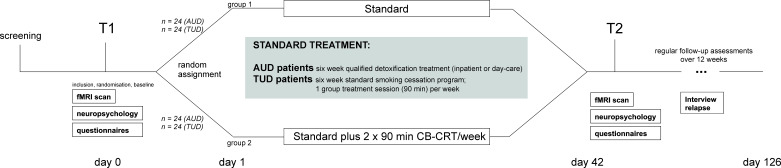
N=96 individuals with either AUD (N=48) or TUD (N=48) between 18 and 65 years of age will participate in a randomised, controlled clinical functional MRI (fMRI) trial. Two control groups will receive treatment as usual, that is, AUD treatment in a clinic, TUD outpatient treatment. Two therapy add-on groups will receive a 6-week CB-CRT as a therapy add-on. FMRI tasks, neurocognitive tests will be administered before and afterwards. All individuals will be followed up on monthly for 3 months. Endpoints include alterations in neural activation and neuropsychological task performance, psychosocial functioning, and relapse or substance intake. Regarding fMRI analyses, a general linear model will be applied, and t-tests, full factorial models and regression analyses will be conducted on the second level. Behavioural and psychometric data will be analysed using t-tests, regression analyses, repeated measures and one-way analyses of variance.
This study has been approved by the ethics committee of the medical faculty Mannheim of the University of Heidelberg (2017-647N-MA). The findings of this study will be presented at conferences and published in peer-reviewed journals.
The study was registered in the Clinical Trials Register (trial identifier: NCT04057534 at clinicaltrials.gov).
酒精和烟草使用障碍(AUD、TUD)在全球和德国人群中都很常见,认知障碍已知会增加复发的可能性。认知训练被提议用于增强认知功能,并可能改善精神障碍的治疗效果。然而,关于 AUD 和 TUD,这些效果和潜在的神经生物学机制尚未完全了解。检查基于国际象棋的认知矫正训练(CB-CRT)对神经生物学、神经心理学和心理社会方面以及治疗结果的影响,将提供有关复发和禁欲的潜在机制的见解,并可能有助于改善受影响个体的健康行为,如果将其用作治疗附加物。
N=96 名年龄在 18 至 65 岁之间的 AUD(N=48)或 TUD(N=48)患者将参加一项随机对照临床功能磁共振成像(fMRI)试验。两个对照组将接受常规治疗,即 AUD 在诊所治疗,TUD 门诊治疗。两个治疗附加组将接受 6 周的 CB-CRT 作为治疗附加物。在之前和之后进行 fMRI 任务、神经认知测试。所有个体将在 3 个月内每月进行随访。终点包括神经激活和神经心理学任务表现、心理社会功能以及复发或物质摄入的改变。关于 fMRI 分析,将应用一般线性模型,并在第二级进行 t 检验、完全因子模型和回归分析。行为和心理测量数据将使用 t 检验、回归分析、重复测量和单向方差分析进行分析。
这项研究已获得海德堡大学曼海姆医学系伦理委员会的批准(2017-647N-MA)。该研究的结果将在会议上公布,并发表在同行评议的期刊上。
该研究已在临床试验注册处(试验标识符:NCT04057534 在 clinicaltrials.gov)注册。