Department of General Practice/Family Medicine, University of Oslo, Oslo, Norway.
Division of Psychiatric Treatment Research, Department of Psychiatry, University of Oslo, Oslo, Norway.
J Med Internet Res. 2023 Jan 24;25:e37289. doi: 10.2196/37289.
Depression is common during adolescence. Early intervention can prevent it from developing into more progressive mental disorders. Combining information technology and clinical psychoeducation is a promising way to intervene at an earlier stage. However, data-driven research on the cognitive response to health information targeting adolescents with symptoms of depression is lacking.
This study aimed to fill this knowledge gap through a new understanding of adolescents' cognitive response to health information about depression. This knowledge can help to develop population-specific information technology, such as chatbots, in addition to clinical therapeutic tools for use in general practice.
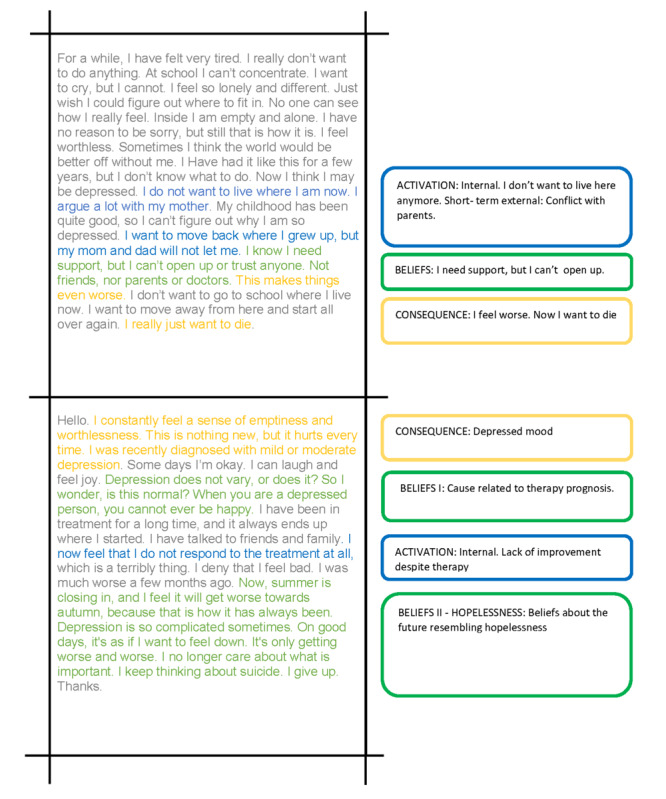
The data set consists of 1870 depression-related questions posted by adolescents on a public web-based information service. Most of the posts contain descriptions of events that lead to depression. On a sample of 100 posts, we conducted a qualitative thematic analysis based on cognitive behavioral theory investigating behavioral, emotional, and symptom responses to beliefs associated with depression.
Results were organized into four themes. (1) Hopelessness, appearing as a set of negative beliefs about the future, possibly results from erroneous beliefs about the causal link between risk factors and the course of depression. We found beliefs about establishing a sturdy therapy alliance as a responsibility resting on the patient. (2) Therapy hesitancy seemed to be associated with negative beliefs about therapy prognosis and doubts about confidentiality. (3) Social shame appeared as a consequence of impaired daily function when the cause is not acknowledged. (4) Failing to attain social interaction appeared to be associated with a negative symptom response. In contrast, actively obtaining social support reduces symptoms and suicidal thoughts.
These results could be used to meet the clinical aims stated by earlier psychoeducation development, such as instilling hope through direct reattribution of beliefs about the future; challenging causal attributions, thereby lowering therapy hesitancy; reducing shame through the mechanisms of externalization by providing a tentative diagnosis despite the risk of stigmatizing; and providing initial symptom relief by giving advice on how to open up and reveal themselves to friends and family and balance the message of self-management to fit coping capabilities. An active counseling style advises the patient to approach the social environment, demonstrating an attitude toward self-action.
抑郁症在青少年中很常见。早期干预可以防止其发展为更严重的精神障碍。结合信息技术和临床心理教育是一种有前途的早期干预方法。然而,针对有抑郁症状的青少年的健康信息的认知反应的基于数据的研究还很缺乏。
本研究旨在通过对青少年对抑郁相关健康信息的认知反应的新理解来填补这一知识空白。这一知识可以帮助开发针对特定人群的信息技术,如聊天机器人,以及一般实践中使用的临床治疗工具。
该数据集包含 1870 个由青少年在一个公共网络信息服务上发布的与抑郁相关的问题。大多数帖子都包含导致抑郁的事件描述。在 100 个帖子的样本中,我们根据认知行为理论,对与抑郁相关的信念的行为、情绪和症状反应进行了定性主题分析。
结果分为四个主题。(1)绝望,表现为一系列对未来的消极信念,可能是由于对风险因素与抑郁病程之间的因果关系的错误信念所致。我们发现,建立牢固的治疗联盟的信念是患者的责任。(2)治疗犹豫似乎与对治疗预后的消极信念和对保密性的怀疑有关。(3)社会耻辱感似乎是由于功能受损而出现的,如果原因不被承认。(4)未能获得社会互动似乎与消极的症状反应有关。相反,积极寻求社会支持可以减轻症状和自杀念头。
这些结果可以用于满足早期心理教育发展所提出的临床目标,例如通过直接重新归因于对未来的信念来灌输希望;通过挑战因果归因来降低治疗犹豫;通过提供暂定诊断来减少耻辱感,尽管存在污名化的风险;通过提供如何与朋友和家人开放和坦诚相待的建议来缓解初始症状,并平衡自我管理的信息以适应应对能力。一种积极的咨询风格建议患者接近社会环境,表现出自我行动的态度。