Wu Shubiao, Heidari Ali Asghar, Zhang Siyang, Kuang Fangjun, Chen Huiling
Department of Computer Science and Artificial Intelligence, Wenzhou University, Wenzhou, 325035 China.
School of Surveying and Geospatial Engineering, College of Engineering, University of Tehran, Tehran, Iran.
Artif Intell Rev. 2023 Jan 20:1-37. doi: 10.1007/s10462-022-10370-7.
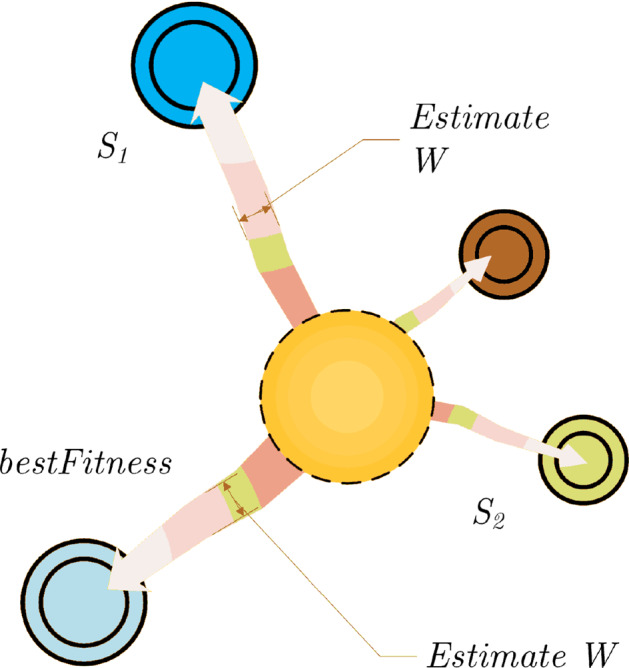
The slime mould algorithm (SMA) is a new meta-heuristic algorithm recently proposed. The algorithm is inspired by the foraging behavior of polycephalus slime moulds. It simulates the behavior and morphological changes of slime moulds during foraging through adaptive weights. Although the original SMA's performance is better than most swarm intelligence algorithms, it still has shortcomings, such as quickly falling into local optimal values and insufficient exploitation. This paper proposes a Gaussian barebone mutation enhanced SMA (GBSMA) to alleviate the original SMA's shortcomings. First of all, the Gaussian function in the Gaussian barebone accelerates the convergence while also expanding the search space, which improves the algorithm exploration and exploitation capabilities. Secondly, the differential evolution (DE) update strategy in the Gaussian barebone, using as the guiding vector. It also enhances the algorithm's global search performance to a certain extent. Also, the greedy selection is introduced on this basis, which prevents individuals from performing invalid position updates. In the IEEE CEC2017 test function, the proposed GBSMA is compared with a variety of meta-heuristic algorithms to verify the performance of GBSMA. Besides, GBSMA is applied to solve truss structure optimization problems. Experimental results show that the convergence speed and solution accuracy of the proposed GBSMA are significantly better than the original SMA and other similar products.
The online version contains supplementary material available at 10.1007/s10462-022-10370-7.
黏液霉菌算法(SMA)是最近提出的一种新的元启发式算法。该算法受多头黏液霉菌觅食行为的启发。它通过自适应权重模拟黏液霉菌觅食过程中的行为和形态变化。尽管原始SMA的性能优于大多数群体智能算法,但它仍有缺点,比如容易陷入局部最优值且开发不足。本文提出一种高斯骨干变异增强型SMA(GBSMA)来缓解原始SMA的缺点。首先,高斯骨干中的高斯函数在加速收敛的同时还扩展了搜索空间,提高了算法的探索和开发能力。其次,高斯骨干中的差分进化(DE)更新策略,以 作为引导向量。这也在一定程度上增强了算法的全局搜索性能。此外,在此基础上引入贪婪选择,防止个体进行无效的位置更新。在IEEE CEC2017测试函数中,将提出的GBSMA与多种元启发式算法进行比较,以验证GBSMA的性能。此外,GBSMA被应用于解决桁架结构优化问题。实验结果表明,所提出的GBSMA的收敛速度和求解精度明显优于原始SMA和其他同类产品。
在线版本包含可在10.1007/s10462-022-10370-7获取的补充材料。