
探讨父母压力与父母和儿童睡眠障碍的关系。
Relating parental stress with sleep disorders in parents and children.
机构信息
Department of Public Health, College of Life Sciences, Brigham Young University, Provo, Utah, United States of America.
出版信息
PLoS One. 2023 Jan 25;18(1):e0279476. doi: 10.1371/journal.pone.0279476. eCollection 2023.
OBJECTIVE
To assess whether child sleep disorders positively correlate with parental insomnia, hypersomnia, and sleep apnea, and whether parental and child sleep disorders simultaneously positively associate with parental stress. Potential modifying influences of these associations by age, sex, and marital status will be considered.
METHODS
Analyses are based on 14,009 employees aged 18-64 with dependent children (n = 44,157) insured by Deseret Mutual Benefit Administrator (DMBA) in 2020. Rate ratios are adjusted for age, sex, and marital status.
RESULTS
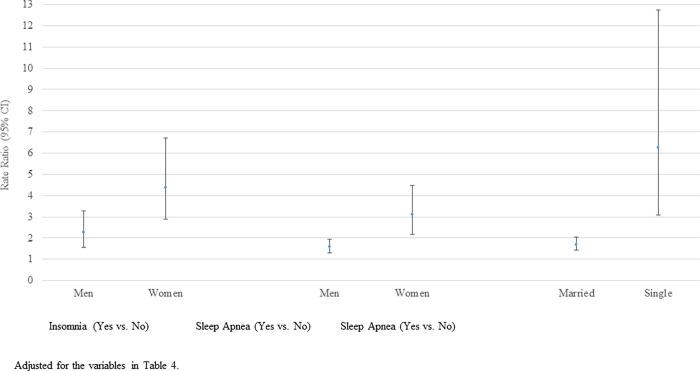
The rate of parental stress is 3.00 (95% CI 2.33-4.85) times greater for those with insomnia and 1.88 (95% CI 1.59-2.22) times greater for those with sleep apnea. There is no increased risk of stress for those with hypersomnia. The number of dependent children filing one or more medical claims for a sleep disorder is 2.0%. Mean age is significantly older among those with a sleep disorder (17.1 vs. 14.4, t p < .0001). Child sex is not associated with the risk of having a sleep disorder. The rate of employee insomnia is 111% greater if their child has a sleep disorder, and employee sleep apnea is 115% greater if their child has a sleep disorder. The association between child sleep disorders and sleep apnea decreases with employee age (Wald chi-square p = 0.0410). The rate of employee stress is 90% greater if their child has a sleep disorder, 189% greater if they have insomnia, and 81% greater if they have sleep apnea. The strength of the association between insomnia and stress is greater for women (Wald Chi-square p = 0.0114), between sleep apnea and stress is greater for women (Wald chi-square p = 0.0010), and between sleep apnea and stress is greater for singles (Wald chi-square p = 0.0010).
CONCLUSIONS
Better understanding the connection between parent and child sleep problems and parent stress, and modifying influences, may improve treatment of these disorders.
目的
评估儿童睡眠障碍是否与父母失眠、嗜睡和睡眠呼吸暂停呈正相关,以及父母和儿童睡眠障碍是否同时与父母压力呈正相关。将考虑这些关联的年龄、性别和婚姻状况的潜在调节影响。
方法
分析基于 2020 年由 Deseret Mutual Benefit Administrator (DMBA) 承保的 14009 名年龄在 18-64 岁之间有子女(n=44157)的员工。率比根据年龄、性别和婚姻状况进行调整。
结果
失眠的父母压力率是无失眠父母的 3.00 倍(95%CI 2.33-4.85),睡眠呼吸暂停的父母压力率是无睡眠呼吸暂停父母的 1.88 倍(95%CI 1.59-2.22)。嗜睡的父母没有增加压力的风险。有一个或多个睡眠障碍医疗索赔的子女人数为 2.0%。有睡眠障碍的员工平均年龄明显较大(17.1 岁对 14.4 岁,t p <.0001)。子女的性别与睡眠障碍的风险无关。如果员工的孩子有睡眠障碍,员工失眠的发生率增加 111%,如果员工的孩子有睡眠呼吸暂停,员工睡眠呼吸暂停的发生率增加 115%。员工年龄越小,子女睡眠障碍与睡眠呼吸暂停之间的关联越低(Wald chi-square p = 0.0410)。如果子女有睡眠障碍,员工的压力率增加 90%,如果子女有失眠,员工的压力率增加 189%,如果子女有睡眠呼吸暂停,员工的压力率增加 81%。失眠与压力之间的关联强度在女性中更强(Wald Chi-square p = 0.0114),睡眠呼吸暂停与压力之间的关联强度在女性中更强(Wald chi-square p = 0.0010),睡眠呼吸暂停与压力之间的关联强度在单身人士中更强(Wald chi-square p = 0.0010)。
结论
更好地了解父母和子女睡眠问题与父母压力之间的联系,以及调节影响,可能会改善这些障碍的治疗效果。
 Zotero 插件