
一种用于肿瘤组织病理学图像分析的具有一致性正则化的半监督学习方法。
A semi-supervised learning approach with consistency regularization for tumor histopathological images analysis.
作者信息
Jiang Yanyun, Sui Xiaodan, Ding Yanhui, Xiao Wei, Zheng Yuanjie, Zhang Yongxin
机构信息
School of Mathematics and Statistics, Shandong Normal University, Jinan, China.
Shandong Provincial Hospital, Shandong University, Jinan, China.
出版信息
Front Oncol. 2023 Jan 9;12:1044026. doi: 10.3389/fonc.2022.1044026. eCollection 2022.
INTRODUCTION
Manual inspection of histopathological images is important in clinical cancer diagnosis. Pathologists implement pathological diagnosis and prognostic evaluation through the microscopic examination of histopathological slices. This entire process is time-consuming, laborious, and challenging for pathologists. The modern use of whole-slide imaging, which scans histopathology slides to digital slices, and analysis using computer-aided diagnosis is an essential problem.
METHODS
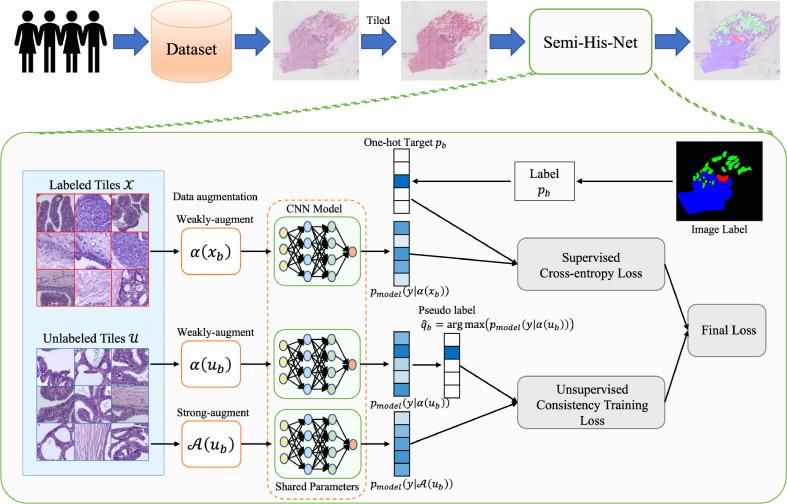
To solve the problem of difficult labeling of histopathological data, and improve the flexibility of histopathological analysis in clinical applications, we herein propose a semi-supervised learning algorithm coupled with consistency regularization strategy, called"Semi- supervised Histopathology Analysis Network"(Semi-His-Net), for automated normal-versus-tumor and subtype classifications. Specifically, when inputted disturbing versions of the same image, the model should predict similar outputs. Based on this, the model itself can assign artificial labels to unlabeled data for subsequent model training, thereby effectively reducing the labeled data required for training.
RESULTS
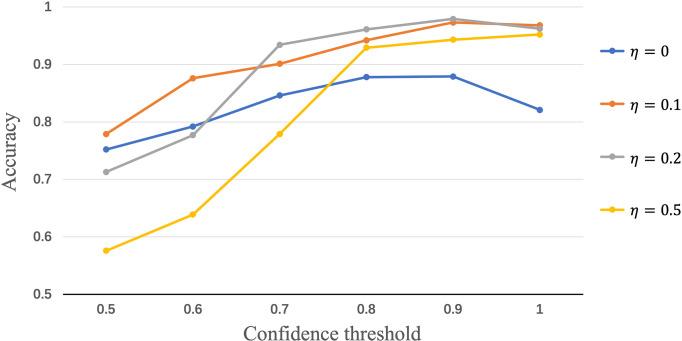
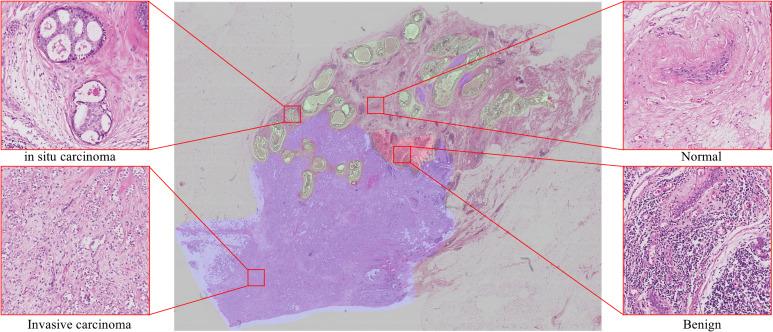
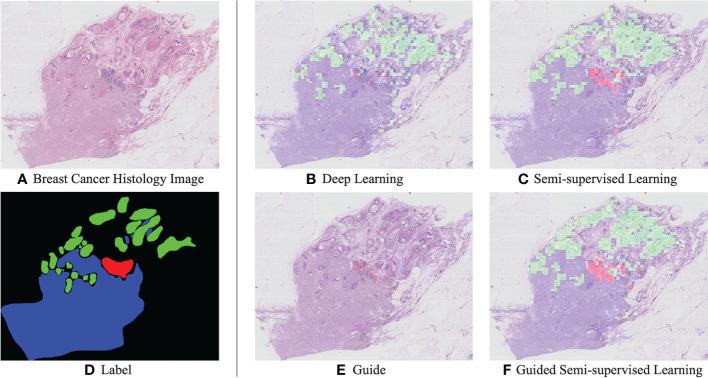
Our Semi-His-Net is able to classify patches from breast cancer histopathological images into normal tissue and three other different tumor subtypes, achieving an accuracy was 90%. The average AUC of cross-classification between tumors reached 0.893.
DISCUSSION
To overcome the limitations of visual inspection by pathologists for histopathology images, such as long time and low repeatability, we have developed a deep learning-based framework (Semi-His-Net) for automatic classification subdivision of the subtypes contained in the whole pathological images. This learning-based framework has great potential to improve the efficiency and repeatability of histopathological image diagnosis.
引言
在临床癌症诊断中,组织病理学图像的人工检查至关重要。病理学家通过对组织病理学切片进行显微镜检查来实施病理诊断和预后评估。整个过程耗时、费力,对病理学家来说具有挑战性。现代使用全切片成像技术,即将组织病理学切片扫描成数字切片,并利用计算机辅助诊断进行分析,是一个至关重要的问题。
方法
为了解决组织病理学数据标注困难的问题,并提高临床应用中组织病理学分析的灵活性,我们在此提出一种结合一致性正则化策略的半监督学习算法,称为“半监督组织病理学分析网络”(Semi-His-Net),用于自动进行正常组织与肿瘤以及亚型分类。具体而言,当输入同一图像的干扰版本时,模型应预测相似的输出。基于此,模型本身可以为未标注数据分配人工标签以供后续模型训练,从而有效减少训练所需的标注数据。
结果
我们的Semi-His-Net能够将乳腺癌组织病理学图像中的切片分类为正常组织和其他三种不同的肿瘤亚型,准确率达到90%。肿瘤之间交叉分类的平均AUC达到0.893。
讨论
为了克服病理学家对组织病理学图像进行目视检查的局限性,如耗时且重复性低,我们开发了一种基于深度学习的框架(Semi-His-Net),用于对整个病理图像中包含的亚型进行自动分类细分。这种基于学习的框架在提高组织病理学图像诊断的效率和重复性方面具有巨大潜力。

 Zotero 插件