
除非出现问题:通过艺术来理解和减轻多发性硬化症治疗中治疗惰性的风险
Unless Something Goes Wrong: Making Art to Understand and Mitigate the Risk of Therapeutic Inertia in the Treatment of Multiple Sclerosis.
作者信息
Byrne Libby
机构信息
School of Psychology and Public Health, La Trobe University, Bundoora, Australia.
Whitley College, University of Divinity, Melbourne, Australia.
出版信息
J Patient Exp. 2023 Jan 17;10:23743735231151550. doi: 10.1177/23743735231151550. eCollection 2023.
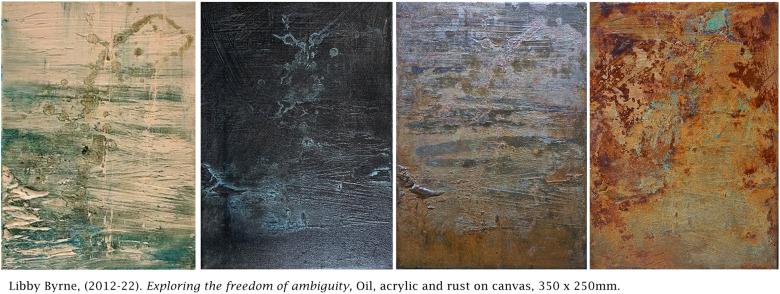
In the long-term management of a degenerative illness there is a risk that the approach we take to treatment can be characterized by therapeutic inertia (TI). With no evidence of disease progression clinicians can be reluctant to make a change to treatment regimes. This can lead to less choice and suboptimal outcomes for people with multiple sclerosis. The risk of TI is however greater when clinicians have an aversion to ambiguity and a low tolerance for uncertainty. (1) This article is an art-based inquiry into the possibility of TI in decision making when the advice from my neurologist was to stick with the treatment unless something goes wrong. (2) Through a unique process of rusting an existing canvas, the article reveals that the phrase, unless something goes wrong, is an expression of openness to uncertainty and ambiguity. (3) Art making offers the artist an opportunity to lean into and grow and capacity for tolerating uncertainty and ambiguity, thereby minimizing the risk of TI.
在退行性疾病的长期管理中,我们采取的治疗方法可能存在治疗惰性(TI)的风险。在没有疾病进展证据的情况下,临床医生可能不愿改变治疗方案。这可能导致多发性硬化症患者的选择减少和治疗效果欠佳。然而,当临床医生厌恶模糊性且对不确定性的容忍度较低时,治疗惰性的风险会更大。(1)本文是一项基于艺术的探究,探讨当我的神经科医生建议坚持治疗,除非出现问题时,决策中存在治疗惰性的可能性。(2)通过对一幅现有画布进行独特的锈蚀过程,本文揭示了“除非出现问题”这一表述是对不确定性和模糊性持开放态度的一种表达。(3)艺术创作让艺术家有机会去接纳并增强容忍不确定性和模糊性的能力,从而将治疗惰性的风险降至最低。
 Zotero 插件