Koronczai Beatrix, Kökönyei Gyöngyi, Griffiths Mark D, Demetrovics Zsolt
Department of Developmental and Clinical Child Psychology, Institute of Psychology, Eötvös Loránd University, Budapest, Hungary.
Department of Clinical Psychology and Addiction, Institute of Psychology, Eötvös Loránd University, Budapest, Hungary.
J Med Internet Res. 2019 Apr 26;21(4):e11837. doi: 10.2196/11837.
There are many empirical studies that demonstrate the associations between problematic internet use, psychopathological symptoms, and personality traits. However, complex models are scarce.
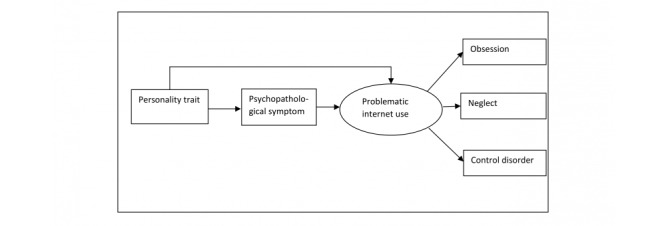
The aim of this study was to build and test a mediation model based on problematic internet use, psychopathological symptoms, and personality traits.
Data were collected from a medical addiction center (43 internet addicts) and internet cafés (222 customers) in Beijing (mean age 22.45, SD 4.96 years; 239/265, 90.2% males). Path analysis was applied to test the mediation models using structural equation modeling.
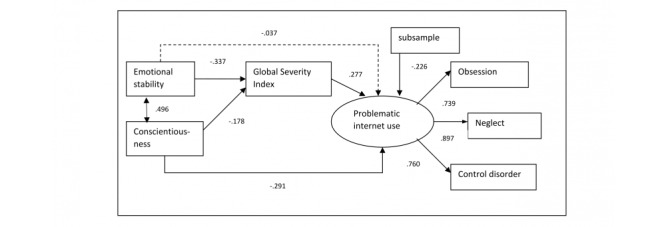
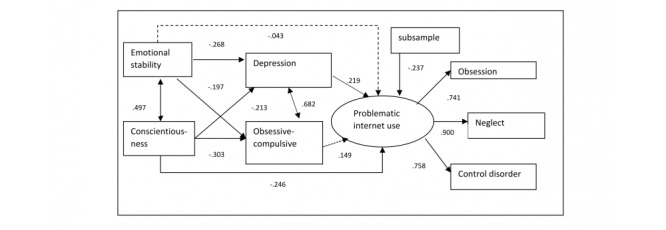
Based on the preliminary analyses (correlations and linear regression), two different models were built. In the first model, low conscientiousness and depression had a direct significant influence on problematic internet use. The indirect effect of conscientiousness-via depression-was nonsignificant. Emotional stability only affected problematic internet use indirectly, via depressive symptoms. In the second model, low conscientiousness also had a direct influence on problematic internet use, whereas the indirect path via the Global Severity Index was again nonsignificant. Emotional stability impacted problematic internet use indirectly via the Global Severity Index, whereas it had no direct effect on it, as in the first model.
Personality traits (ie, conscientiousness as a protective factor and neuroticism as a risk factor) play a significant role in problematic internet use, both directly and indirectly (via distress level).
有许多实证研究表明了有问题的互联网使用、心理病理症状和人格特质之间的关联。然而,复杂模型却很稀缺。
本研究的目的是构建并检验一个基于有问题的互联网使用、心理病理症状和人格特质的中介模型。
数据收集自北京的一个医学成瘾中心(43名网络成瘾者)和网吧(222名顾客)(平均年龄22.45岁,标准差4.96岁;239/265,90.2%为男性)。使用结构方程模型应用路径分析来检验中介模型。
基于初步分析(相关性和线性回归),构建了两个不同的模型。在第一个模型中,低尽责性和抑郁对有问题的互联网使用有直接显著影响。尽责性通过抑郁的间接效应不显著。情绪稳定性仅通过抑郁症状间接影响有问题的互联网使用。在第二个模型中,低尽责性对有问题的互联网使用也有直接影响,而通过总体严重程度指数的间接路径再次不显著。情绪稳定性通过总体严重程度指数间接影响有问题的互联网使用,而与第一个模型一样,对其没有直接影响。
人格特质(即尽责性作为保护因素,神经质作为风险因素)在有问题的互联网使用中直接和间接(通过痛苦水平)都发挥着重要作用。