
体内评估传统扭簧和各种固定正畸 CAD/CAM 保持器引起的 MRI 图像伪影。
In vivo assessment of artefacts in MRI images caused by conventional twistflex and various fixed orthodontic CAD/CAM retainers.
机构信息
Department of Orthodontics and Dentofacial Orthopedics, Heidelberg University Hospital, Im Neuenheimer Feld 400, 69120, Heidelberg, Germany.
Department of Neuroradiology, Heidelberg University Hospital, Im Neuenheimer Feld 400, 69120, Heidelberg, Germany.
出版信息
J Orofac Orthop. 2024 Jul;85(4):279-288. doi: 10.1007/s00056-022-00445-z. Epub 2023 Jan 26.
PURPOSE
To assess magnetic resonance imaging (MRI) artefacts caused by different computer-aided design/computer-aided manufacturing (CAD/CAM) retainers in comparison with conventional hand bent stainless steel twistflex retainers in vivo.
MATERIALS AND METHODS
MRI scans (3 Tesla) were performed on a male volunteer with different CAD/CAM retainers (cobalt-chromium, CoCr; nickel-titanium, NiTi; grade 5 titanium, Ti5) and twistflex retainers inserted. A total of 126 landmarks inside and outside the retainer area (RA; from canine to canine) were evaluated by two blinded radiologists using an established five-point visibility scoring (1: excellent, 2: good, 3: moderate, 4: poor, 5: not visible). Friedman and two-tailed Wilcoxon tests were used for statistical analysis (significance level: p < 0.05).
RESULTS
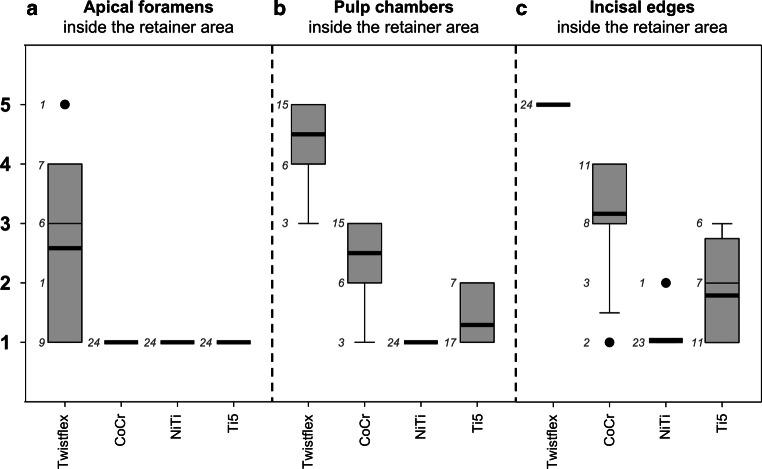
Twistflex retainers had the strongest impact on the visibility of all landmarks inside (4.0 ± 1.5) and outside the RA (1.7 ± 1.2). In contrast, artefacts caused by CAD/CAM retainers were limited to the dental area inside the RA (CoCr: 2.2 ± 1.2) or did not impair MRI-based diagnostics in a clinically relevant way (NiTi: 1.0 ± 0.1; Ti5: 1.4 ± 0.6).
CONCLUSION
The present study on a single test person demonstrates that conventional stainless steel twistflex retainers can severely impair the diagnostic value in head/neck and dental MRI. By contrast, CoCr CAD/CAM retainers can cause artefacts which only slightly impair dental MRI but not head/neck MRI, whereas NiTi and Ti5 CAD/CAM might be fully compatible with both head/neck and dental MRI.
目的
评估不同 CAD/CAM 保持器(钴铬、CoCr;镍钛、NiTi;5 级钛、Ti5)与传统手工弯制不锈钢扭转丝保持器在体内引起的磁共振成像(MRI)伪影,并与后者进行比较。
材料和方法
对一名男性志愿者进行 MRI 扫描(3 Tesla),在志愿者体内插入不同 CAD/CAM 保持器(钴铬、CoCr;镍钛、NiTi;5 级钛、Ti5)和扭转丝保持器。两名盲法阅片放射科医师使用既定的五分可视性评分(1:极好,2:好,3:中等,4:差,5:不可见)对保持器区域(RA;从尖牙到尖牙)内外共 126 个标志点进行评估。采用 Friedman 检验和双侧 Wilcoxon 检验进行统计学分析(显著性水平:p < 0.05)。
结果
扭转丝保持器对 RA 内外所有标志点的可视性影响最强(4.0 ± 1.5)和(1.7 ± 1.2)。相比之下,CAD/CAM 保持器引起的伪影仅限于 RA 内的牙齿区域(CoCr:2.2 ± 1.2)或不会以临床相关的方式损害基于 MRI 的诊断(NiTi:1.0 ± 0.1;Ti5:1.4 ± 0.6)。
结论
本研究在单名测试者中进行,结果表明传统不锈钢扭转丝保持器可严重损害头颈部和牙齿 MRI 的诊断价值。相比之下,CoCr CAD/CAM 保持器可引起仅轻微损害牙齿 MRI 但不损害头颈部 MRI 的伪影,而 NiTi 和 Ti5 CAD/CAM 可能与头颈部和牙齿 MRI 完全兼容。


 Zotero 插件