Department of Radiology, Feinberg School of Medicine, Northwestern University, Chicago, Illinois, United States of America.
Electrical and Electronics Engineering Department, Bilkent University, Ankara, Turkey.
PLoS One. 2023 Jan 26;18(1):e0280655. doi: 10.1371/journal.pone.0280655. eCollection 2023.
Since the advent of magnetic resonance imaging (MRI) nearly four decades ago, there has been a quest for ever-higher magnetic field strengths. Strong incentives exist to do so, as increasing the magnetic field strength increases the signal-to-noise ratio of images. However, ensuring patient safety becomes more challenging at high and ultrahigh field MRI (i.e., ≥3 T) compared to lower fields. The problem is exacerbated for patients with conductive implants, such as those with deep brain stimulation (DBS) devices, as excessive local heating can occur around implanted lead tips. Despite extensive effort to assess radio frequency (RF) heating of implants during MRI at 1.5 T, a comparative study that systematically examines the effects of field strength and various exposure limits on RF heating is missing.
This study aims to perform numerical simulations that systematically compare RF power deposition near DBS lead models during MRI at common clinical and ultra-high field strengths, namely 1.5, 3, 7, and 10.5 T. Furthermore, we assess the effects of different exposure constraints on RF power deposition by imposing limits on either the B1+ or global head specific absorption rate (SAR) as these two exposure limits commonly appear in MRI guidelines.
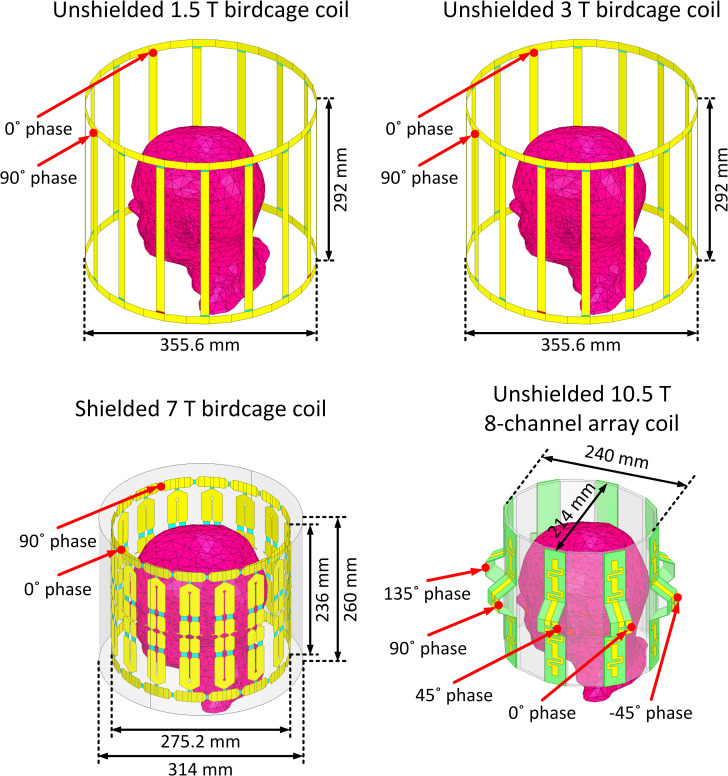
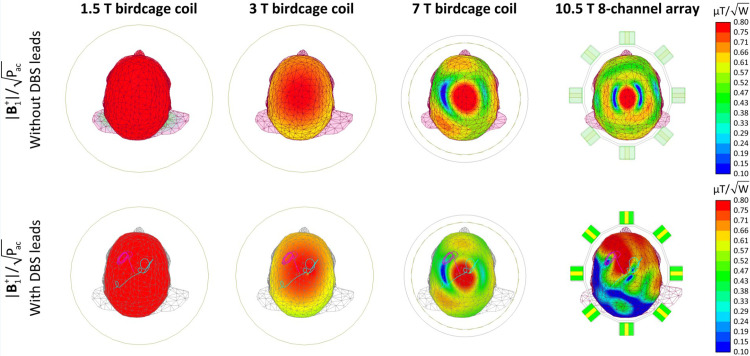
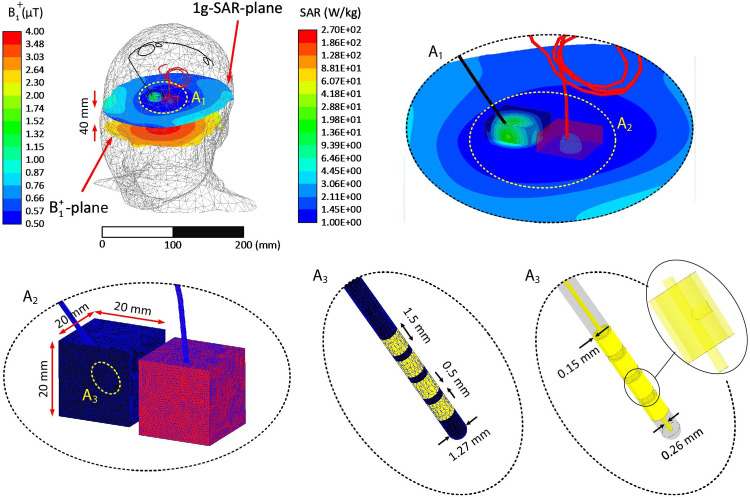
We created 33 unique DBS lead models based on postoperative computed tomography (CT) images of patients with implanted DBS devices and performed electromagnetic simulations to evaluate the SAR of RF energy in the tissue surrounding lead tips during RF exposure at frequencies ranging from 64 MHz (1.5 T) to 447 MHz (10.5 T). The RF exposure was implemented via realistic MRI RF coil models created based on physical prototypes built in our institutions. We systematically examined the distribution of local SAR at different frequencies with the input coil power adjusted to either limit the B1+ or the global head SAR.
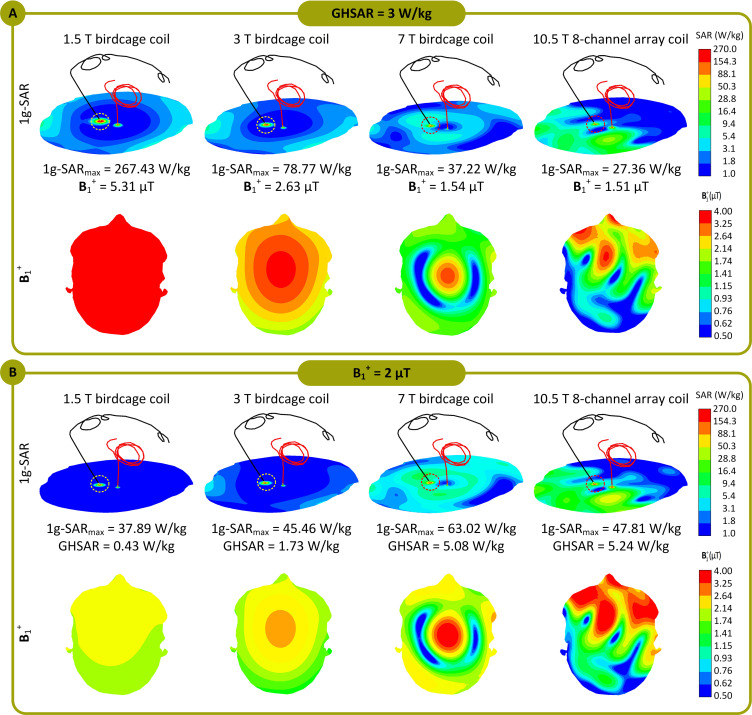
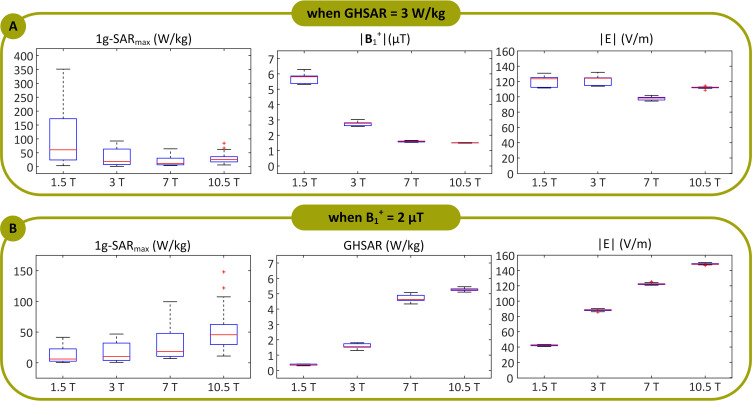
The MRI RF coils at higher resonant frequencies generated lower SARs around the lead tips when the global head SAR was constrained. The trend was reversed when the constraint was imposed on B1+.
At higher static fields, MRI is not necessarily more dangerous than at lower fields for patients with conductive leads. Specifically, when a conservative safety criterion, such as constraints on the global SAR, is imposed, coils at a higher resonant frequency tend to generate a lower local SAR around implanted leads due to the decreased B1+ and, by proxy, E field levels.
自近四十年前磁共振成像(MRI)问世以来,人们一直在追求更高的磁场强度。这样做的动力很强,因为增加磁场强度可以提高图像的信噪比。然而,与较低的磁场相比,在高场和超高场 MRI(即≥3 T)中,确保患者安全变得更具挑战性。对于具有导电性植入物的患者,问题更加严重,例如那些具有深部脑刺激(DBS)装置的患者,因为在植入的导联尖端周围会发生过度的局部加热。尽管在 1.5 T 时对 MRI 期间植入物的射频(RF)加热进行了广泛的评估,但缺乏一项系统地检查场强和各种暴露限制对 RF 加热影响的比较研究。
本研究旨在进行数值模拟,系统比较常见临床和超高场强度(即 1.5、3、7 和 10.5 T)下 DBS 导联模型附近的 RF 功率沉积。此外,我们通过限制 B1+或全身局部吸收率(SAR)来评估不同暴露限制对 RF 功率沉积的影响,因为这两个暴露限制在 MRI 指南中经常出现。
我们根据植入 DBS 装置的患者的术后计算机断层扫描(CT)图像创建了 33 个独特的 DBS 导联模型,并进行了电磁模拟,以评估在 64 MHz(1.5 T)至 447 MHz(10.5 T)范围内的 RF 能量在导联尖端周围组织中的 SAR。通过基于我们机构内构建的物理原型创建的现实 MRI RF 线圈模型来实现 RF 暴露。我们系统地检查了在不同频率下局部 SAR 的分布,通过调节输入线圈功率来限制 B1+或全身头部 SAR。
当限制全身头部 SAR 时,较高谐振频率的 MRI RF 线圈在导联尖端周围产生的 SAR 较低。当限制 B1+时,趋势相反。
对于具有导电性导联的患者,在更高的静态场中,MRI 并不一定比在较低的场中更危险。具体而言,当施加保守的安全标准(例如限制全身 SAR)时,由于 B1+和 E 场水平降低,较高谐振频率的线圈往往会在植入导联周围产生较低的局部 SAR。