Department of Neurology, University Medical Center Groningen, University of Groningen, PO Box 30.001, 9700 RB, Groningen, the Netherlands.
Expertise Center Movement Disorders Groningen, University Medical Center Groningen (UMCG), PO Box 30.001, 9700 RB, Groningen, the Netherlands.
Eur J Nucl Med Mol Imaging. 2023 Jun;50(7):1954-1973. doi: 10.1007/s00259-023-06110-w. Epub 2023 Jan 27.
To give a comprehensive literature overview of alterations in regional cerebral glucose metabolism, measured using [F]FDG PET, in conditions associated with hyperkinetic movement disorders and ataxia. In addition, correlations between glucose metabolism and clinical variables as well as the effect of treatment on glucose metabolism are discussed.
A systematic literature search was performed according to PRISMA guidelines. Studies concerning tremors, tics, dystonia, ataxia, chorea, myoclonus, functional movement disorders, or mixed movement disorders due to autoimmune or metabolic aetiologies were eligible for inclusion. A PubMed search was performed up to November 2021.
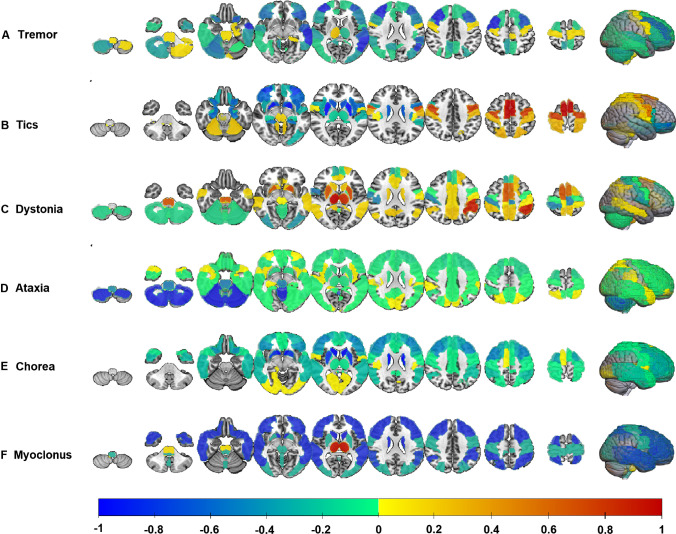
Of 1240 studies retrieved in the original search, 104 articles were included. Most articles concerned patients with chorea (n = 27), followed by ataxia (n = 25), dystonia (n = 20), tremor (n = 8), metabolic disease (n = 7), myoclonus (n = 6), tics (n = 6), and autoimmune disorders (n = 5). No papers on functional movement disorders were included. Altered glucose metabolism was detected in various brain regions in all movement disorders, with dystonia-related hypermetabolism of the lentiform nuclei and both hyper- and hypometabolism of the cerebellum; pronounced cerebellar hypometabolism in ataxia; and striatal hypometabolism in chorea (dominated by Huntington disease). Correlations between clinical characteristics and glucose metabolism were often described. [F]FDG PET-showed normalization of metabolic alterations after treatment in tremors, ataxia, and chorea.
In all conditions with hyperkinetic movement disorders, hypo- or hypermetabolism was found in multiple, partly overlapping brain regions, and clinical characteristics often correlated with glucose metabolism. For some movement disorders, [F]FDG PET metabolic changes reflected the effect of treatment.
全面综述与快动眼运动障碍和共济失调相关的疾病中,使用[F]FDG PET 测量的区域性脑葡萄糖代谢改变。此外,还讨论了葡萄糖代谢与临床变量的相关性以及治疗对葡萄糖代谢的影响。
根据 PRISMA 指南进行系统文献检索。纳入震颤、抽动、肌张力障碍、共济失调、舞蹈症、肌阵挛、功能性运动障碍或自身免疫或代谢病因引起的混合运动障碍的研究。在原始搜索中检索到 1240 项研究,其中有 104 项符合纳入标准。
在最初的搜索中检索到 1240 项研究,其中有 104 项符合纳入标准。大多数文章涉及舞蹈症患者(n=27),其次是共济失调(n=25)、肌张力障碍(n=20)、震颤(n=8)、代谢性疾病(n=7)、肌阵挛(n=6)、抽动(n=6)和自身免疫性疾病(n=5)。没有关于功能性运动障碍的论文。所有运动障碍均发现葡萄糖代谢异常,其中肌张力障碍相关的豆状核代谢亢进,小脑呈高代谢和低代谢;共济失调表现为明显的小脑代谢低下;舞蹈症表现为纹状体代谢低下(以亨廷顿病为主)。临床特征与葡萄糖代谢之间的相关性经常被描述。[F]FDG PET 显示治疗后震颤、共济失调和舞蹈症的代谢改变恢复正常。
在所有快动眼运动障碍的情况下,多个部分重叠的脑区都发现了代谢低下或亢进,临床特征往往与葡萄糖代谢相关。对于一些运动障碍,[F]FDG PET 代谢变化反映了治疗效果。