Postgraduate Program of Pharmaceutical Sciences of Faculty of Pharmacy, Universitas Gadjah Mada, Yogyakarta, Indonesia.
Department of Pharmacy, Faculty of Health, Universitas Jenderal Achmad Yani Yogyakarta, Yogyakarta,Indonesia.
Asian Pac J Cancer Prev. 2023 Jan 1;24(1):75-80. doi: 10.31557/APJCP.2023.24.1.75.
Ficus septica is an Indonesian medicinal plant traditionally used to treat various illness, including cancer. The n-hexane insoluble fraction of the ethanolic extract of F. septica leaves (HIFFS) shows a potential anticancer activity against breast cancer cell line T47D. Considering that angiogenesis is a pivotal factor in malignant cancer growth, progression, and invasion, we aimed to investigate the antiangiogenic effect of HIFFS on chicken chorioallantoic membrane (CAM) induced by bFGF. We also evaluated tylophorine, the cytotoxic alkaloid of F. septica.
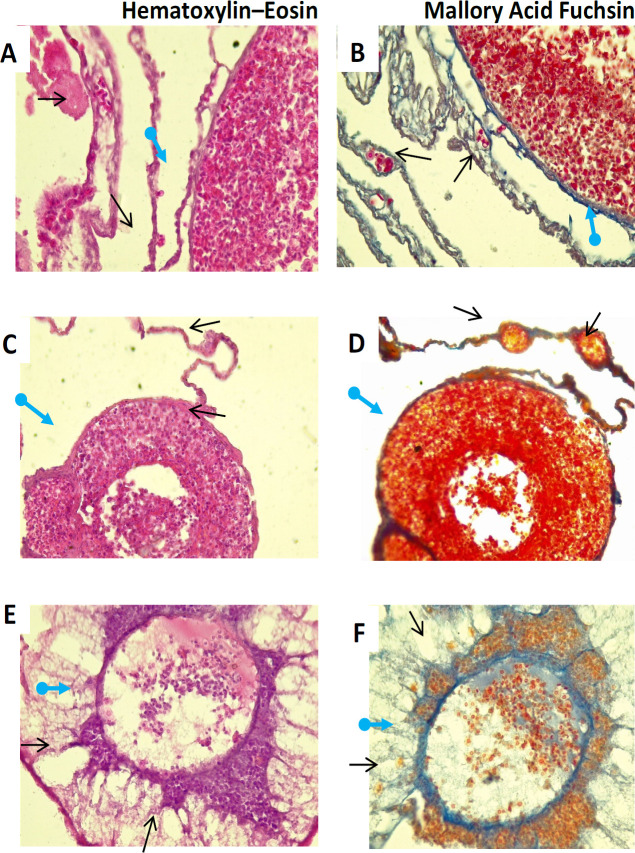
Chicken CAM was used to assess the antiangiogenic effect. Fertilized chicken eggs were induced with basic fibroblast growth factor (bFGF) ex ovo. Prior to bFGF induction, HIFFS (2.33, 4.65, 6.98, and 9.30 μg/mL) or tylophorine (9.20 µM) was added (10 µL) to a paper disk and implanted to the CAM. After 48 h of incubation, each treatment group was photographed, and the number of new blood vessel was calculated and compared with that in the solvent-treated group to determine the antiangiogenic activity. Histology of the CAM was evaluated after hematoxylin-eosin and Mallory acid fuchsin staining.
We found that HIFFS at low concentrations (2.33, 4.65, 6.98, and 9.30 μg/mL) inhibited angiogenesis activity (31.87, 41.99, 53.65, and 70.08, respectively) in chicken CAM induced by bFGF. Tylophorine (9.20 µM) also showed similar antiangiogenesis activity in the same model. Histopathology analysis revealed that HIFFS and tylophorine reduced the number of new blood vessels in CAM induced by bFGF.
HIFFS and tylophorine showed antiangiogenic effect on chicken CAM induced by bFGF. This finding emphasized the potential of F. septica as a candidate anticancer agent.
海芒果是印度尼西亚的一种药用植物,传统上用于治疗各种疾病,包括癌症。海芒果叶乙醇提取物的正己烷不溶部分(HIFFS)对乳腺癌细胞系 T47D 显示出潜在的抗癌活性。考虑到血管生成是恶性肿瘤生长、进展和侵袭的关键因素,我们旨在研究 HIFFS 对碱性成纤维细胞生长因子(bFGF)诱导的鸡胚绒毛尿囊膜(CAM)的抗血管生成作用。我们还评估了 HIFFS 中的毒性生物碱美登木素碱。
鸡胚绒毛尿囊膜(CAM)用于评估抗血管生成作用。用碱性成纤维细胞生长因子(bFGF)在鸡胚外诱导鸡胚绒毛尿囊膜(CAM)。在 bFGF 诱导之前,将 HIFFS(2.33、4.65、6.98 和 9.30 μg/mL)或美登木素碱(9.20 μM)加入(10 μL)到纸片中,并植入到 CAM 上。孵育 48 h 后,对每个处理组进行拍照,并计算新血管的数量,并与溶剂处理组进行比较,以确定抗血管生成活性。用苏木精-伊红和马洛里酸福辛染色法评估 CAM 的组织学。
我们发现 HIFFS 在低浓度(2.33、4.65、6.98 和 9.30 μg/mL)时抑制了 bFGF 诱导的鸡胚绒毛尿囊膜(CAM)中的血管生成活性(分别为 31.87、41.99、53.65 和 70.08)。美登木素碱(9.20 μM)在相同模型中也表现出类似的抗血管生成活性。组织病理学分析显示,HIFFS 和美登木素碱减少了 bFGF 诱导的鸡胚绒毛尿囊膜(CAM)中的新血管数量。
HIFFS 和美登木素碱对 bFGF 诱导的鸡胚绒毛尿囊膜(CAM)显示出抗血管生成作用。这一发现强调了海芒果作为候选抗癌药物的潜力。