Research Group Virology, Bacteriology and Phytoplasmology, Agroscope, Nyon, Switzerland.
Virol J. 2023 Jan 30;20(1):17. doi: 10.1186/s12985-023-01976-6.
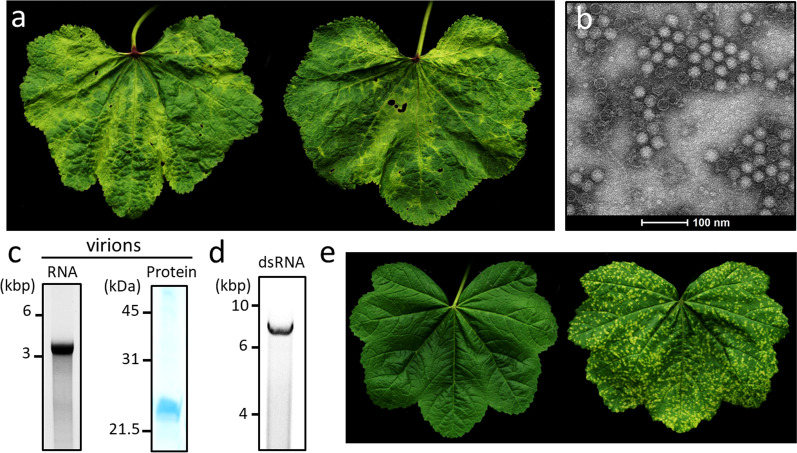
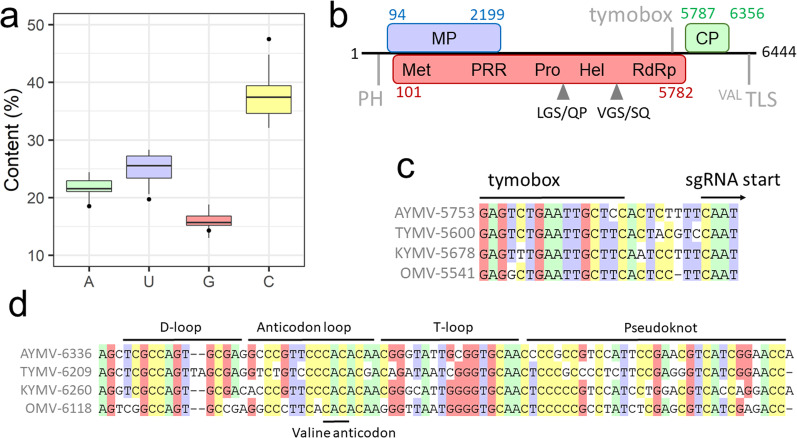
Leaves of hollyhock (Alcea rosea) exhibiting vein chlorosis and yellow mosaic symptoms were collected at public sites in Lausanne and Nyon, two cities of western Switzerland. Diagnostic methods untangled in samples from both sites the mixed infections of a novel isometric virus, tentatively named "Alcea yellow mosaic virus" (AYMV) with the carlavirus Gaillardia latent virus. A new potyvirus was also identified in samples from Nyon. A combination of Illumina, Nanopore and Sanger sequencing was necessary to assemble the full-length genome of AYMV, revealing an exceptionally high cytidine content and other features typically associated with members of the genus Tymovirus. The host range of AYMV was found to be restricted to mallows, including ornamentals as well as economically important plants. Phylogenetic analyses further showed that AYMV belongs to a Tymovirus subclade that also gathers the other mallow-infecting members. The virus was readily transmitted by sap inoculation, and the weevil species Aspidapion radiolus was evidenced as a vector. Transmission assays using another weevil or other insect species did not succeed, and seed transmission was not observed.
在瑞士西部的洛桑和尼翁两个城市的公共场所采集到表现叶脉褪绿和黄色花叶症状的蜀葵叶片。在这两个地点的样本中,应用诊断方法鉴定出了一种新型等径病毒的混合感染,暂命名为“蜀葵黄色花叶病毒”(AYMV),与加利福尼亚卫矛潜隐病毒共同感染。在尼翁的样本中还鉴定出了一种新的马铃薯 Y 病毒。需要结合 Illumina、Nanopore 和 Sanger 测序来组装 AYMV 的全长基因组,结果表明其胞嘧啶含量极高,具有与 Tymovirus 属成员通常相关的其他特征。AYMV 的宿主范围仅限于锦葵科植物,包括观赏植物和具有重要经济价值的植物。系统发育分析进一步表明,AYMV 属于 Tymovirus 亚组,该亚组还包含其他侵染锦葵科植物的成员。该病毒很容易通过汁液接种传播,证据表明叶甲科的 Aspidapion radiolus 是其传播媒介。使用另一种叶甲或其他昆虫进行的传播试验没有成功,也没有观察到种子传播。