Department of Botany, University of Innsbruck, Sternwartestraße 15, 6020, Innsbruck, Austria.
Department of Life Sciences, University of Trieste, Via L. Giorgieri 10, 34127, Trieste, Italy.
New Phytol. 2023 May;238(4):1362-1378. doi: 10.1111/nph.18780. Epub 2023 Mar 4.
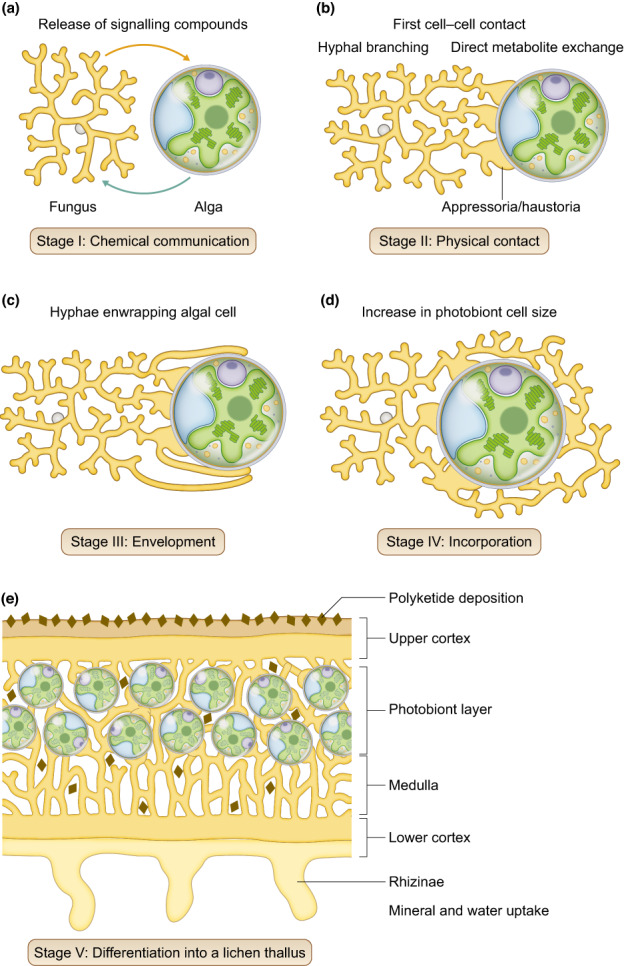
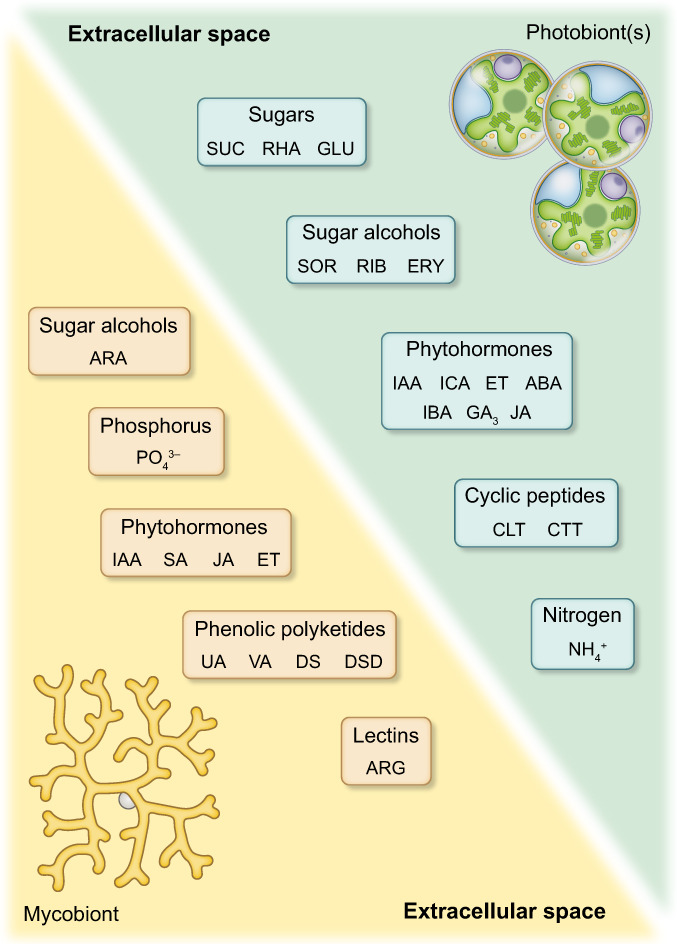
Exposing their vegetative bodies to the light, lichens are outstanding amongst other fungal symbioses. Not requiring a pre-established host, 'lichenized fungi' build an entirely new structure together with microbial photosynthetic partners that neither can form alone. The signals involved in the transition of a fungus and a compatible photosynthetic partner from a free-living to a symbiotic state culminating in thallus formation, termed 'lichenization', and in the maintenance of the symbiosis, are poorly understood. Here, we synthesise the puzzle pieces of the scarce knowledge available into an updated concept of signalling involved in lichenization, comprising five main stages: (1) the 'pre-contact stage', (2) the 'contact stage', (3) 'envelopment' of algal cells by the fungus, (4) their 'incorporation' into a pre-thallus and (5) 'differentiation' into a complex thallus. Considering the involvement of extracellularly released metabolites in each phase, we propose that compounds such as fungal lectins and algal cyclic peptides elicit early contact between the symbionts-to-be, whereas phytohormone signalling, antioxidant protection and carbon exchange through sugars and sugar alcohols are of continued importance throughout all stages. In the fully formed lichen thallus, secondary lichen metabolites and mineral nutrition are suggested to stabilize the functionalities of the thallus, including the associated microbiota.
将其营养体暴露在光线下,地衣在其他真菌共生体中表现突出。“地衣化真菌”不需要预先建立的宿主,与微生物光合伙伴共同构建一个全新的结构,这两者都无法单独形成。真菌和相容的光合伙伴从自由生活到共生状态的转变所涉及的信号,最终导致地衣化以及共生关系的维持,其机制尚不清楚。在这里,我们将现有知识中的零碎信息综合起来,形成了一个关于地衣化过程中信号转导的更新概念,包括五个主要阶段:(1)“预接触阶段”;(2)“接触阶段”;(3)真菌包裹藻类细胞;(4)将其“纳入”前地衣体;(5)“分化”成复杂的地衣体。考虑到细胞外释放的代谢物在每个阶段的参与,我们提出真菌凝集素和藻类环肽等化合物可能会引发潜在共生体之间的早期接触,而植物激素信号转导、抗氧化保护以及通过糖和糖醇进行的碳交换在所有阶段都具有持续的重要性。在地衣体完全形成后,次生地衣代谢物和矿物质营养被认为可以稳定地衣体的功能,包括相关的微生物群。