Lazarchuk Pavlo, Nguyen Vy N, Brunon Salomé, Pavlova Maria N, Sidorova Julia M
Department of Laboratory Medicine and Pathology, University of Washington School of Medicine, Seattle, WA, United States.
Front Mol Biosci. 2023 Jan 12;9:1048726. doi: 10.3389/fmolb.2022.1048726. eCollection 2022.
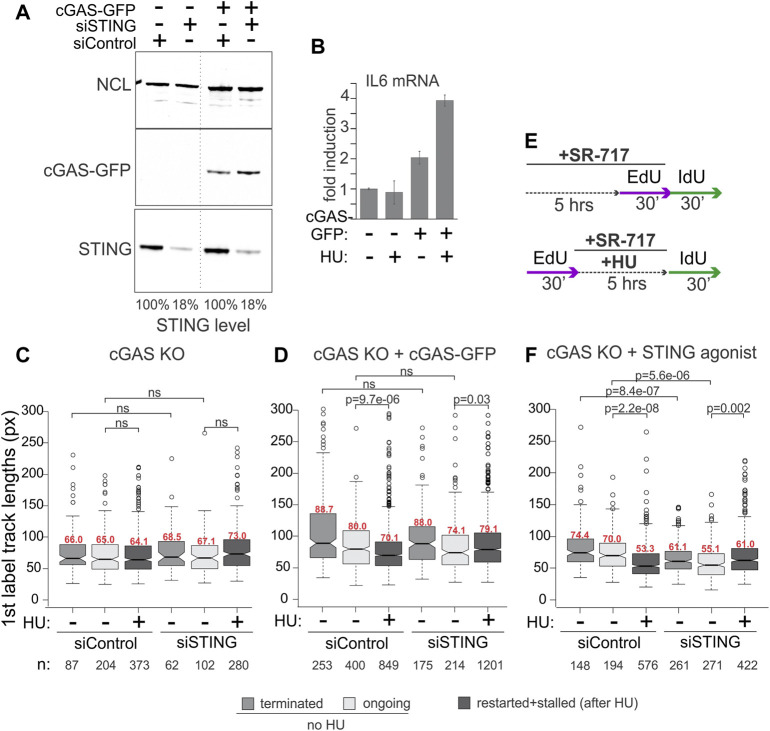
The cGAS/STING pathway, part of the innate immune response to foreign DNA, can be activated by cell's own DNA arising from the processing of the genome, including the degradation of nascent DNA at arrested replication forks, which can be upregulated in cancer cells. Recent evidence raises a possibility that the cGAS/STING pathway may also modulate the very processes that trigger it, e.g., DNA damage repair or processing of stalled forks. We manipulated STING levels in human cells by depleting or re-expressing it, and assessed the effects of STING on replication using microfluidics-assisted replication track analysis, or maRTA, a DNA fiber assay, as well as immuno-precipitation of nascent DNA, or iPOND. We also assessed STING subcellular distribution and its ability to activate. Depletion of STING suppressed and its re-expression in STING-deficient cancer cells upregulated the degradation of nascent DNA at arrested replication forks. Replication fork arrest was accompanied by the STING pathway activation, and a STING mutant that does not activate the pathway failed to upregulate nascent DNA degradation. cGAS was required for STING's effect on degradation, but this requirement could be bypassed by treating cells with a STING agonist. Cells expressing inactive STING had a reduced level of RPA on parental and nascent DNA of arrested forks and a reduced CHK1 activation compared to cells with the wild type STING. STING also affected unperturbed fork progression in a subset of cell lines. STING fractionated to the nuclear fractions enriched for structural components of chromatin and nuclear envelope, and furthermore, it associated with the chromatin of arrested replication forks as well as post-replicative chromatin. Our data highlight STING as a determinant of stalled replication fork integrity, thus revealing a novel connection between the replication stress and innate immune responses.
cGAS/STING通路是对外源DNA的固有免疫反应的一部分,可被细胞自身基因组加工产生的DNA激活,包括停滞复制叉处新生DNA的降解,而这在癌细胞中可能会上调。最近的证据表明,cGAS/STING通路也可能调节触发它的过程,例如DNA损伤修复或停滞复制叉的加工。我们通过耗尽或重新表达STING来操纵人细胞中的STING水平,并使用微流控辅助复制轨迹分析(maRTA)、DNA纤维分析以及新生DNA免疫沉淀(iPOND)来评估STING对复制的影响。我们还评估了STING的亚细胞分布及其激活能力。STING的耗尽会抑制停滞复制叉处新生DNA的降解,而在STING缺陷的癌细胞中重新表达STING则会上调这种降解。复制叉停滞伴随着STING通路的激活,而一个不激活该通路的STING突变体未能上调新生DNA的降解。STING对降解的作用需要cGAS,但用STING激动剂处理细胞可以绕过这一需求。与具有野生型STING的细胞相比,表达无活性STING的细胞在停滞复制叉的亲本DNA和新生DNA上的RPA水平降低,CHK1激活也减少。STING还在一部分细胞系中影响未受干扰的复制叉进展。STING分布在富含染色质和核膜结构成分的核部分,此外,它与停滞复制叉的染色质以及复制后染色质相关。我们的数据突出了STING作为停滞复制叉完整性的决定因素,从而揭示了复制应激与固有免疫反应之间的新联系。