Department of Science and Innovation/National Research Foundation Centre of Excellence for Biomedical Tuberculosis Research, The National Health Laboratory Service, School of Pathology, Faculty of Health Sciences, University of the Witwatersrand, Johannesburg, South Africa.
Perinatal HIV Research Unit, University of the Witwatersrand, Johannesburg, South Africa.
Front Cell Infect Microbiol. 2023 Jan 12;12:1064148. doi: 10.3389/fcimb.2022.1064148. eCollection 2022.
Routine efficacy assessments of new tuberculosis (TB) treatments include quantitative solid culture or routine liquid culture, which likely miss quantification of drug tolerant bacteria. To improve these assessments, comparative analyses using additional measures such as quantification of differentially culturable tubercle bacteria (DCTB) are required. Essential for enabling this is a comparative measure of TB treatment responses using routine solid and liquid culture with liquid limiting dilutions (LLDs) that detect DCTB in sputum.
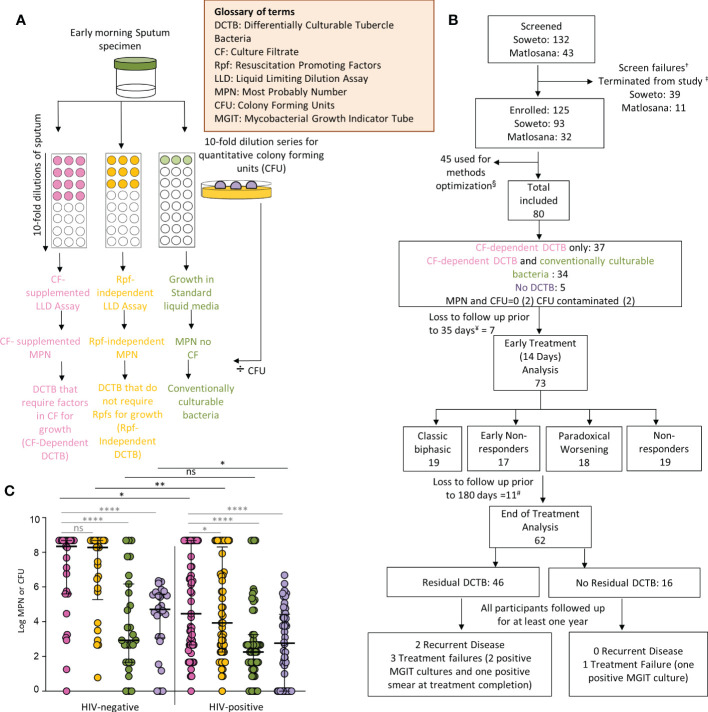
We recruited treatment-naïve TB patients, with and without HIV-infection, and serially quantified their sputum for DCTB over the course of treatment.
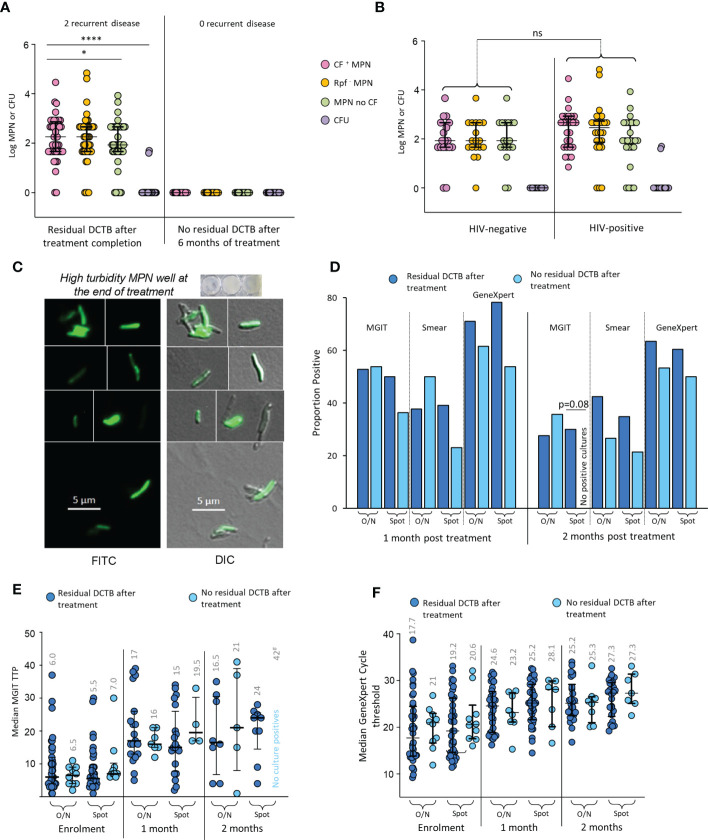
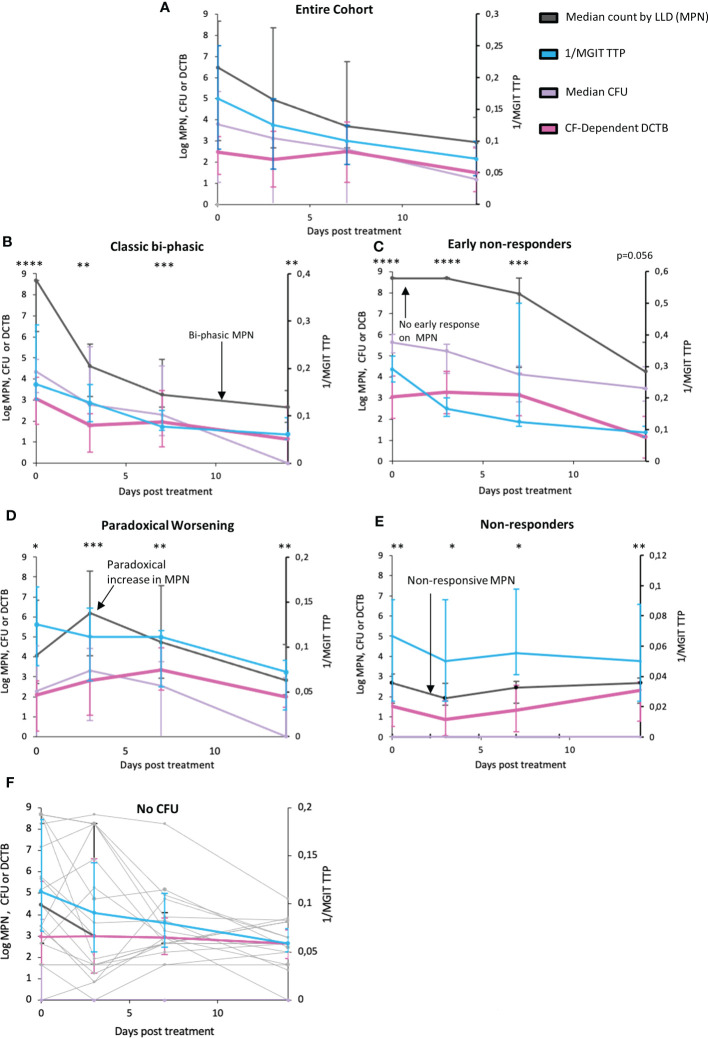
Serial sputum sampling in 73 individuals during their first 14 days of treatment demonstrated that clearance of DCTB was slower compared to routine solid culture. Treatment response appeared to be characterized by four patterns: (1) Classic bi-phasic bacterial clearance; (2) early non-responders with slower clearance; (3) paradoxical worsening with an increase in bacterial count upon treatment initiation; and (4) non-responders with no change in bacterial load. During treatment, LLDs displayed greater bacterial yield when compared with quantitative solid culture. Upon treatment completion, 74% [46/62] of specimens displayed residual DCTB and within this group, two recurrences were diagnosed. Residual DCTB upon treatment completion was associated with a higher proportion of MGIT culture, GeneXpert, and smear positivity at two months post treatment. No recurrences occurred in the group without residual DCTB.
These data indicate that DCTB assays detect distinct subpopulations of organisms in sputum that are missed by routine solid and liquid culture, and offer important alternatives for efficacy assessments of new TB treatments. The residual DCTB observed upon treatment completion suggests that TB treatment does not always eliminate all bacterial populations, a finding that should be investigated in larger cohorts.
新的结核病(TB)治疗的常规疗效评估包括定量固体培养或常规液体培养,但可能会错过耐药菌的定量。为了改进这些评估,需要使用额外的测量方法(如可培养结核分枝杆菌的差异定量[DCTB])进行比较分析。这就需要使用常规固体和液体培养与液体限制稀释(LLD)来检测痰液中的 DCTB,对 TB 治疗反应进行比较测量,这是至关重要的。
我们招募了未经治疗的 TB 患者,包括合并和不合并 HIV 感染的患者,并在治疗过程中对他们的痰液进行了 DCTB 的连续定量检测。
在 73 名患者接受治疗的前 14 天内进行了连续痰液采样,结果表明 DCTB 的清除速度比常规固体培养慢。治疗反应似乎具有以下四种模式:(1)经典双相细菌清除;(2)早期非应答者,清除速度较慢;(3)治疗开始时细菌计数增加的反常恶化;(4)无细菌负荷变化的无应答者。在治疗期间,LLD 显示的细菌产量比定量固体培养更高。治疗完成后,74%[46/62]的标本显示残留 DCTB,在此组中,诊断出 2 例复发。治疗完成后残留 DCTB 与 MGIT 培养、GeneXpert 和痰涂片在治疗后两个月的阳性率较高有关。在无残留 DCTB 的组中没有复发。
这些数据表明,DCTB 检测方法检测到痰液中常规固体和液体培养错过的不同生物体亚群,为新的结核病治疗的疗效评估提供了重要的替代方法。治疗完成后观察到的残留 DCTB 表明,TB 治疗并不总是能消除所有细菌群体,这一发现应在更大的队列中进行研究。