Ha Kyoo-Man
Faculty of Resilience, Rabdan Academy, Abu Dhabi, UAE.
Crime Law Soc Change. 2023 Jan 24:1-20. doi: 10.1007/s10611-023-10077-y.
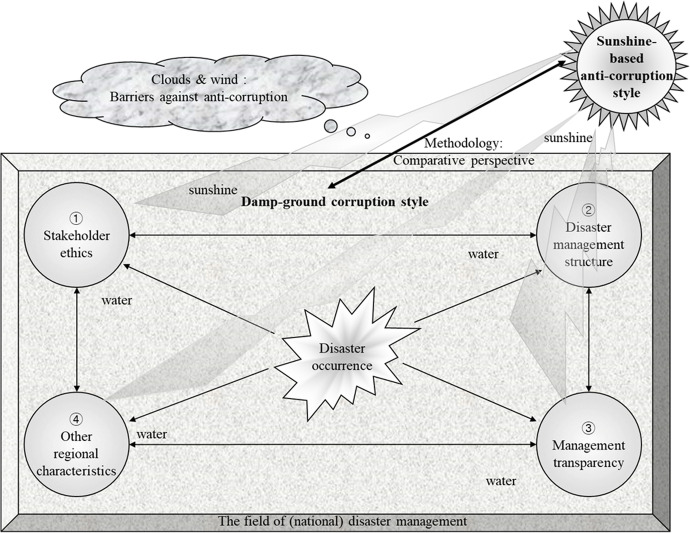
Corruption has always existed in the field of national disaster management. Although many case studies on (anti)corruption have been carried out, these works have not dealt sufficiently with the evidence. The present research aims to study how to shift from corruption to anti-corruption, or simply, how to decrease corruption within the system. The comparative perspective is applied as the major methodology. The "damp-ground" style is where corruption breeds, whereas the "sunshine-based" style is where disaster management ethics, structure, transparency, and regional characteristics are established, sustained, and maximized. Therefore, the personnel, system, operating principles, and other relevant factors need to evolve and change to contribute significantly to the sunshine-based model. In this regard, stakeholders should carry out their roles and responsibilities effectively to succeed in disaster impact mitigation and overall disaster management. The contribution of this work lies in providing a comprehensive viewpoint on the shift from damp-ground corruption to sunshine-based anti-corruption toward the ultimate goal of disaster mitigation.
腐败现象在国家灾害管理领域一直存在。尽管已经开展了许多关于(反)腐败的案例研究,但这些研究对相关证据的处理并不充分。本研究旨在探讨如何从腐败转向反腐败,或者简单地说,如何减少系统内的腐败现象。比较视角被用作主要研究方法。“潮湿环境”是腐败滋生的温床,而“阳光型”则是建立、维持和最大化灾害管理伦理、结构、透明度及区域特色的模式。因此,人员、制度、运作原则及其他相关因素需要不断演变和变革,以对阳光型模式做出重大贡献。在这方面,利益相关者应有效履行其角色和职责,以成功减轻灾害影响并实现整体灾害管理。这项工作的贡献在于提供了一个全面的视角,阐述了从“潮湿环境”腐败向以减轻灾害为最终目标的“阳光型”反腐败转变的过程。