D'Souza Gavin, Reddy N V Subba, Manjunath K N
Department of Instrumentation and Control Engineering, Manipal Institute of Technology, Manipal Academy of Higher Education, Manipal, Karnataka 576104 India.
Department of Information Technology, Manipal Institute of Technology Bengaluru, Manipal Academy of Higher Education, Manipal, Karnataka 560064 India.
Biomed Eng Lett. 2022 Nov 3;13(1):21-30. doi: 10.1007/s13534-022-00249-5. eCollection 2023 Feb.
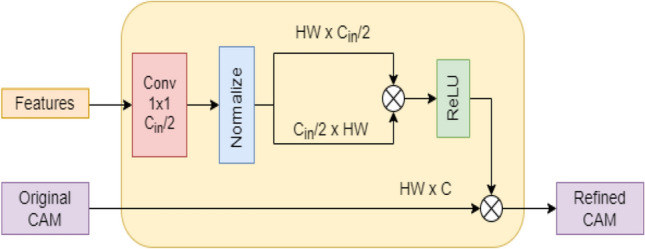
Chest X-Ray (CXR) images provide most anatomical details and the abnormalities on a 2D plane. Therefore, a 2D view of the 3D anatomy is sometimes sufficient for the initial diagnosis. However, close to fourteen commonly occurring diseases are sometimes difficult to identify by visually inspecting the images. Therefore, there is a drift toward developing computer-aided assistive systems to help radiologists. This paper proposes a deep learning model for the classification and localization of chest diseases by using image-level annotations. The model consists of a modified Resnet50 backbone for extracting feature corpus from the images, a classifier, and a pixel correlation module (PCM). During PCM training, the network is a weight-shared siamese architecture where the first branch applies the affine transform to the image before feeding to the network, while the second applies the same transform to the network output. The method was evaluated on CXR from the clinical center in the ratio of 70:20 for training and testing. The model was developed and tested using the cloud computing platform Google Colaboratory (NVidia Tesla P100 GPU, 16 GB of RAM). A radiologist subjectively validated the results. Our model trained with the configurations mentioned in this paper outperformed benchmark results.
The online version contains supplementary material available at 10.1007/s13534-022-00249-5.
胸部X光(CXR)图像在二维平面上提供了大部分解剖细节和异常情况。因此,三维解剖结构的二维视图有时足以进行初步诊断。然而,近十四种常见疾病有时通过目视检查图像很难识别。因此,出现了开发计算机辅助辅助系统以帮助放射科医生的趋势。本文提出了一种利用图像级注释对胸部疾病进行分类和定位的深度学习模型。该模型由一个用于从图像中提取特征语料库的改进型Resnet50主干、一个分类器和一个像素相关模块(PCM)组成。在PCM训练期间,网络是一种权重共享的连体架构,其中第一个分支在将图像输入网络之前对其应用仿射变换,而第二个分支对网络输出应用相同的变换。该方法在临床中心的CXR上以70:20的比例进行训练和测试。该模型使用云计算平台谷歌协作实验室(英伟达特斯拉P100 GPU,16GB内存)进行开发和测试。一名放射科医生对结果进行了主观验证。我们使用本文所述配置训练的模型优于基准结果。
在线版本包含可在10.1007/s13534-022-00249-5获取的补充材料。