Jensen Magnus T, Treskes Roderick W, Caiani Enrico G, Casado-Arroyo Ruben, Cowie Martin R, Dilaveris Polychronis, Duncker David, Di Rienzo Marco, Frederix Ines, De Groot Natasja, Kolh Philippe H, Kemps Hareld, Mamas Mamas, McGreavy Paul, Neubeck Lis, Parati Gianfranco, Platonov Pyotr G, Schmidt-Trucksäss Arno, Schuuring Mark J, Simova Iana, Svennberg Emma, Verstrael Axel, Lumens Joost
Department of Cardiology, Copenhagen University Hospital Amager & Hvidovre, Kettegaard Alle 30, 2650 Hvidovre, Denmark.
Department of Cardiology, Leiden University Medical Center, Albinusdreef 2, 2333 ZA Leiden, the Netherlands.
Eur Heart J Digit Health. 2021 Feb 8;2(1):49-59. doi: 10.1093/ehjdh/ztab011. eCollection 2021 Mar.
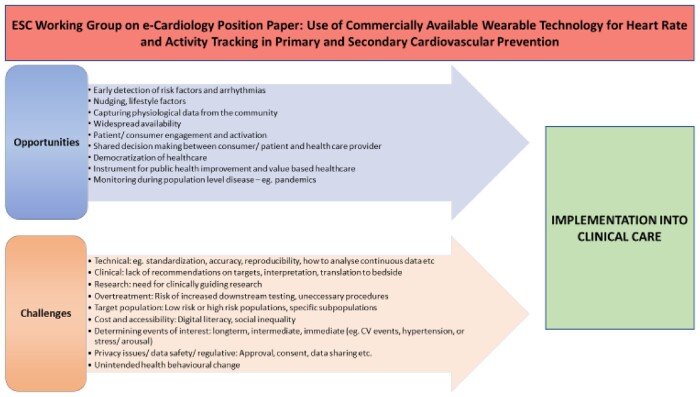
Commercially available health technologies such as smartphones and smartwatches, activity trackers and eHealth applications, commonly referred to as , are increasingly available and used both in the leisure and healthcare sector for pulse and fitness/activity tracking. The aim of the Position Paper is to identify specific barriers and knowledge gaps for the use of wearables, in particular for heart rate (HR) and activity tracking, in clinical cardiovascular healthcare to support their implementation into clinical care. The widespread use of HR and fitness tracking technologies provides unparalleled opportunities for capturing physiological information from large populations in the community, which has previously only been available in patient populations in the setting of healthcare provision. The availability of low-cost and high-volume physiological data from the community also provides unique challenges. While the number of patients meeting healthcare providers with data from wearables is rapidly growing, there are at present no clinical guidelines on how and when to use data from wearables in primary and secondary prevention. Technical aspects of HR tracking especially during activity need to be further validated. How to analyse, translate, and interpret large datasets of information into clinically applicable recommendations needs further consideration. While the current users of wearable technologies tend to be young, healthy and in the higher sociodemographic strata, wearables could potentially have a greater utility in the elderly and higher-risk population. Wearables may also provide a benefit through increased health awareness, democratization of health data and patient engagement. Use of continuous monitoring may provide opportunities for detection of risk factors and disease development earlier in the causal pathway, which may provide novel applications in both prevention and clinical research. However, wearables may also have potential adverse consequences due to unintended modification of behaviour, uncertain use and interpretation of large physiological data, a possible increase in social inequality due to differential access and technological literacy, challenges with regulatory bodies and privacy issues. In the present position paper, current applications as well as specific barriers and gaps in knowledge are identified and discussed in order to support the implementation of wearable technologies from gadget-ology into clinical cardiology.
诸如智能手机、智能手表、活动追踪器和电子健康应用程序等商业上可用的健康技术,通常被称为可穿戴设备,在休闲和医疗保健领域越来越多地用于脉搏和健康/活动追踪。本立场文件的目的是确定在临床心血管医疗保健中使用可穿戴设备,特别是用于心率(HR)和活动追踪的具体障碍和知识差距,以支持将其应用于临床护理。HR和健康追踪技术的广泛使用为从社区大量人群中获取生理信息提供了前所未有的机会,而此前这些信息仅在医疗保健机构的患者群体中才能获得。来自社区的低成本、大量生理数据的可用性也带来了独特的挑战。虽然带着可穿戴设备数据与医疗保健提供者会面的患者数量正在迅速增加,但目前尚无关于如何以及何时在一级和二级预防中使用可穿戴设备数据的临床指南。HR追踪的技术方面,尤其是在活动期间,需要进一步验证。如何将大量信息数据集分析、转化并解读为临床适用的建议需要进一步考虑。虽然目前可穿戴技术的使用者往往是年轻、健康且社会人口统计学层次较高的人群,但可穿戴设备在老年人和高风险人群中可能具有更大的效用。可穿戴设备还可能通过提高健康意识、健康数据民主化和患者参与度而带来益处。使用连续监测可能为在因果路径中更早地检测风险因素和疾病发展提供机会,这可能在预防和临床研究中带来新的应用。然而,可穿戴设备也可能由于行为的意外改变、大量生理数据的不确定使用和解读、由于获取和技术素养差异可能导致的社会不平等加剧、监管机构的挑战以及隐私问题而产生潜在的不良后果。在本立场文件中,确定并讨论了当前的应用以及知识方面的具体障碍和差距,以支持可穿戴技术从小工具学应用到临床心脏病学中。