Center for Community Health Integration, Case Western Reserve University, Cleveland, OH, United States.
Institute of European and American Studies, Academia Sinica, New Taipei, Taiwan.
Front Public Health. 2023 Jan 13;10:1082183. doi: 10.3389/fpubh.2022.1082183. eCollection 2022.
As the United States population ages, the adult population with chronic diseases is expected to increase. Exploring credible, evidence-based projections of the future burden of chronic diseases is fundamental to understanding the likely impact of established and emerging interventions on the incidence and prevalence of chronic disease. Projections of chronic disease often involve cross-sectional data that fails to account for the transition of individuals across different health states. Thus, this research aims to address this gap by projecting the number of adult Americans with chronic disease based on empirically estimated age, gender, and race-specific transition rates across predetermined health states.
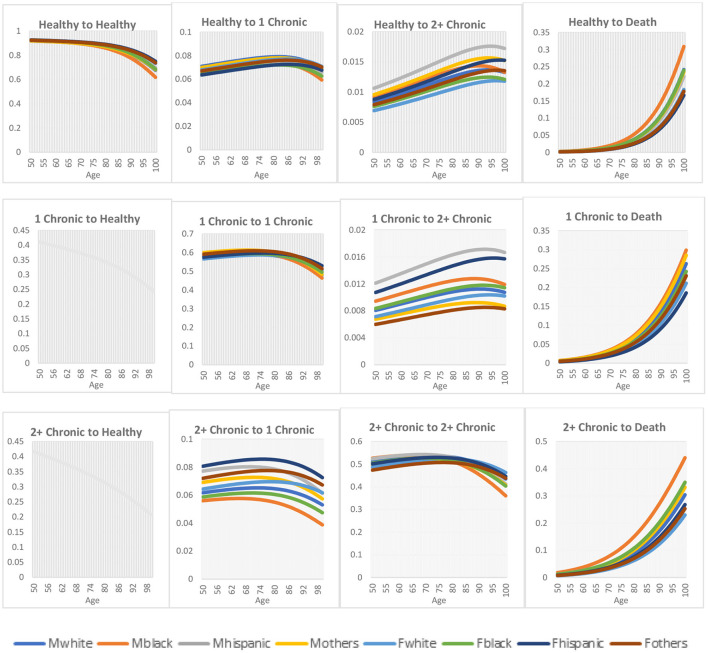
We developed a multi-state population model that disaggregates the adult population in the United States into three health states, i.e., (a) healthy, (b) one chronic condition, and (c) multimorbidity. Data from the 1998 to 2018 Health and Retirement Study was used to estimate age, gender, and race-specific transition rates across the three health states, as input to the multi-state population model to project future chronic disease burden.
The number of people in the United States aged 50 years and older will increase by 61.11% from 137.25 million in 2020 to 221.13 million in 2050. Of the population 50 years and older, the number with at least one chronic disease is estimated to increase by 99.5% from 71.522 million in 2020 to 142.66 million by 2050. At the same time, those with multimorbidity are projected to increase 91.16% from 7.8304 million in 2020 to 14.968 million in 2050. By race by 2050, 64.6% of non-Hispanic whites will likely have one or more chronic conditions, while for non-Hispanic black, 61.47%, and Hispanic and other races 64.5%.
The evidence-based projections provide the foundation for policymakers to explore the impact of interventions on targeted population groups and plan for the health workforce required to provide adequate care for current and future individuals with chronic diseases.
随着美国人口老龄化,预计患有慢性病的成年人数量将会增加。探索慢性病未来负担的可靠、基于证据的预测,对于了解既定和新兴干预措施对慢性病发病率和患病率的可能影响至关重要。慢性病的预测通常涉及到无法解释个体在不同健康状态之间转移的横截面数据。因此,这项研究旨在通过基于经验估计的年龄、性别和种族特定的跨预定健康状态的转移率来预测美国成年慢性病患者的数量来解决这一差距。
我们开发了一个多状态人口模型,将美国成年人分为三种健康状态,即(a)健康,(b)一种慢性病,和(c)多种慢性病。利用 1998 年至 2018 年的健康与退休研究的数据,估计了三种健康状态下的年龄、性别和种族特定的转移率,作为多状态人口模型的输入,以预测未来的慢性病负担。
2020 年,50 岁及以上的美国人将从 1.3725 亿增加到 2.2113 亿,增长 61.11%。在 50 岁及以上的人群中,至少有一种慢性病的人数预计将从 2020 年的 7152.22 万人增加到 2050 年的 1426.66 万人,增长 99.5%。与此同时,预计 2020 年有 783.04 万人患有多种慢性病,到 2050 年将增加到 1496.8 万人,增长 91.16%。按种族划分,到 2050 年,64.6%的非西班牙裔白人可能患有一种或多种慢性病,而非西班牙裔黑人、西班牙裔和其他种族的这一比例分别为 61.47%和 64.5%。
基于证据的预测为政策制定者提供了基础,以探索干预措施对目标人群的影响,并为当前和未来患有慢性病的个人提供足够护理所需的卫生人力规划。