Smith Sydney E, Kosik Eena L, van Engen Quirine, Kohn Jordan, Hill Aron T, Zomorrodi Reza, Blumberger Daniel M, Daskalakis Zafiris J, Hadas Itay, Voytek Bradley
Neurosciences Graduate Program, University of California, San Diego, La Jolla, CA, USA.
Department of Cognitive Science, University of California, San Diego, La Jolla, CA, USA.
medRxiv. 2023 Oct 27:2023.01.11.23284450. doi: 10.1101/2023.01.11.23284450.
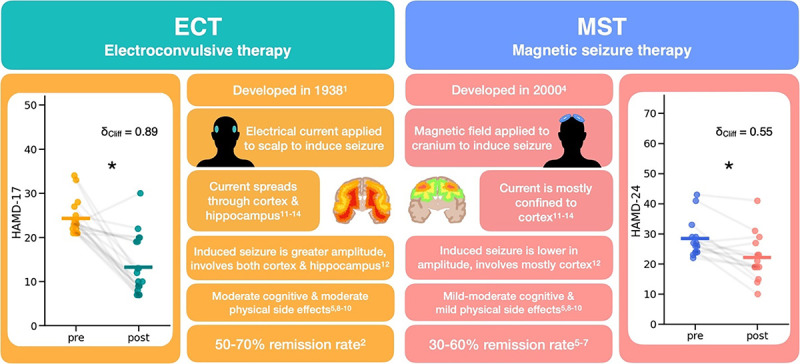
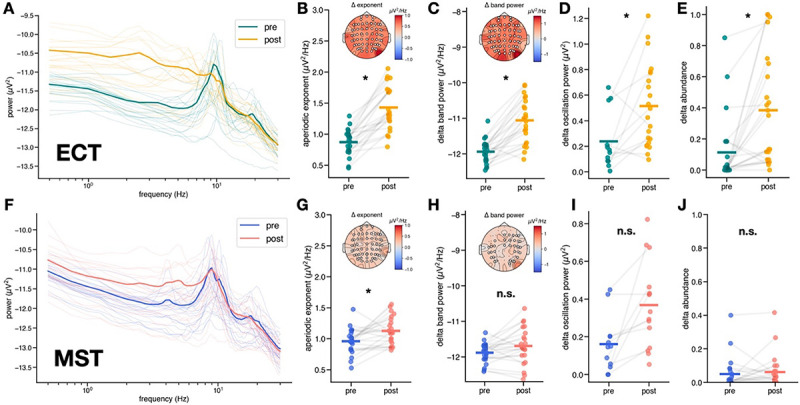
Major depressive disorder (MDD) is a leading cause of disability worldwide. One of the most efficacious treatments for treatment-resistant MDD is electroconvulsive therapy (ECT). Recently, magnetic seizure therapy (MST) was developed as an alternative to ECT due to its more favorable side effect profile. While these approaches have been very successful clinically, the neural mechanisms underlying their therapeutic effects are unknown. For example, clinical "slowing" of the electroencephalogram beginning in the postictal state and extending days to weeks post-treatment has been observed in both treatment modalities. However, a recent longitudinal study of a small cohort of ECT patients revealed that, rather than delta oscillations, clinical slowing was better explained by increases in aperiodic activity, an emerging EEG signal linked to neural inhibition. Here we investigate the role of aperiodic activity in a cohort of patients who received ECT and a cohort of patients who received MST treatment. We find that aperiodic neural activity increases significantly in patients receiving either ECT or MST. Although not directly related to clinical efficacy in this dataset, increased aperiodic activity is linked to greater amounts of neural inhibition, which is suggestive of a potential shared neural mechanism of action across ECT and MST.
重度抑郁症(MDD)是全球致残的主要原因之一。对于难治性MDD,最有效的治疗方法之一是电休克疗法(ECT)。最近,磁惊厥疗法(MST)作为ECT的替代方法被开发出来,因为它的副作用更小。虽然这些方法在临床上非常成功,但其治疗效果背后的神经机制尚不清楚。例如,在两种治疗方式中都观察到脑电图从发作后状态开始出现临床“减慢”,并持续到治疗后数天至数周。然而,最近一项对一小群ECT患者的纵向研究表明,临床减慢并非由δ振荡引起,而是由非周期性活动增加更好地解释,非周期性活动是一种与神经抑制相关的新兴脑电图信号。在这里,我们研究了非周期性活动在接受ECT治疗的患者队列和接受MST治疗的患者队列中的作用。我们发现,接受ECT或MST治疗的患者的非周期性神经活动显著增加。虽然在该数据集中与临床疗效没有直接关系,但非周期性活动的增加与更多的神经抑制有关,这提示了ECT和MST之间潜在的共同神经作用机制。