Piasini Eugenio, Liu Shuze, Chaudhari Pratik, Balasubramanian Vijay, Gold Joshua I
International School for Advanced Studies (SISSA), Trieste, Italy.
University of Pennsylvania, Philadelphia, PA, USA.
bioRxiv. 2025 Mar 16:2023.01.10.523479. doi: 10.1101/2023.01.10.523479.
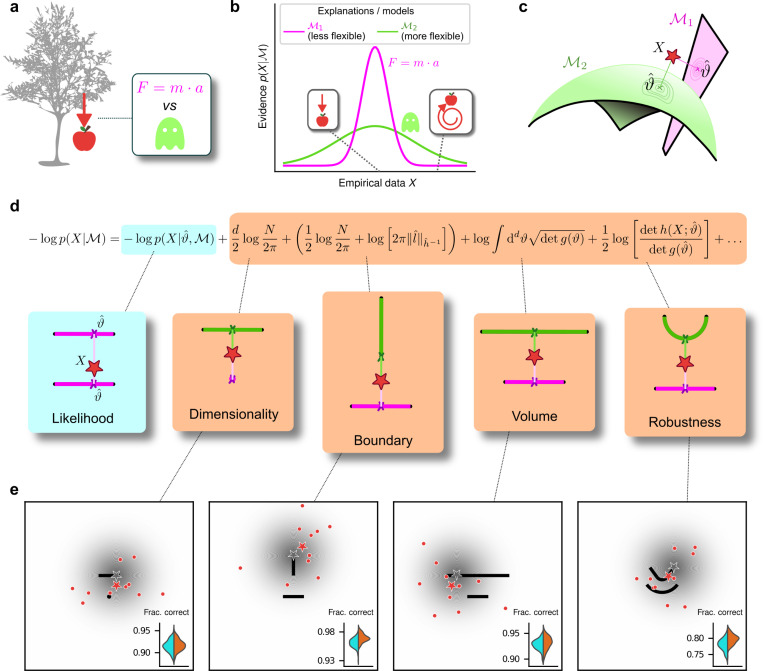
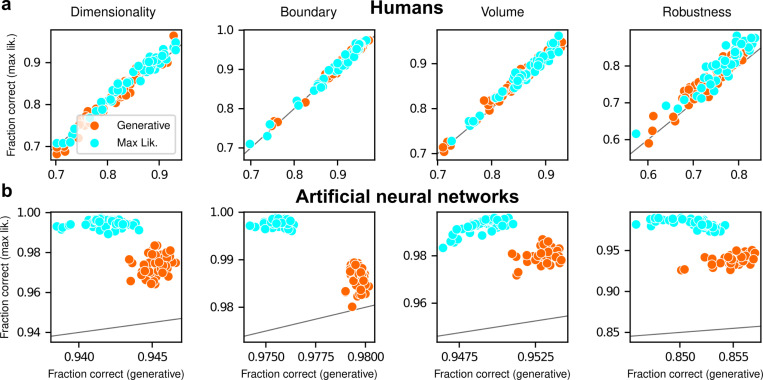
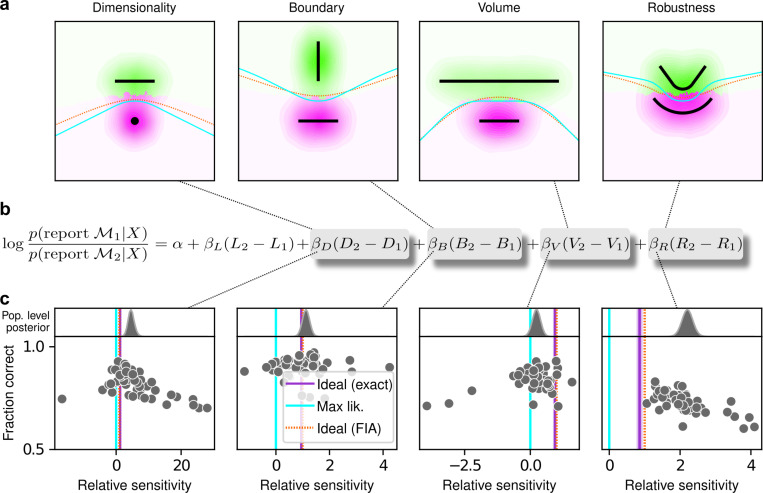
Occam's razor is the principle that, all else being equal, simpler explanations should be preferred over more complex ones. This principle is thought to guide human decision-making, but the nature of this guidance is not known. Here we used preregistered behavioral experiments to show that people tend to prefer the simpler of two alternative explanations for uncertain data. These preferences match predictions of formal theories of model selection that penalize excessive flexibility. These penalties emerge when considering not just the best explanation but the integral over all possible, relevant explanations. We further show that these simplicity preferences persist in humans, but not in certain artificial neural networks, even when they are maladaptive. Our results imply that principled notions of statistical model selection, including integrating over possible, latent causes to avoid overfitting to noisy observations, may play a central role in human decision-making.
奥卡姆剃刀原理是指,在其他条件相同的情况下,较简单的解释应优于更复杂的解释。人们认为这一原理指导着人类的决策,但这种指导的本质尚不清楚。在此,我们通过预先注册的行为实验表明,对于不确定的数据,人们倾向于在两种备选解释中选择更简单的那个。这些偏好与惩罚过度灵活性的模型选择形式理论的预测相符。当不仅考虑最佳解释,还考虑所有可能的相关解释的积分时,就会出现这些惩罚。我们进一步表明,即使这些简单性偏好具有适应不良性,它们在人类中仍然存在,而在某些人工神经网络中则不然。我们的结果表明,统计模型选择的原则性概念,包括对可能的潜在原因进行积分以避免过度拟合噪声观测数据,可能在人类决策中发挥核心作用。