Wang Jinhai, Wilson Alan E, Su Baofeng, Dunham Rex A
School of Fisheries, Aquaculture and Aquatic Sciences, Auburn University, 203 Swingle Hall, Auburn, AL 36849, USA.
Anim Nutr. 2022 Oct 20;12:200-214. doi: 10.1016/j.aninu.2022.10.001. eCollection 2023 Mar.
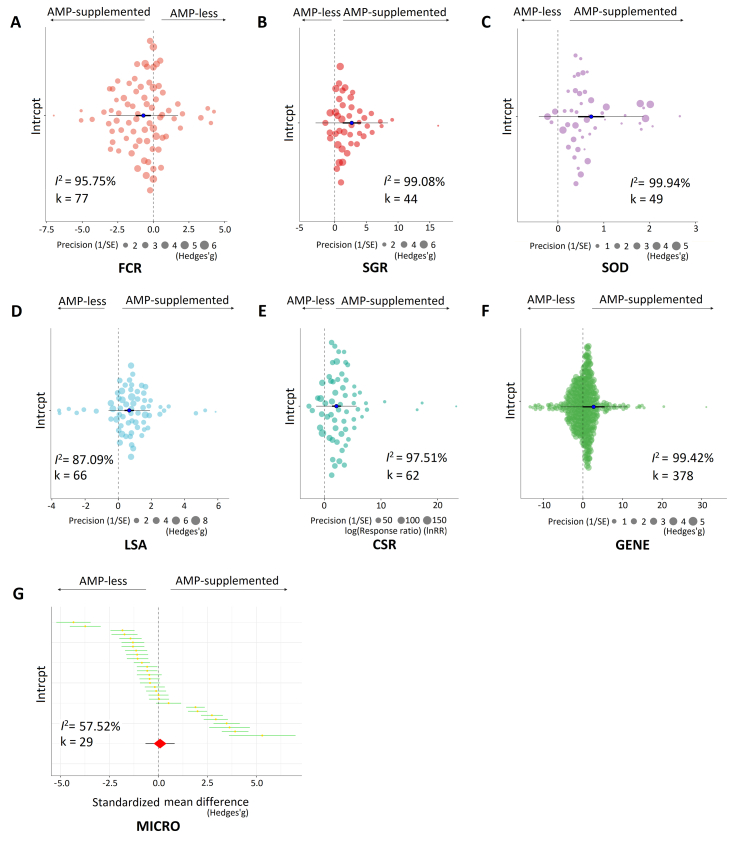
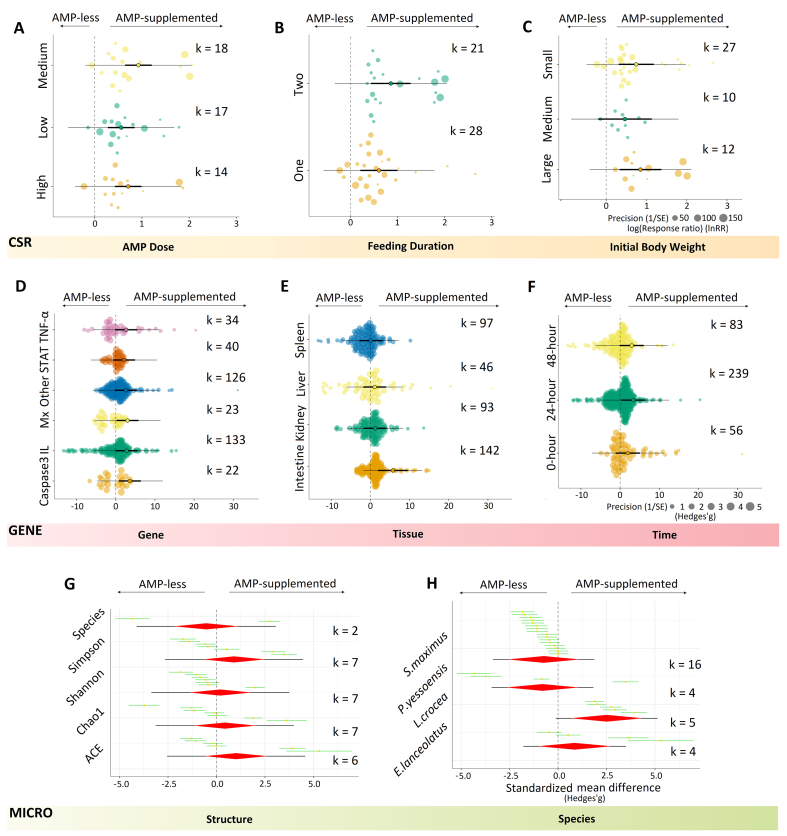
Effects of antimicrobial peptides (AMP) added to diets on aquatic animal health and body function are influenced by multiple factors such as animal species, initial body weight, the dosage of AMP and feeding duration. However, there is limited knowledge on the relationship between these factors and the body function of aquatic animals. Here, we aimed to perform multiple meta-analyses to investigate the effects of dietary AMP on growth performance (feed conversion ratio [FCR], specific growth rate [SGR]), enzyme activity (superoxide dismutase activity [SOD], lysozyme activity [LSA]), disease resistance (cumulative survival rate [CSR], the expression of immune-related genes [GENE]) and the abundance of gut microbiota (MICRO) from a pool of empirical studies. Additionally, the dose-effect model was applied to determine the optimal AMP dose, initial body weight and feeding duration to maximize body function. To conduct the meta-analyses, we included 34 publications that estimated 705 effect sizes across 21 fish, 2 shrimp and 2 shellfish species. The results confirmed that the inclusion of AMP in the diet can significantly improve SGR, SOD, LSA, CSR and GENE and decrease FCR for aquatic animals. Interestingly, our findings implied a slight positive effect of AMP on MICRO albeit with a limited number of studies available on fish gut microbial communities. Although no significant linear or quadratic relationship was predicted by meta-regression, the dose-effect indicated that the optimal AMP doses for FCR, SGR, SOD and LSA were 707.5, 750.0, 1,050.0 and 937.5 mg/kg, respectively. Taken together, fish with an initial body weight of 30 g could be fed with a dose of 600 to 800 mg/kg for 2 mo when AMP-supplemented diets were applied in aquaculture, which can effectively improve body function and health while lowering aquafeed costs. In addition, more studies should address fish gut microbiota to delimitate the influence of dietary AMP on MICRO in the future.
添加到饲料中的抗菌肽(AMP)对水生动物健康和身体机能的影响受多种因素影响,如动物种类、初始体重、AMP剂量和投喂持续时间。然而,关于这些因素与水生动物身体机能之间的关系,人们了解有限。在此,我们旨在进行多项荟萃分析,以研究从一系列实证研究中得出的饲料中添加AMP对生长性能(饲料转化率[FCR]、特定生长率[SGR])、酶活性(超氧化物歧化酶活性[SOD]、溶菌酶活性[LSA])、抗病能力(累积存活率[CSR]、免疫相关基因表达[GENE])以及肠道微生物群丰度(MICRO)的影响。此外,应用剂量效应模型来确定使身体机能最大化的最佳AMP剂量、初始体重和投喂持续时间。为进行荟萃分析,我们纳入了34篇出版物,这些出版物估计了21种鱼类、2种虾类和2种贝类的705个效应量。结果证实,在饲料中添加AMP可显著提高水生动物的SGR、SOD、LSA、CSR和GENE,并降低FCR。有趣的是,我们的研究结果表明AMP对MICRO有轻微的积极影响,尽管关于鱼类肠道微生物群落的研究数量有限。尽管荟萃回归未预测到显著的线性或二次关系,但剂量效应表明,FCR、SGR、SOD和LSA的最佳AMP剂量分别为707.5、750.0、1050.0和937.5毫克/千克。综上所述,当水产养殖中应用添加AMP的饲料时,初始体重为30克的鱼类可以按600至800毫克/千克的剂量投喂2个月,这可以有效改善身体机能和健康状况,同时降低水产饲料成本。此外,未来应开展更多针对鱼类肠道微生物群的研究,以界定饲料中添加AMP对MICRO的影响。