Edwardson Nicholas, Adsul Prajakta, Gonzalez Zorisadday, Pankratz V Shane, Parasher Gulshan, English Kevin, Mishra Shiraz
University of New Mexico, School of Public Administration, Albuquerque, New Mexico, United States.
University of New Mexico, Department of Internal Medicine, Albuquerque, New Mexico, United States.
Endosc Int Open. 2023 Jan 26;11(1):E107-E116. doi: 10.1055/a-1990-0509. eCollection 2023 Jan.
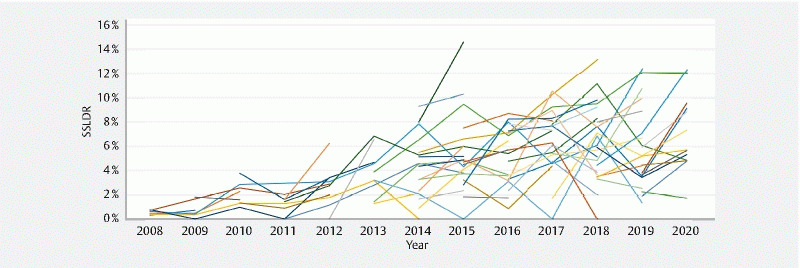
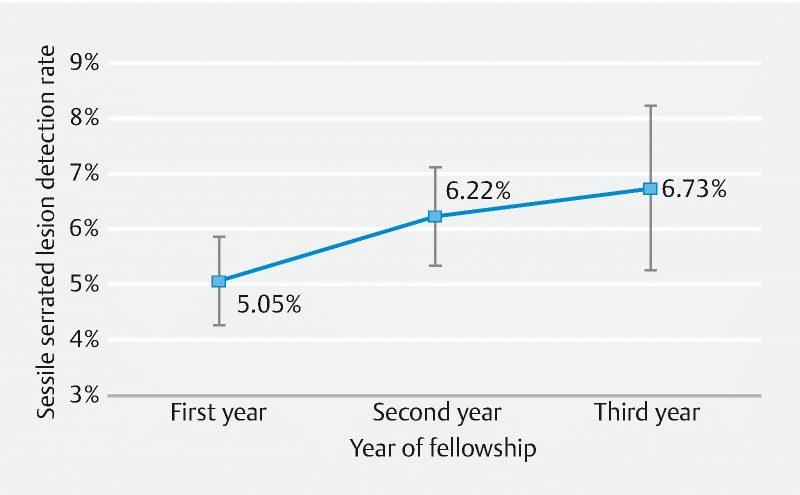
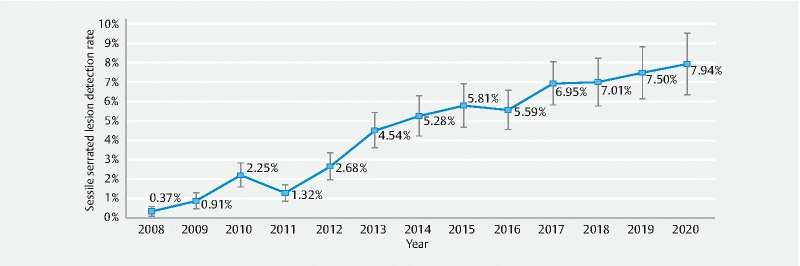
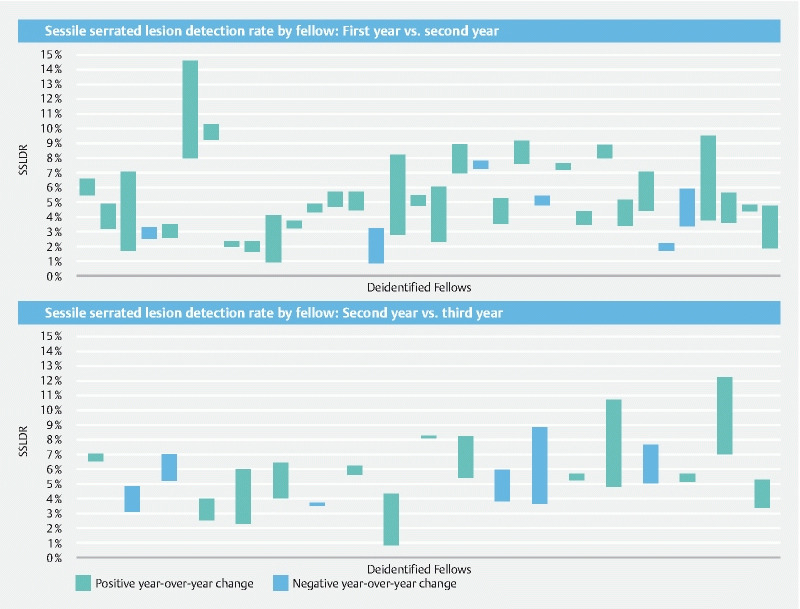
We assessed sessile serrated lesion detection rate (SSLDR) at a large academic medical center from 2008 to 2020 and modeled a local, aspirational target SSLDR. We also assessed SSLDRs among all gastroenterology fellows to better understand the relationship between SSLDRs and total colonoscopies performed. SSL-positive pathology results were flagged from a dataset composed of all screening colonoscopies for average-risk patients from 2008 to 2020. Unadjusted SSLDRs were calculated for individual endoscopists by year. A mixed effects logistic regression was used to estimate the log odds of SSL detection, with one model estimating division-wide predictors of SSL detection and a second model focused exclusively on colonoscopies performed by fellows. Model-adjusted SSLDRs were estimated for all 13 years and across both categories of all endoscopists and fellows only. Adjusted SSLDRs showed a consistent improvement in SSLDR from a low of 0.37 % (95 % confidence interval [CI]: 0.10-0.63) in 2008 to a high of 7.94 % (95 % CI: 6.34-9.54) in 2020. Among fellows only, the odds of SSL detection were significantly lower during their first year compared to their second year (OR: 0.80, 95 % CI: 0.66-0.98) but not significantly higher in their third year compared to their second year (OR: 1.09, 95 % CI: 0.85-1.4). SSLDR increased steadily and significantly throughout our study period but variance among endoscopists persists. The peak SSLDR from 2020 of 7.94 % should serve as the local aspirational target for this division's attendings and fellows but should be continuously reevaluated.
我们评估了2008年至2020年期间一家大型学术医疗中心的无蒂锯齿状病变检出率(SSLDR),并建立了一个本地的、理想的目标SSLDR模型。我们还评估了所有胃肠病学研究员的SSLDR,以更好地了解SSLDR与所进行的全结肠镜检查总数之间的关系。SSL阳性病理结果从2008年至2020年所有平均风险患者的筛查结肠镜检查数据集中标出。按年份计算了个体内镜医师的未调整SSLDR。使用混合效应逻辑回归来估计SSL检测的对数几率,一个模型估计全科室SSL检测的预测因素,另一个模型专门关注研究员进行的结肠镜检查。仅针对所有13年以及所有内镜医师和研究员这两类人群估计了模型调整后的SSLDR。调整后的SSLDR显示出从2008年的低水平0.37%(95%置信区间[CI]:0.10 - 0.63)持续提高到2020年的高水平7.94%(95%CI:6.34 - 9.54)。仅在研究员中,与第二年相比,他们第一年检测到SSL的几率显著更低(OR:0.80,95%CI:0.66 - 0.98),但与第二年相比,第三年并没有显著更高(OR:1.09,95%CI:0.85 - 1.4)。在我们的研究期间,SSLDR稳步且显著增加,但内镜医师之间的差异仍然存在。2020年7.94%的SSLDR峰值应作为该科室主治医师和研究员的本地理想目标,但应持续重新评估。