• 文献检索
  • 文档翻译
  • 深度研究
  • 学术资讯
  • Suppr Zotero 插件Zotero 插件
  • 邀请有礼
  • 套餐&价格
  • 历史记录
应用&插件
Suppr Zotero 插件Zotero 插件浏览器插件Mac 客户端Windows 客户端微信小程序
定价
高级版会员购买积分包购买API积分包
服务
文献检索文档翻译深度研究API 文档MCP 服务
关于我们
关于 Suppr公司介绍联系我们用户协议隐私条款
关注我们

Suppr 超能文献

核心技术专利:CN118964589B侵权必究
粤ICP备2023148730 号-1Suppr @ 2026

文献检索

告别复杂PubMed语法,用中文像聊天一样搜索,搜遍4000万医学文献。AI智能推荐,让科研检索更轻松。

立即免费搜索

文件翻译

保留排版,准确专业,支持PDF/Word/PPT等文件格式,支持 12+语言互译。

免费翻译文档

深度研究

AI帮你快速写综述,25分钟生成高质量综述,智能提取关键信息,辅助科研写作。

立即免费体验

一种可及的10年数字心血管(DiCAVA)风险评估方法的开发:一项英国生物银行研究。

Development of an accessible 10-year Digital CArdioVAscular (DiCAVA) risk assessment: a UK Biobank study.

作者信息

Dolezalova Nikola, Reed Angus B, Despotovic Aleksa, Obika Bernard Dillon, Morelli Davide, Aral Mert, Plans David

机构信息

Department of Research and Development, Huma Therapeutics Limited, Millbank Tower, 21-24 Millbank, London SW1P 4QP, UK.

Department for Social Studies and Public Health, Faculty of Medicine, Faculty of Medicine, University of Belgrade, Belgrade, Serbia.

出版信息

Eur Heart J Digit Health. 2021 Jun 26;2(3):528-538. doi: 10.1093/ehjdh/ztab057. eCollection 2021 Sep.

DOI:10.1093/ehjdh/ztab057
PMID:36713604
原文链接:https://pmc.ncbi.nlm.nih.gov/articles/PMC9707906/
Abstract

AIMS

Cardiovascular diseases (CVDs) are among the leading causes of death worldwide. Predictive scores providing personalized risk of developing CVD are increasingly used in clinical practice. Most scores, however, utilize a homogenous set of features and require the presence of a physician. The aim was to develop a new risk model (DiCAVA) using statistical and machine learning techniques that could be applied in a remote setting. A secondary goal was to identify new patient-centric variables that could be incorporated into CVD risk assessments.

METHODS AND RESULTS

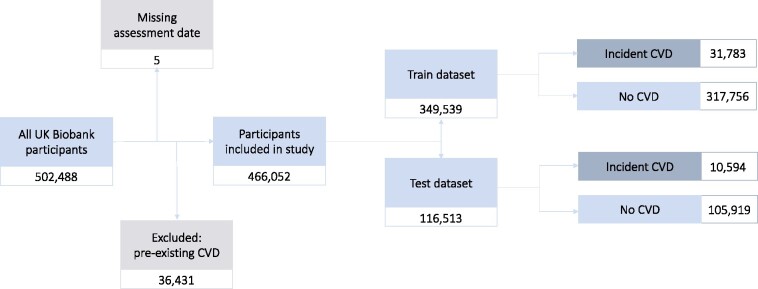
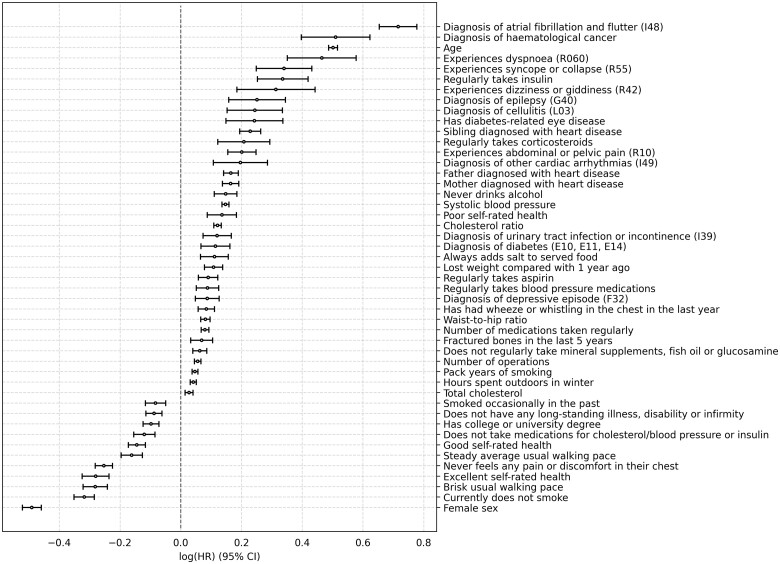
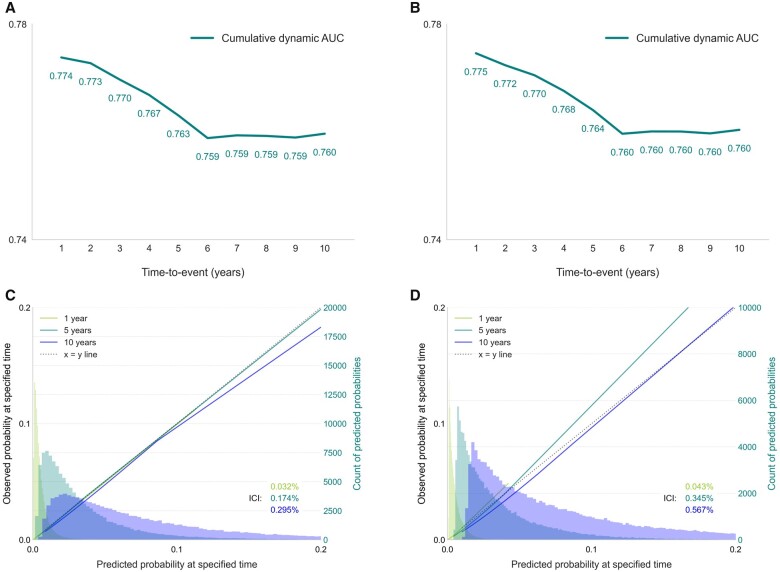
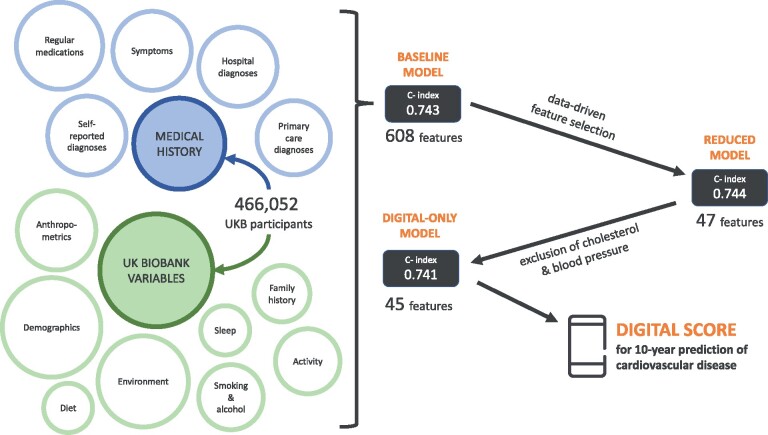
Across 466 052 participants, Cox proportional hazards (CPH) and DeepSurv models were trained using 608 variables derived from the UK Biobank to investigate the 10-year risk of developing a CVD. Data-driven feature selection reduced the number of features to 47, after which reduced models were trained. Both models were compared to the Framingham score. The reduced CPH model achieved a c-index of 0.7443, whereas DeepSurv achieved a c-index of 0.7446. Both CPH and DeepSurv were superior in determining the CVD risk compared to Framingham score. Minimal difference was observed when cholesterol and blood pressure were excluded from the models (CPH: 0.741, DeepSurv: 0.739). The models show very good calibration and discrimination on the test data.

CONCLUSION

We developed a cardiovascular risk model that has very good predictive capacity and encompasses new variables. The score could be incorporated into clinical practice and utilized in a remote setting, without the need of including cholesterol. Future studies will focus on external validation across heterogeneous samples.

摘要

目的

心血管疾病(CVD)是全球主要死因之一。提供CVD发病个性化风险的预测评分在临床实践中越来越常用。然而,大多数评分使用一组同质化的特征,且需要医生在场。目的是使用可应用于远程环境的统计和机器学习技术开发一种新的风险模型(DiCAVA)。次要目标是识别可纳入CVD风险评估的以患者为中心的新变量。

方法与结果

在466052名参与者中,使用从英国生物银行衍生的608个变量训练Cox比例风险(CPH)模型和深度生存(DeepSurv)模型,以研究CVD发病的10年风险。数据驱动的特征选择将特征数量减少到47个,之后训练简化模型。将这两个模型与弗雷明汉评分进行比较。简化后的CPH模型的c指数为0.7443,而DeepSurv模型的c指数为0.7446。与弗雷明汉评分相比,CPH和DeepSurv在确定CVD风险方面都更优。当模型中排除胆固醇和血压时,观察到的差异最小(CPH:0.741,DeepSurv:0.739)。模型在测试数据上显示出非常好的校准和区分能力。

结论

我们开发了一种具有非常好预测能力且包含新变量的心血管风险模型。该评分可纳入临床实践并在远程环境中使用,无需纳入胆固醇。未来的研究将集中在跨异质样本的外部验证上。
https://cdn.ncbi.nlm.nih.gov/pmc/blobs/fa96/9707906/8ce4f94a48bf/ztab057f5.jpg
https://cdn.ncbi.nlm.nih.gov/pmc/blobs/fa96/9707906/540d7ceff8a2/ztab057f4.jpg
https://cdn.ncbi.nlm.nih.gov/pmc/blobs/fa96/9707906/d8ab3bdf5c05/ztab057f1.jpg
https://cdn.ncbi.nlm.nih.gov/pmc/blobs/fa96/9707906/d7d64d22f252/ztab057f2.jpg
https://cdn.ncbi.nlm.nih.gov/pmc/blobs/fa96/9707906/68401d5469ff/ztab057f3.jpg
https://cdn.ncbi.nlm.nih.gov/pmc/blobs/fa96/9707906/8ce4f94a48bf/ztab057f5.jpg
https://cdn.ncbi.nlm.nih.gov/pmc/blobs/fa96/9707906/540d7ceff8a2/ztab057f4.jpg
https://cdn.ncbi.nlm.nih.gov/pmc/blobs/fa96/9707906/d8ab3bdf5c05/ztab057f1.jpg
https://cdn.ncbi.nlm.nih.gov/pmc/blobs/fa96/9707906/d7d64d22f252/ztab057f2.jpg
https://cdn.ncbi.nlm.nih.gov/pmc/blobs/fa96/9707906/68401d5469ff/ztab057f3.jpg
https://cdn.ncbi.nlm.nih.gov/pmc/blobs/fa96/9707906/8ce4f94a48bf/ztab057f5.jpg

相似文献

1
Development of an accessible 10-year Digital CArdioVAscular (DiCAVA) risk assessment: a UK Biobank study.一种可及的10年数字心血管(DiCAVA)风险评估方法的开发:一项英国生物银行研究。
Eur Heart J Digit Health. 2021 Jun 26;2(3):528-538. doi: 10.1093/ehjdh/ztab057. eCollection 2021 Sep.
2
Cardiovascular disease risk prediction using automated machine learning: A prospective study of 423,604 UK Biobank participants.使用自动化机器学习进行心血管疾病风险预测:对 423604 名英国生物库参与者的前瞻性研究。
PLoS One. 2019 May 15;14(5):e0213653. doi: 10.1371/journal.pone.0213653. eCollection 2019.
3
Development of Digitally Obtainable 10-Year Risk Scores for Depression and Anxiety in the General Population.普通人群中抑郁症和焦虑症的数字可获取10年风险评分的开发。
Front Psychiatry. 2021 Aug 13;12:689026. doi: 10.3389/fpsyt.2021.689026. eCollection 2021.
4
Prediction and Risk Stratification of Cardiovascular Disease in Diabetic Kidney Disease Patients.糖尿病肾病患者心血管疾病的预测与风险分层
Front Cardiovasc Med. 2022 Jun 24;9:923549. doi: 10.3389/fcvm.2022.923549. eCollection 2022.
5
Development and validation of machine learning models for predicting prognosis and guiding individualized postoperative chemotherapy: A real-world study of distal cholangiocarcinoma.用于预测预后和指导个体化术后化疗的机器学习模型的开发与验证:一项远端胆管癌的真实世界研究
Front Oncol. 2023 Mar 15;13:1106029. doi: 10.3389/fonc.2023.1106029. eCollection 2023.
6
Machine learning-based prediction of 1-year mortality for acute coronary syndrome.基于机器学习的急性冠状动脉综合征 1 年死亡率预测。
J Cardiol. 2022 Mar;79(3):342-351. doi: 10.1016/j.jjcc.2021.11.006. Epub 2021 Nov 29.
7
Deep learning-based survival analysis for brain metastasis patients with the national cancer database.基于深度学习的国家癌症数据库脑转移患者生存分析。
J Appl Clin Med Phys. 2020 Sep;21(9):187-192. doi: 10.1002/acm2.12995. Epub 2020 Aug 13.
8
9
A comparative study of model-centric and data-centric approaches in the development of cardiovascular disease risk prediction models in the UK Biobank.英国生物银行中心血管疾病风险预测模型开发中以模型为中心和以数据为中心方法的比较研究。
Eur Heart J Digit Health. 2023 May 15;4(4):337-346. doi: 10.1093/ehjdh/ztad033. eCollection 2023 Aug.
10
Development and validation of risk prediction models for multiple cardiovascular diseases and Type 2 diabetes.多种心血管疾病和 2 型糖尿病风险预测模型的开发和验证。
PLoS One. 2020 Jul 29;15(7):e0235758. doi: 10.1371/journal.pone.0235758. eCollection 2020.

引用本文的文献

1
AI-driven preclinical disease risk assessment using imaging in UK biobank.在英国生物银行中使用成像技术进行人工智能驱动的临床前疾病风险评估。
NPJ Digit Med. 2025 Jul 26;8(1):480. doi: 10.1038/s41746-025-01771-3.
2
A digital tool for self-reporting cardiovascular risk factors: The RADICAL study.一种用于自我报告心血管危险因素的数字工具:RADICAL研究。
Int J Cardiol Cardiovasc Risk Prev. 2025 Jan 8;24:200368. doi: 10.1016/j.ijcrp.2025.200368. eCollection 2025 Mar.
3
Do positive psychosocial factors contribute to the prediction of coronary artery disease? A UK Biobank-based machine learning approach.

本文引用的文献

1
Global Burden of Cardiovascular Diseases and Risk Factors, 1990-2019: Update From the GBD 2019 Study.全球心血管疾病负担及危险因素, 1990-2019:来自 GBD 2019 研究的更新。
J Am Coll Cardiol. 2020 Dec 22;76(25):2982-3021. doi: 10.1016/j.jacc.2020.11.010.
2
Global burden of 369 diseases and injuries in 204 countries and territories, 1990-2019: a systematic analysis for the Global Burden of Disease Study 2019.204 个国家和地区 1990-2019 年 369 种疾病和伤害导致的全球负担:2019 年全球疾病负担研究的系统分析。
Lancet. 2020 Oct 17;396(10258):1204-1222. doi: 10.1016/S0140-6736(20)30925-9.
3
Machine learning and atherosclerotic cardiovascular disease risk prediction in a multi-ethnic population.
积极的社会心理因素是否有助于预测冠状动脉疾病?一种基于英国生物银行的机器学习方法。
Eur J Prev Cardiol. 2025 Apr 22;32(6):443-452. doi: 10.1093/eurjpc/zwae237.
4
Feasibility of multiorgan risk prediction with routinely collected diagnostics: a prospective cohort study in the UK Biobank.多器官风险预测的可行性与常规收集的诊断:英国生物库的前瞻性队列研究。
BMJ Evid Based Med. 2024 Sep 20;29(5):313-323. doi: 10.1136/bmjebm-2023-112518.
5
NHS Health Check attendance is associated with reduced multiorgan disease risk: a matched cohort study in the UK Biobank.NHS 健康检查的参与与降低多器官疾病风险相关:英国生物银行的匹配队列研究。
BMC Med. 2024 Jan 23;22(1):1. doi: 10.1186/s12916-023-03187-w.
6
Adopting artificial intelligence in cardiovascular medicine: a scoping review.采用人工智能在心血管医学中的应用:范围综述。
Hypertens Res. 2024 Mar;47(3):685-699. doi: 10.1038/s41440-023-01469-7. Epub 2023 Oct 31.
7
Development of machine learning-based models to predict 10-year risk of cardiovascular disease: a prospective cohort study.基于机器学习的模型预测心血管疾病 10 年风险的开发:一项前瞻性队列研究。
Stroke Vasc Neurol. 2023 Dec 29;8(6):475-485. doi: 10.1136/svn-2023-002332.
8
Comparison of State-of-the-Art Neural Network Survival Models with the Pooled Cohort Equations for Cardiovascular Disease Risk Prediction.比较最先进的神经网络生存模型与用于心血管疾病风险预测的合并队列方程。
BMC Med Res Methodol. 2023 Jan 24;23(1):22. doi: 10.1186/s12874-022-01829-w.
9
Actionable absolute risk prediction of atherosclerotic cardiovascular disease based on the UK Biobank.基于英国生物库的动脉粥样硬化性心血管疾病可操作的绝对风险预测。
PLoS One. 2022 Feb 11;17(2):e0263940. doi: 10.1371/journal.pone.0263940. eCollection 2022.
多民族人群中的机器学习与动脉粥样硬化性心血管疾病风险预测
NPJ Digit Med. 2020 Sep 23;3:125. doi: 10.1038/s41746-020-00331-1. eCollection 2020.
4
Predictive Accuracy of a Polygenic Risk Score-Enhanced Prediction Model vs a Clinical Risk Score for Coronary Artery Disease.多基因风险评分增强预测模型与临床风险评分对冠状动脉疾病预测的准确性比较。
JAMA. 2020 Feb 18;323(7):636-645. doi: 10.1001/jama.2019.22241.
5
European Society of Cardiology: Cardiovascular Disease Statistics 2019.欧洲心脏病学会:《2019年心血管疾病统计数据》
Eur Heart J. 2020 Jan 1;41(1):12-85. doi: 10.1093/eurheartj/ehz859.
6
Atherosclerotic cardiovascular disease in women with endometriosis: a systematic review of risk factors and prospects for early surveillance.子宫内膜异位症女性的动脉粥样硬化性心血管疾病:危险因素的系统评价及早期监测展望。
Reprod Biomed Online. 2019 Dec;39(6):1007-1016. doi: 10.1016/j.rbmo.2019.05.021. Epub 2019 Jun 8.
7
Modifiable risk factors, cardiovascular disease, and mortality in 155 722 individuals from 21 high-income, middle-income, and low-income countries (PURE): a prospective cohort study.在来自 21 个高收入、中等收入和低收入国家(PURE)的 155722 人中,可改变的风险因素、心血管疾病和死亡率:一项前瞻性队列研究。
Lancet. 2020 Mar 7;395(10226):795-808. doi: 10.1016/S0140-6736(19)32008-2. Epub 2019 Sep 3.
8
Contribution of Gene Regulatory Networks to Heritability of Coronary Artery Disease.基因调控网络对冠状动脉疾病遗传力的贡献。
J Am Coll Cardiol. 2019 Jun 18;73(23):2946-2957. doi: 10.1016/j.jacc.2019.03.520.
9
Understanding the consequences of education inequality on cardiovascular disease: mendelian randomisation study.理解教育不平等对心血管疾病的影响:孟德尔随机化研究。
BMJ. 2019 May 22;365:l1855. doi: 10.1136/bmj.l1855.
10
Effect of using cardiovascular risk scoring in routine risk assessment in primary prevention of cardiovascular disease: an overview of systematic reviews.使用心血管风险评分进行心血管疾病一级预防常规风险评估的效果:系统评价概述。
BMC Cardiovasc Disord. 2019 Jan 9;19(1):11. doi: 10.1186/s12872-018-0990-2.