Ladeiras-Lopes Ricardo, Baciu Lavinia, Grapsa Julia, Sohaib Afzal, Vidal-Perez Rafael, Bohm Allan, Silvola Harri, Gimenez Maria Rubini, Muscoli Saverio, Wallner Markus, Rakisheva Amina, Nagy Vivien Klaudia, Cowie Martin R, Clarke Sarah C, Achenbach Stephan
Cardiology Department, Gaia Hospital Centre, Vila Nova de Gaia, Portugal.
Cardiovascular Research Centre, Faculty of Medicine, University of Porto, Porto, Portugal.
Eur Heart J Digit Health. 2020 Nov 30;1(1):10-19. doi: 10.1093/ehjdh/ztaa004. eCollection 2020 Nov.
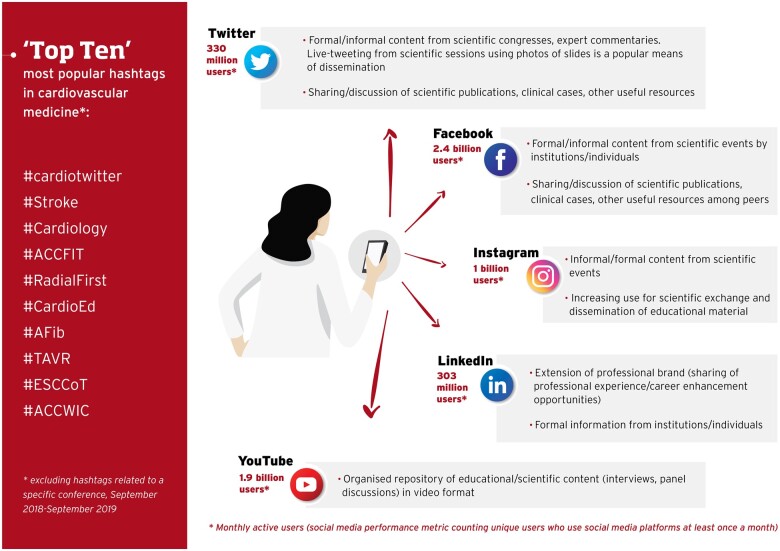
Social media increasingly impact both the private and professional lives of the majority of the population, including individuals engaged in cardiovascular healthcare and research. Healthcare providers across the world use social media platforms such as Twitter or Facebook to find medical and scientific information, to follow scientific meetings, to discuss individual clinical cases with colleagues, and to engage with patients. While social media provide a means for fast, interactive and accessible communication without geographic boundaries, their use to obtain and disseminate information has limitations and the potential threats are not always clearly understood. Governance concerns include a lack of rigorous quality control, bias due to the pre-selection of presented content by filter algorithms, and the risk of inadvertent breach of patient confidentiality. This article provides information and guidance regarding the role and use of social media platforms in cardiovascular medicine, with an emphasis on the new opportunities for the dissemination of scientific information and continuing education that arise from their responsible use.
社交媒体对大多数人的私人生活和职业生活的影响日益增大,这其中包括从事心血管医疗保健和研究的人员。世界各地的医疗保健提供者利用推特或脸书等社交媒体平台来查找医学和科学信息、关注科学会议、与同事讨论个别临床病例以及与患者互动。虽然社交媒体提供了一种不受地理限制的快速、互动且便捷的沟通方式,但其用于获取和传播信息存在局限性,潜在威胁也并非总是被清楚理解。管理方面的问题包括缺乏严格的质量控制、由于过滤算法对所呈现内容的预先筛选而产生的偏差,以及无意中泄露患者机密的风险。本文提供了有关社交媒体平台在心血管医学中的作用和使用的信息及指导,重点是合理使用这些平台所带来的科学信息传播和继续教育的新机遇。