Bertrand Jane T, Ross John A, Sauter Sydney R
Tulane University School of Public Health and Tropical Medicine, Department of International Health and Sustainable Development, New Orleans, LA, United States.
Independent Demographic Consultant, New Paltz, New York, United States.
Front Glob Womens Health. 2023 Jan 11;3:1061648. doi: 10.3389/fgwh.2022.1061648. eCollection 2022.
Method mix - the percent distribution of contraceptive use by method among contraceptive users - reflects both client choice of method and method availability. In a country where clients have access to a wide range of methods at an affordable price, method mix is a strong proxy for method choice. In contrast, where access is limited by numerous factors - method availability, cost, or provider attitudes - method mix may not capture method choice well. Given that method mix can be measured reliably from population-based surveys, it is useful in exploring method choice. While the method mix for all women of reproductive age (15-49 years) has been described previously, the method mix for adolescents and young women aged 15-24 remains unexplored despite this population's high risk for unintended pregnancy.
This study investigates the contraceptive method mix for women aged 15-24 in low- and middle-income countries (LMICs) with national survey data and describes how the method mix differs by age group, geographic region, and marital status for women.
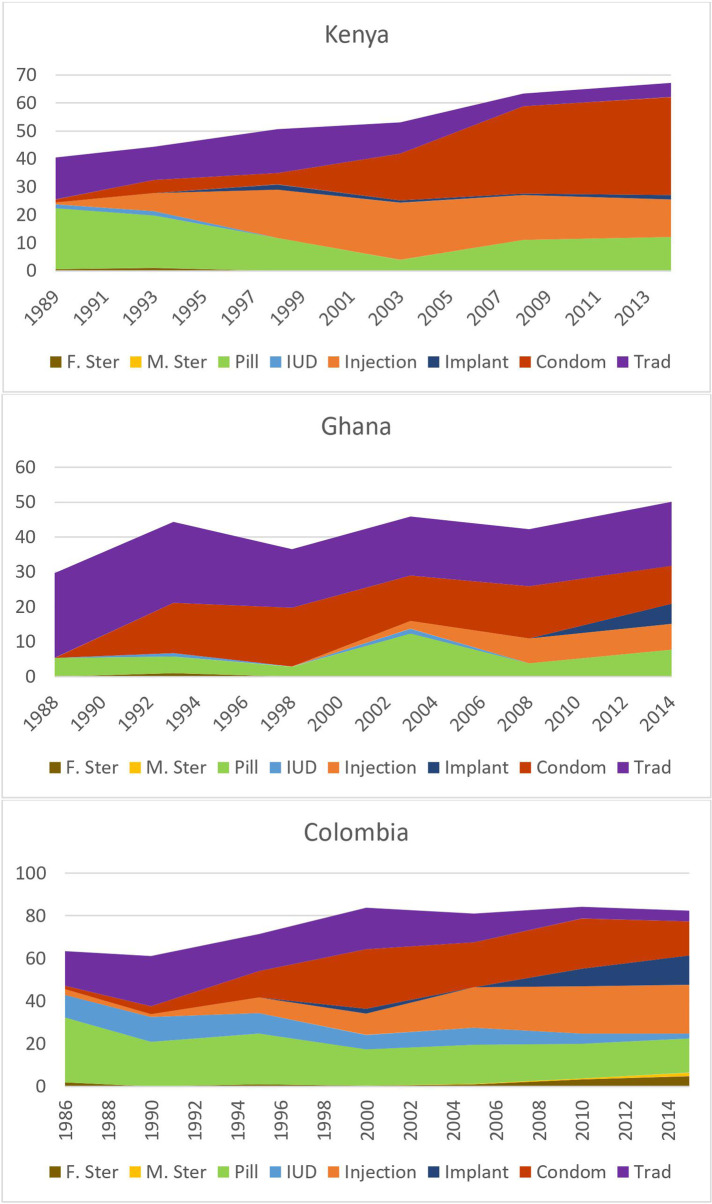
Using data from the Demographic and Health (DHS) Surveys, the contraceptive method mix among women aged 15-24 across 64 LMICs is analyzed by age, marital status, and region, with measures of skew and average deviation. Three case studies are presented in which the trend over time in the method mix is examined.
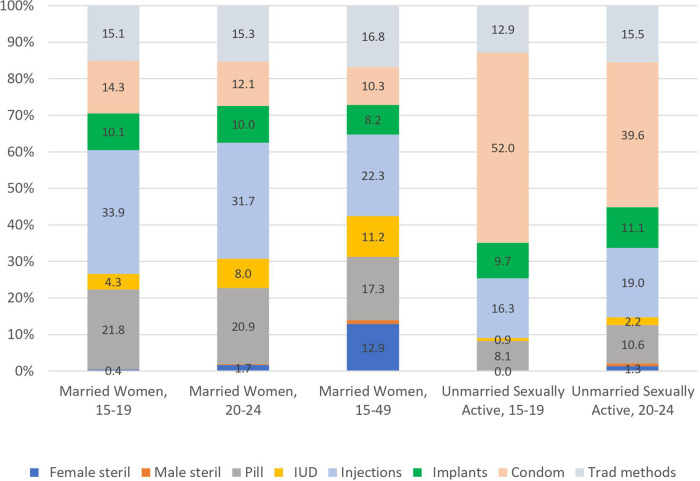
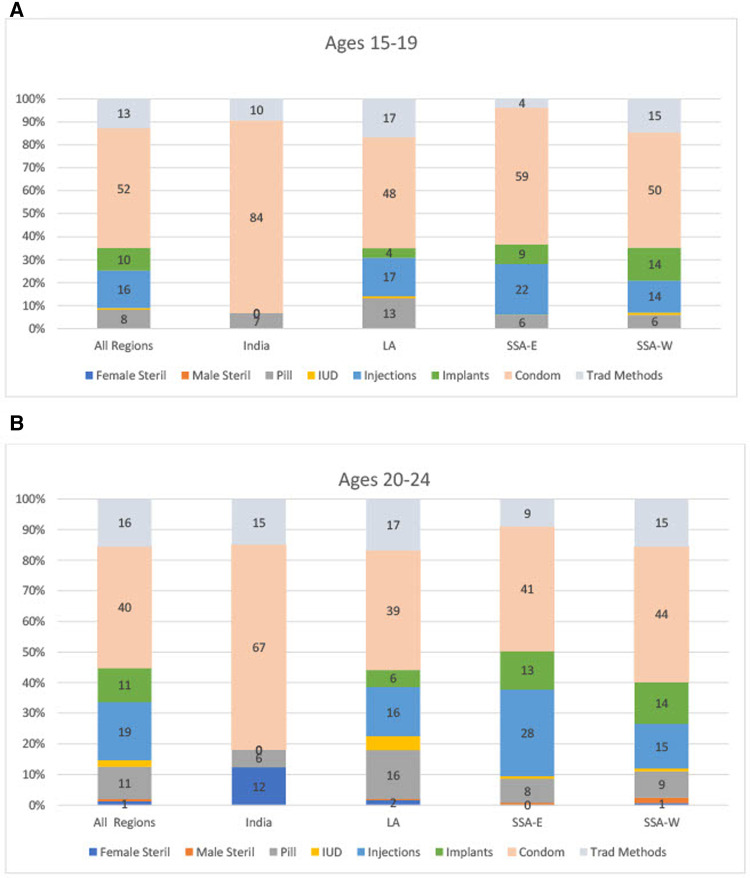
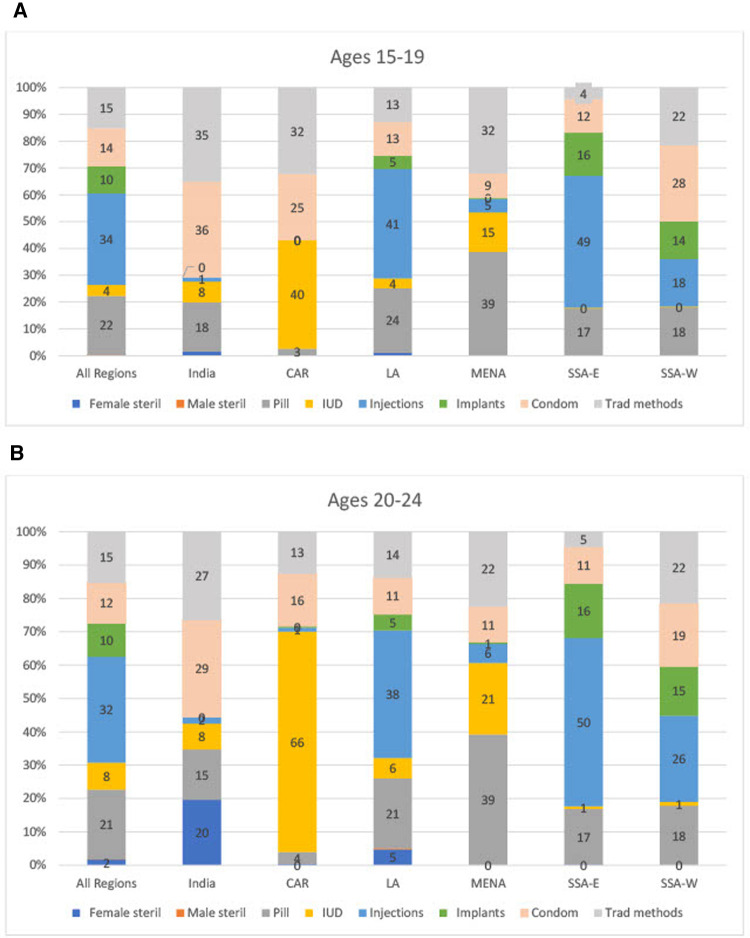
There are large variations in method mixes across regions, which reflect their differences in various supply and demand constraints. However, there is consistently high usage of short-acting methods among both age groups, 15-19 and 20-24, compared to the full population of all women of reproductive age. Male condoms overwhelmingly predominate as the method used by women 15-24 in all regions.
The marked differences found by marital status, region, and age show the need for programs to be tailored to local circumstances. Additionally, the large unmet need for contraception signals the ongoing urgency for strengthened programmatic efforts, and for a wider offering of methods to enlarge the choices available to young women. Unmarried women in particular deserve attention, as well as young married women who wish to postpone a pregnancy.
方法组合——避孕方法在避孕使用者中的百分比分布——既反映了服务对象对方法的选择,也反映了方法的可及性。在一个服务对象能够以可承受的价格获得多种避孕方法的国家,方法组合是方法选择的有力代表。相比之下,在因多种因素(方法可及性、成本或提供者态度)而导致获取受限的情况下,方法组合可能无法很好地反映方法选择。鉴于方法组合可通过基于人群的调查可靠地测量,它在探索方法选择方面很有用。虽然之前已经描述了所有育龄妇女(15 - 49岁)的方法组合,但15 - 24岁青少年和年轻女性的方法组合仍未得到探索,尽管这一人群意外怀孕风险很高。
本研究利用国家调查数据调查低收入和中等收入国家(LMICs)15 - 24岁女性的避孕方法组合,并描述该方法组合在不同年龄组、地理区域和婚姻状况的女性中如何不同。
利用人口与健康调查(DHS)的数据,通过年龄、婚姻状况和地区,采用偏度和平均偏差度量,分析了64个低收入和中等收入国家15 - 24岁女性的避孕方法组合。呈现了三个案例研究,其中考察了方法组合随时间的趋势。
各地区的方法组合存在很大差异,这反映了它们在各种供需限制方面的差异。然而,与所有育龄妇女总体相比,15 - 19岁和20 - 24岁这两个年龄组短效方法的使用率一直很高。在所有地区,男用避孕套在15 - 24岁女性使用的方法中占绝对主导地位。
在婚姻状况、地区和年龄方面发现的显著差异表明,项目需要根据当地情况进行调整。此外,避孕方面大量未满足的需求表明,加强项目努力以及提供更多方法以扩大年轻女性的选择范围的紧迫性依然存在。特别是未婚女性以及希望推迟怀孕的年轻已婚女性值得关注。