Rodríguez Patricio, Villanueva Alexis, Dombrovskaia Lioubov, Valenzuela Juan Pablo
Institute of Education and Center for Advanced Research in Education, Universidad de Chile, Periodista José Carrasco Tapia 75, 8330014 Santiago, Región Metropolitana Chile.
Center for Advanced Research in Education, Universidad de Chile, Santiago, Chile.
Educ Inf Technol (Dordr). 2023 Jan 23:1-47. doi: 10.1007/s10639-022-11515-5.
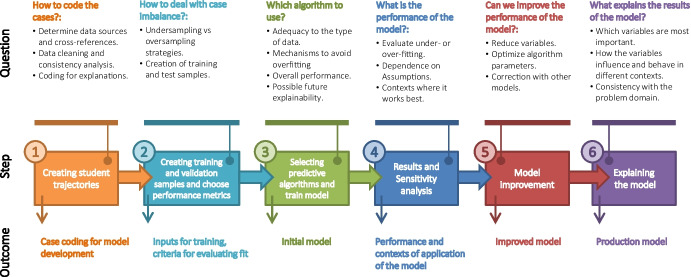
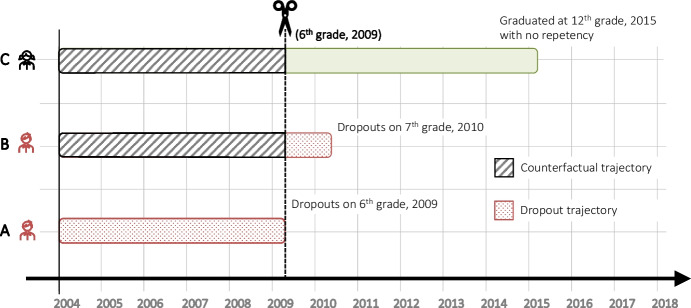
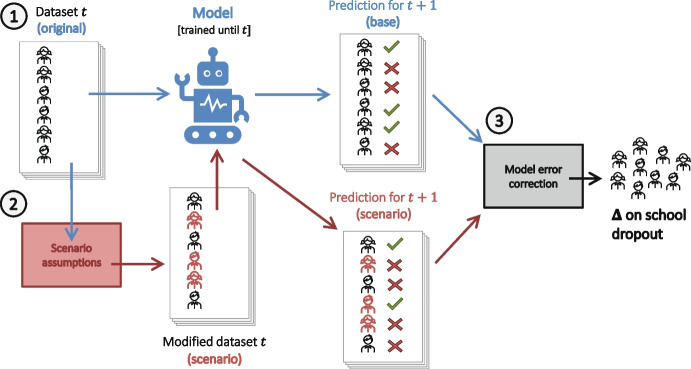
School dropout is a structural problem which permanently penalizes students and society in areas such as low qualification jobs, higher poverty levels and lower life expectancy, lower pensions, and higher economic burden for governments. Given these high consequences and the surge of the problem due to COVID-19 pandemic, in this paper we propose a methodology to design, develop, and evaluate a machine learning model for predicting dropout in school systems. In this methodology, we introduce necessary steps to develop a robust model to estimate the individual risk of each student to drop out of school. As advancement from previous research, this proposal focuses on analyzing individual trajectories of students, incorporating the student situation at school, family, among other levels, changes, and accumulation of events to predict dropout. Following the methodology, we create a model for the Chilean case based on data available mostly through administrative data from the educational system, and according to known factors associated with school dropout. Our results are better than those from previous research with a relevant sample size, with a predictive capability 20% higher for the actual dropout cases. Also, in contrast to previous work, the including non-individual dimensions results in a substantive contribution to the prediction of leaving school. We also illustrate applications of the model for Chilean case to support public policy decision making such as profiling schools for qualitative studies of pedagogic practices, profiling students' dropout trajectories and simulating scenarios.
辍学是一个结构性问题,它在低学历工作、较高贫困水平、较低预期寿命、较低养老金以及政府更高经济负担等方面对学生和社会造成永久性的不利影响。鉴于这些严重后果以及新冠疫情导致该问题激增,在本文中,我们提出一种方法,用于设计、开发和评估一个机器学习模型,以预测学校系统中的辍学情况。在这种方法中,我们介绍了开发一个稳健模型所需的步骤,以估计每个学生辍学的个体风险。作为对先前研究的推进,本提议侧重于分析学生的个体轨迹,纳入学生在学校、家庭等层面的情况、变化以及事件的累积,以预测辍学情况。按照该方法,我们基于主要通过教育系统行政数据获得的数据,并根据与辍学相关的已知因素,为智利的情况创建了一个模型。我们的结果优于之前具有相关样本量的研究,对实际辍学案例的预测能力高出20%。此外,与之前的工作不同,纳入非个体维度对预测辍学有实质性贡献。我们还举例说明了智利案例模型在支持公共政策决策方面的应用,如为教学实践的定性研究对学校进行剖析、描绘学生的辍学轨迹以及模拟情景。