Markowitz David M
School of Journalism and Communication, University of Oregon, Eugene, OR, USA.
PNAS Nexus. 2022 Aug 18;1(4):pgac157. doi: 10.1093/pnasnexus/pgac157. eCollection 2022 Sep.
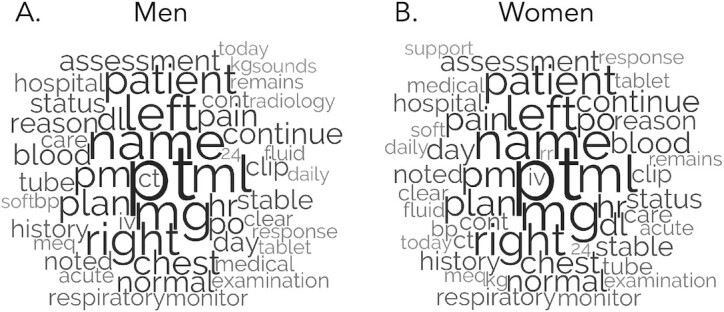
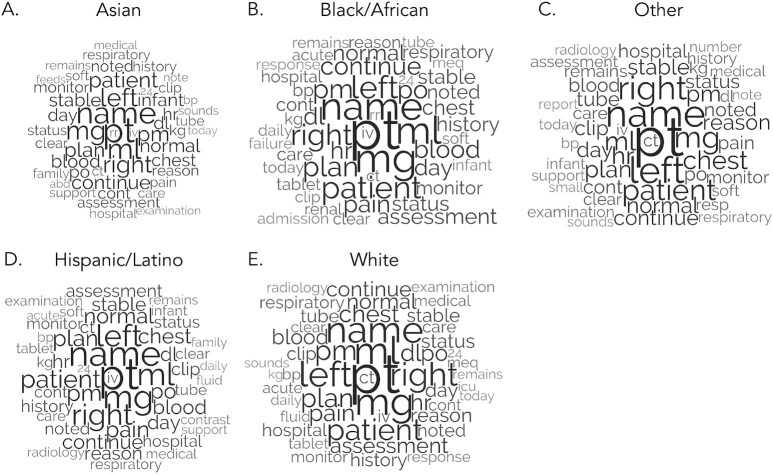
Gender and ethnicity biases are pervasive across many societal domains including politics, employment, and medicine. Such biases will facilitate inequalities until they are revealed and mitigated at scale. To this end, over 1.8 million caregiver notes (502 million words) from a large US hospital were evaluated with natural language processing techniques in search of gender and ethnicity bias indicators. Consistent with nonlinguistic evidence of bias in medicine, physicians focused more on the emotions of women compared to men and focused more on the scientific and bodily diagnoses of men compared to women. Content patterns were relatively consistent across genders. Physicians also attended to fewer emotions for Black/African and Asian patients compared to White patients, and physicians demonstrated the greatest need to work through diagnoses for Black/African women compared to other patients. Content disparities were clearer across ethnicities, as physicians focused less on the of Black/African and Asian patients compared to White patients in their critical care notes. This research provides evidence of gender and ethnicity biases in medicine as communicated by physicians in the field and requires the critical examination of institutions that perpetuate bias in social systems.
性别和种族偏见在包括政治、就业和医学在内的许多社会领域普遍存在。在这些偏见被大规模揭示和缓解之前,它们将助长不平等现象。为此,研究人员运用自然语言处理技术,对美国一家大型医院超过180万份护理记录(5.02亿字)进行了评估,以寻找性别和种族偏见指标。与医学领域存在偏见的非语言证据一致,与男性相比,医生更多地关注女性的情绪,与女性相比,医生更多地关注男性的科学诊断和身体诊断。不同性别的内容模式相对一致。与白人患者相比,医生对黑人/非裔和亚洲患者的情绪关注也较少,与其他患者相比,医生对黑人/非裔女性进行诊断时的需求最大。不同种族之间的内容差异更为明显,因为在重症护理记录中,与白人患者相比,医生对黑人/非裔和亚洲患者的关注较少。这项研究提供了医学领域中医生所传达的性别和种族偏见的证据,并要求对在社会系统中延续偏见的机构进行严格审查。