van Zyl Chéri, le Roux Talita, Swanepoel De Wet
Department of Audiology, Red Cross War Memorial Children's Hospital, Cape Town, Western Cape, South Africa.
Department of Speech-Language Pathology and Audiology, University of Pretoria, Pretoria, Gauteng, South Africa.
Int Arch Otorhinolaryngol. 2022 Jul 13;27(1):e83-e96. doi: 10.1055/s-0042-1742769. eCollection 2023 Jan.
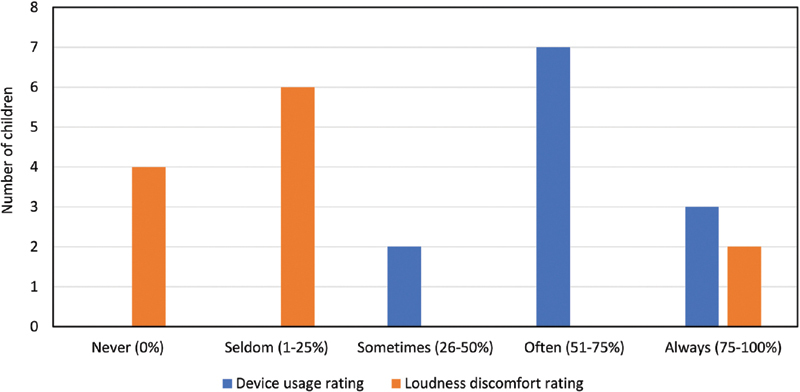
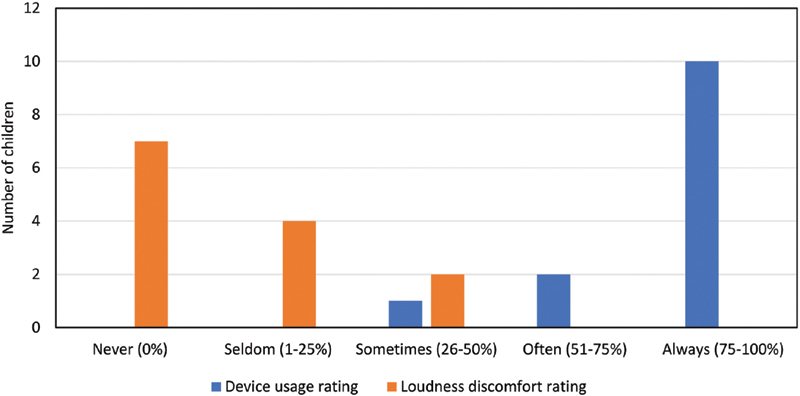
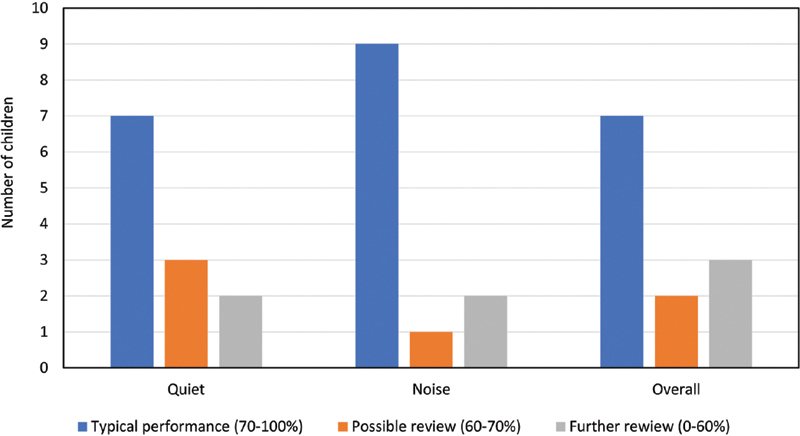
Hearing aids are a frequent management option for children with conductive hearing loss (CHL) and it is necessary to determine the efficacy of outcomes. Limited information regarding caregivers' perceptions and experiences are available to examine outcomes in this population. To describe hearing aid outcomes and caregivers' experiences for children with CHL who wear behind-the-ear (BTE) hearing aids. Retrospective review of clinical data from 19 children between 0 and 13 years of age with CHL, who were fitted with BTE hearing aids between January 2017 and March 2020. Hearing aid outcomes were documented at one month post-hearing aid fitting, via average daily use and caregiver and teacher reports obtained through the Parents' Evaluation of Aural/oral performance of Children (PEACH) and the Teachers' Evaluation of Aural/oral performance of Children (TEACH). Telephonic surveys were conducted with 13 caregivers to explore their experiences. Qualitative data from open-ended questions were analyzed thematically. The average hearing aid use was 6.5 hours/day (2.0 standard deviation, SD; range 4.1-10.3) for bilateral hearing aid users. Questionnaire results indicated that most children (PEACH - 83.3% and TEACH - 92.3%) used their hearing aids more than 75% of the time. Participants performed better in quiet environments with limited sensitivity to loud sounds at home and at school. Reported challenges included stigma and device compliance. Children with CHL used their hearing aids for comparable hours (5-8 hours/day), as reported for children with sensorineural hearing loss, but less than the recommended 10 hours/day required for adequate language development. Caregivers reported benefits equivalent to expectations, with challenges similar to those reported in high-income countries.
助听器是传导性听力损失(CHL)儿童常见的治疗选择,因此有必要确定其治疗效果。目前关于护理人员认知和经历的信息有限,难以考察该群体的治疗效果。
描述佩戴耳背式(BTE)助听器的CHL儿童的助听器使用效果及护理人员的经历。
回顾性分析2017年1月至2020年3月期间为19名0至13岁CHL儿童佩戴BTE助听器的临床数据。在助听器验配后1个月记录助听器使用效果,通过平均每日使用时长以及护理人员和教师通过儿童听觉/口语表现家长评估(PEACH)和儿童听觉/口语表现教师评估(TEACH)提供的报告进行记录。对13名护理人员进行电话调查,以了解他们的经历。对开放式问题的定性数据进行主题分析。
双侧佩戴助听器的用户平均每天使用助听器6.5小时(标准差2.0;范围4.1 - 10.3)。问卷调查结果表明,大多数儿童(PEACH - 83.3%,TEACH - 92.3%)使用助听器的时间超过75%。参与者在安静环境中表现更好,在家中和学校对大声响的敏感度较低。报告的挑战包括耻辱感和设备依从性。
CHL儿童使用助听器的时长与感音神经性听力损失儿童报告的时长相当(5 - 8小时/天),但低于语言充分发育所需的建议时长10小时/天。护理人员报告称益处与预期相当,面临的挑战与高收入国家报告的类似。