Department of Integrative Biology and Jepson Herbarium, University of California, Berkeley, CA 94720.
Department of Ecology and Evolutionary Biology, University of California, Los Angeles, CA 90095.
Proc Natl Acad Sci U S A. 2023 Feb 7;120(6):e2214729120. doi: 10.1073/pnas.2214729120. Epub 2023 Jan 30.
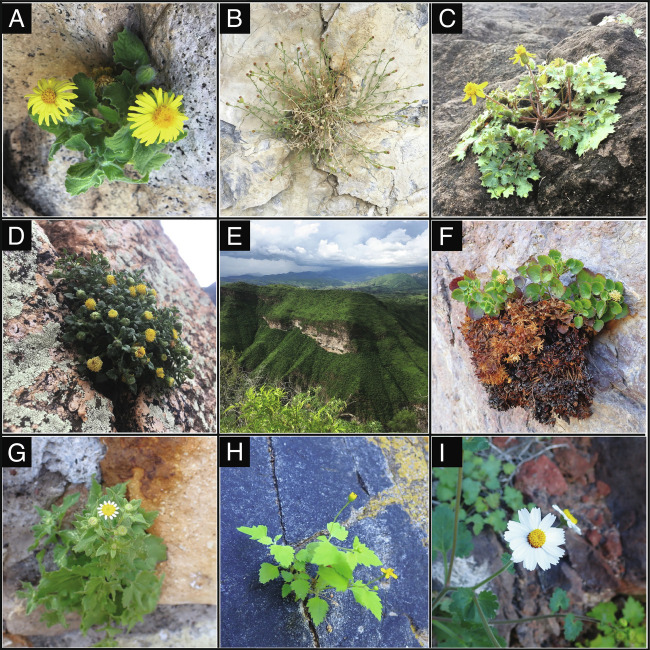
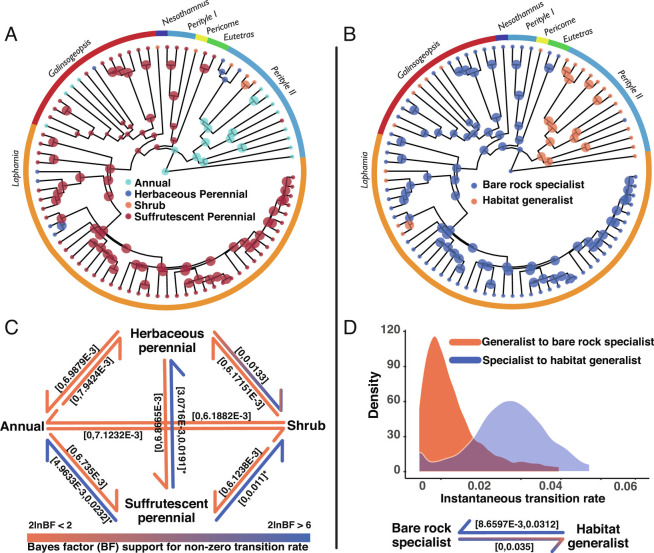
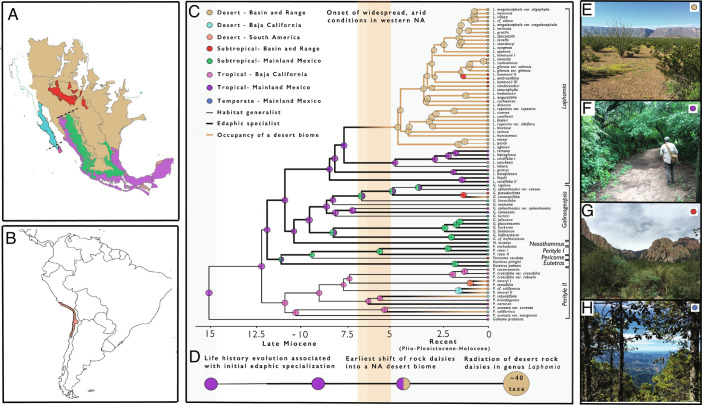
Understanding the processes that enable organisms to shift into more arid environments as they emerge is critical for gauging resilience to climate change, yet these forces remain poorly known. In a comprehensive clade-based study, we investigate recent shifts into North American deserts in the rock daisies (tribe Perityleae), a diverse tribe of desert sunflowers (Compositae). We sample rock daisies across two separate contact zones between tropical deciduous forest and desert biomes in western North America and infer a time-calibrated phylogeny based on target capture sequence data. We infer biome shifts using Bayesian inference with paleobiome-informed models and find evidence for seven independent shifts into desert habitats since the onset of aridification in the late Miocene. The earliest shift occurred out of tropical deciduous forests and led to an extensive radiation throughout North American deserts that accounts for the majority of extant desert rock daisies. Estimates of life history and micro-habitat in the rock daisies reveal a correlation between a suffrutescent perennial life history and edaphic endemism onto rocky outcrops, an ecological specialization that evolved prior to establishment and diversification in deserts. That the insular radiation of desert rock daisies stemmed from ancestors preadapted for dry conditions as edaphic endemics in otherwise densely vegetated tropical deciduous forests in northwest Mexico underscores the crucial role of exaptation and dispersal for shifts into arid environments.
理解生物在出现时如何适应更干旱的环境的过程对于评估对气候变化的适应能力至关重要,但这些力量仍然知之甚少。在一项全面的基于进化枝的研究中,我们调查了北美沙漠中岩石雏菊(Perityleae 族)的近期转移,这是一个多样化的沙漠向日葵(菊科)族。我们在北美西部的热带落叶林和沙漠生物群落之间的两个单独接触区采样了岩石雏菊,并根据目标捕获序列数据推断了一个时间校准的系统发育。我们使用具有古生物群信息模型的贝叶斯推断来推断生物群落的转移,并发现了自中新世晚期干旱化开始以来,有 7 次独立的沙漠栖息地转移的证据。最早的转移发生在热带落叶林之外,并导致了北美沙漠中广泛的辐射,这解释了现存的大多数沙漠岩石雏菊。对岩石雏菊的生活史和微生境的估计揭示了一种 suffrutescent 多年生生活史和土壤特有性与岩石露头之间的相关性,这种生态特化在沙漠中建立和多样化之前就已经进化了。沙漠岩石雏菊的孤岛辐射源于适应干旱条件的祖先,它们是墨西哥西北部其他茂密的热带落叶林中的土壤特有种,这突出了适应和扩散在适应干旱环境中的关键作用。