Jiangsu Key Laboratory of Advanced Catalytic Materials and Technology, School of Petrochemical Engineering, Changzhou University, Changzhou 213164, China.
College of Biological, Chemical Sciences and Engineering, Jiaxing University, Jiaxing 314001, China.
Bioelectrochemistry. 2023 Jun;151:108375. doi: 10.1016/j.bioelechem.2023.108375. Epub 2023 Jan 27.
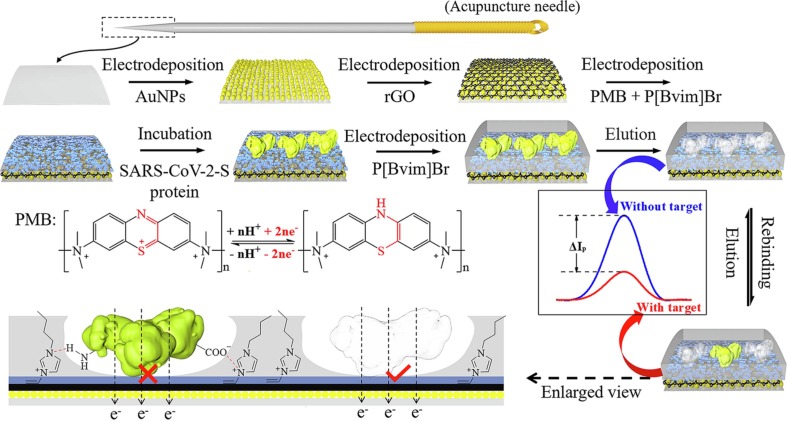
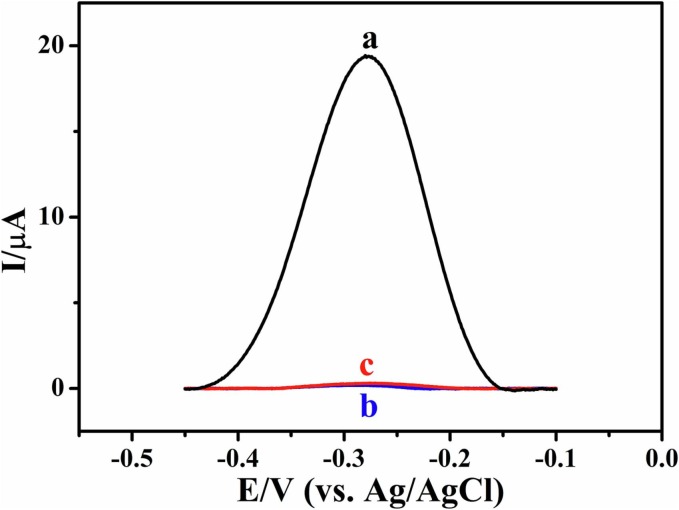
Accurate detection of SARS-CoV-2 spike (SARS-CoV-2-S) protein is of clinical significance for early diagnosis and timely treatment of severe acute respiratory syndrome coronavirus 2 (SARS-CoV-2). Herein, a surface molecularly imprinted miniature biosensor was fabricated. Au nanoparticles (AuNPs), reduced graphene oxide (rGO), poly(methylene blue)/poly(ionic liquids) and poly(ionic liquids) were successively electrodeposited onto the pinpoint of an acupuncture needle (AN). The molecularly imprinted miniature biosensor was obtained after the template of SARS-CoV-2-S protein was removed, which could be used for sensitive detection of SARS-CoV-2-S protein. The linear range and limit of detection (LOD) were 0.1 ∼ 1000 ng mL and 38 pg mL, respectively, which were superior to other molecularly imprinted biosensors previously reported. The developed miniature biosensor also exhibited high specificity and stability. The reliability of the biosensor was evaluated by the detection of SARS-CoV-2-S protein in clinical serum samples.
准确检测严重急性呼吸综合征冠状病毒 2(SARS-CoV-2)的刺突(SARS-CoV-2-S)蛋白对于早期诊断和及时治疗具有重要的临床意义。在此,构建了一种表面分子印迹微型生物传感器。金纳米粒子(AuNPs)、还原氧化石墨烯(rGO)、聚亚甲基蓝/聚离子液体和聚离子液体依次被电沉积在针灸针的针尖上。去除 SARS-CoV-2-S 蛋白模板后,得到分子印迹微型生物传感器,可用于灵敏检测 SARS-CoV-2-S 蛋白。该传感器的线性范围和检测限(LOD)分别为 0.1~1000ng mL 和 38pg mL,优于之前报道的其他分子印迹生物传感器。所开发的微型生物传感器还表现出高特异性和稳定性。通过检测临床血清样本中的 SARS-CoV-2-S 蛋白来评估生物传感器的可靠性。