Ratautaite Vilma, Boguzaite Raimonda, Brazys Ernestas, Ramanaviciene Almira, Ciplys Evaldas, Juozapaitis Mindaugas, Slibinskas Rimantas, Bechelany Mikhael, Ramanavicius Arunas
Laboratory of Nanotechnology, Department of Functional Materials and Electronics, Center for Physical Sciences and Technology, Sauletekio av. 3, Vilnius LT-10257, Lithuania.
NanoTechnas - Center of Nanotechnology and Materials Science at Faculty of Chemistry and Geosciences, Vilnius University, Naugarduko str. 24, LT-03225, Vilnius, Lithuania.
Electrochim Acta. 2022 Jan 20;403:139581. doi: 10.1016/j.electacta.2021.139581. Epub 2021 Nov 16.
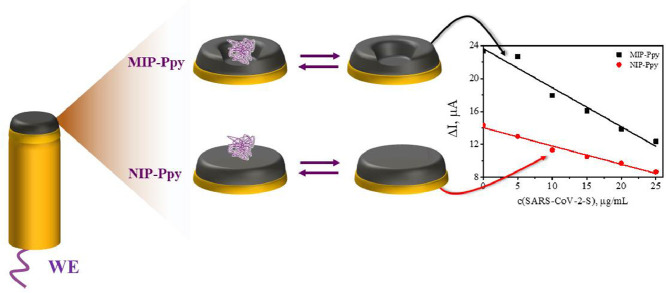
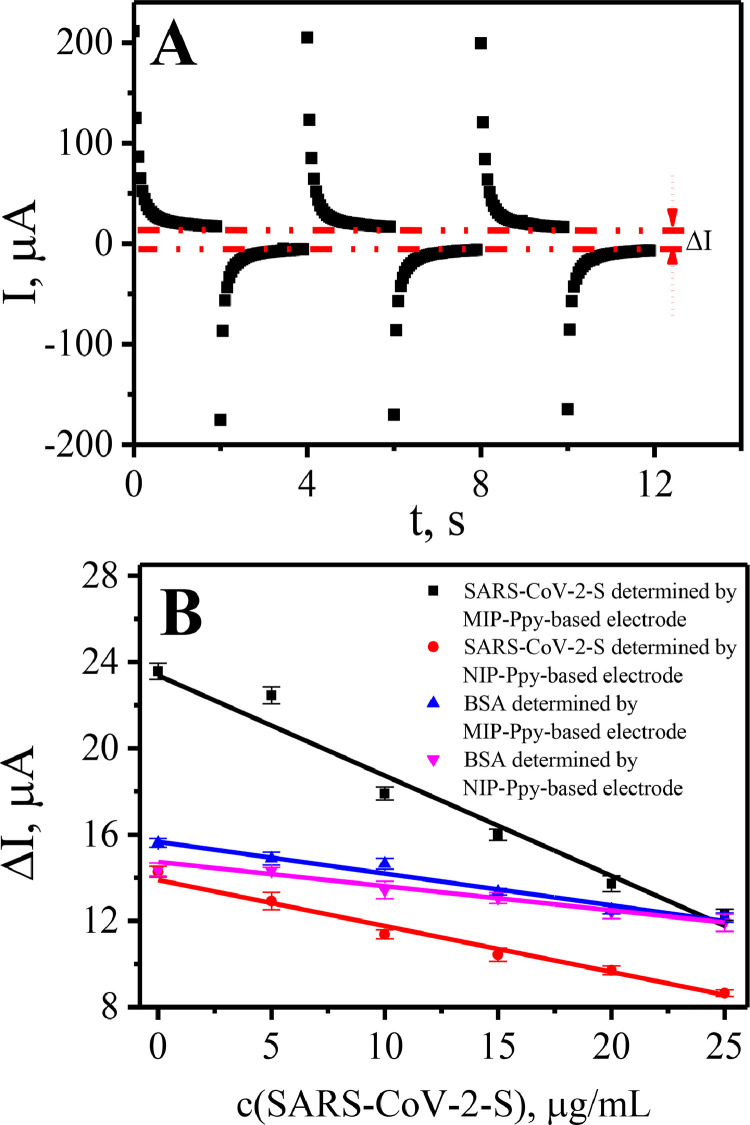
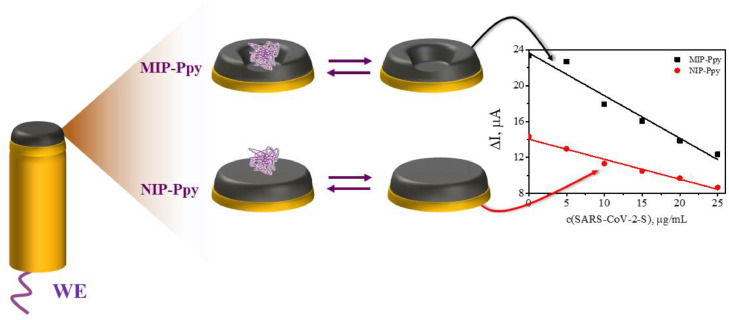
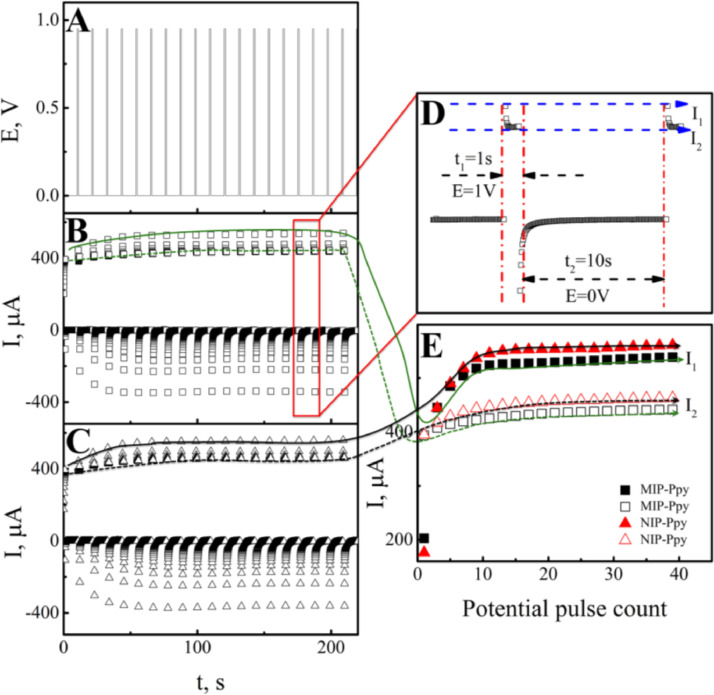
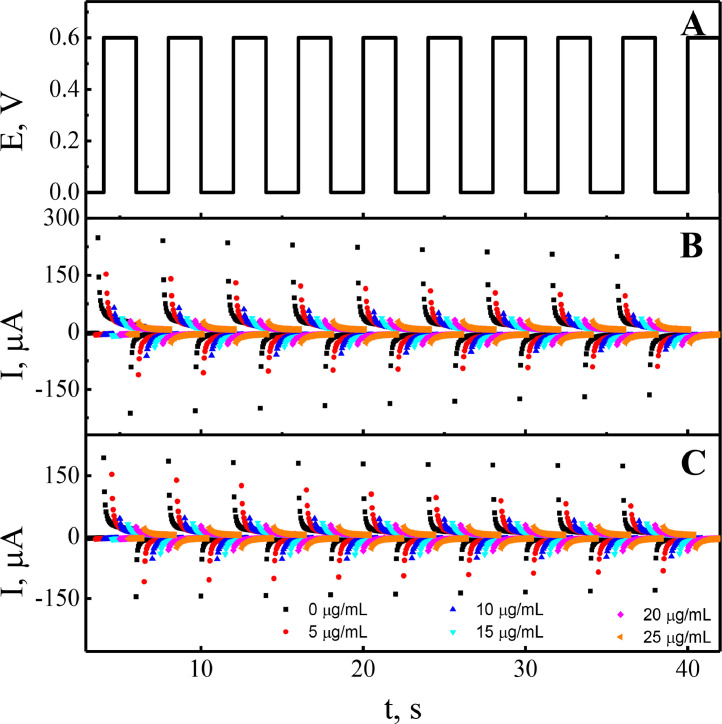
This study describes the application of a polypyrrole-based sensor for the determination of SARS-CoV-2-S spike glycoprotein. The SARS-CoV-2-S spike glycoprotein is a spike protein of the coronavirus SARS-CoV-2 that recently caused the worldwide spread of COVID-19 disease. This study is dedicated to the development of an electrochemical determination method based on the application of molecularly imprinted polymer technology. The electrochemical sensor was designed by molecular imprinting of polypyrrole (Ppy) with SARS-CoV-2-S spike glycoprotein (MIP-Ppy). The electrochemical sensors with MIP-Ppy and with polypyrrole without imprints (NIP-Ppy) layers were electrochemically deposited on a platinum electrode surface by a sequence of potential pulses. The performance of polymer layers was evaluated by pulsed amperometric detection. According to the obtained results, a sensor based on MIP-Ppy is more sensitive to the SARS-CoV-2-S spike glycoprotein than a sensor based on NIP-Ppy. Also, the results demonstrate that the MIP-Ppy layer is more selectively interacting with SARS-CoV-2-S glycoprotein than with bovine serum albumin. This proves that molecularly imprinted MIP-Ppy-based sensors can be applied for the detection of SARS-CoV-2 virus proteins.
本研究描述了一种基于聚吡咯的传感器在测定严重急性呼吸综合征冠状病毒2(SARS-CoV-2)刺突糖蛋白中的应用。SARS-CoV-2刺突糖蛋白是冠状病毒SARS-CoV-2的一种刺突蛋白,该病毒最近导致了2019冠状病毒病在全球范围内传播。本研究致力于基于分子印迹聚合物技术开发一种电化学测定方法。通过用SARS-CoV-2刺突糖蛋白对聚吡咯(Ppy)进行分子印迹设计了电化学传感器(MIP-Ppy)。通过一系列电位脉冲将带有MIP-Ppy层和不带印迹的聚吡咯(NIP-Ppy)层的电化学传感器电化学沉积在铂电极表面。通过脉冲安培检测评估聚合物层的性能。根据所得结果,基于MIP-Ppy的传感器对SARS-CoV-2刺突糖蛋白比基于NIP-Ppy的传感器更敏感。此外,结果表明MIP-Ppy层与SARS-CoV-2糖蛋白的相互作用比与牛血清白蛋白的相互作用更具选择性。这证明基于分子印迹MIP-Ppy的传感器可用于检测SARS-CoV-2病毒蛋白。