Department of Thoracic Surgery, China-Japan Union Hospital of Jilin University, 126 Xiantai Street, Changchun, 130033, P. R. China.
Key Laboratory of Polymer Ecomaterials, Changchun Institute of Applied Chemistry, Chinese Academy of Sciences, 5625 Renmin Street, Changchun, 130022, P. R. China.
Adv Sci (Weinh). 2023 Apr;10(11):e2206154. doi: 10.1002/advs.202206154. Epub 2023 Jan 30.
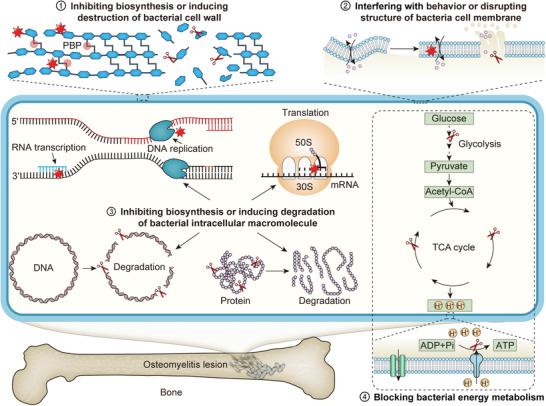
Osteomyelitis is a destructive disease of bone tissue caused by infection with pathogenic microorganisms. Because of the complex and long-term abnormal conditions, osteomyelitis is one of the refractory diseases in orthopedics. Currently, anti-infective therapy is the primary modality for osteomyelitis therapy in addition to thorough surgical debridement. However, bacterial resistance has gradually reduced the benefits of traditional antibiotics, and the development of advanced antibacterial agents has received growing attention. This review introduces the main targets of antibacterial agents for treating osteomyelitis, including bacterial cell wall, cell membrane, intracellular macromolecules, and bacterial energy metabolism, focuses on their mechanisms, and predicts prospects for clinical applications.
骨髓炎是一种由致病微生物感染引起的骨骼组织破坏性疾病。由于复杂和长期的异常情况,骨髓炎是骨科领域的难治性疾病之一。目前,除了彻底的手术清创外,抗感染治疗仍是骨髓炎治疗的主要方式。然而,细菌耐药性逐渐降低了传统抗生素的疗效,因此开发新型抗菌药物受到了越来越多的关注。本综述介绍了治疗骨髓炎的抗菌药物的主要作用靶点,包括细菌细胞壁、细胞膜、细胞内大分子和细菌能量代谢,并重点介绍了它们的作用机制,并对其临床应用前景进行了预测。