Tokyo Medical University Hospital, Tokyo, Japan.
Tokyo Medical University Hospital, Tokyo, Japan; The Second Kawasaki Saiwai Clinic, Kanagawa, Japan.
Clin Breast Cancer. 2023 Apr;23(3):265-271. doi: 10.1016/j.clbc.2023.01.001. Epub 2023 Jan 10.
Breast screening services were suspended for several months owing to the coronavirus disease 2019 (COVID-19) pandemic. We estimated the potential impact on breast cancer mortality using long-term global observations. However, the magnitude of the impact may vary across countries; therefore, we conducted an analysis and modeling study of this impact in Japan.
We compared the clinicopathological features of breast cancers between the nonpandemicgroup (April 1, 2019 to October 31, 2019) and the pandemic group (April 1, 2020 to October 31, 2020). We also compared the estimated 10-year survival rates between the two groups based on the weighted average of the 10-year survival rate by clinical stage and site (2004-2007).
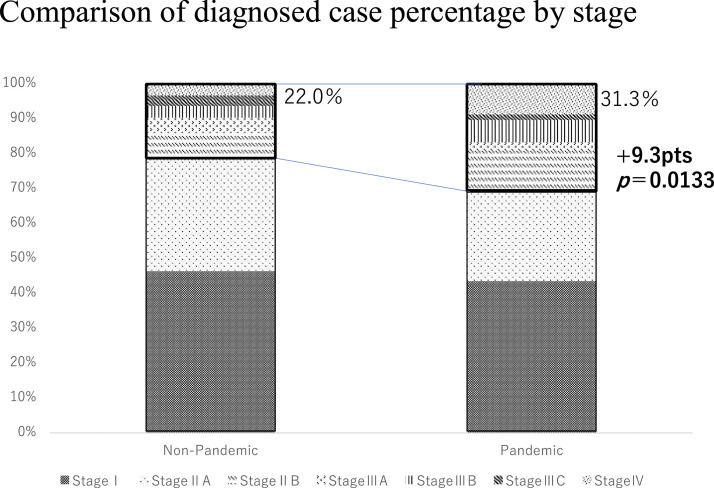
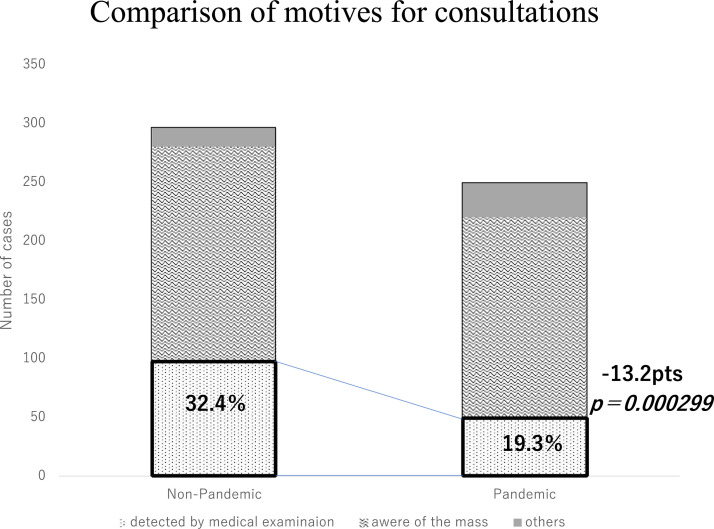
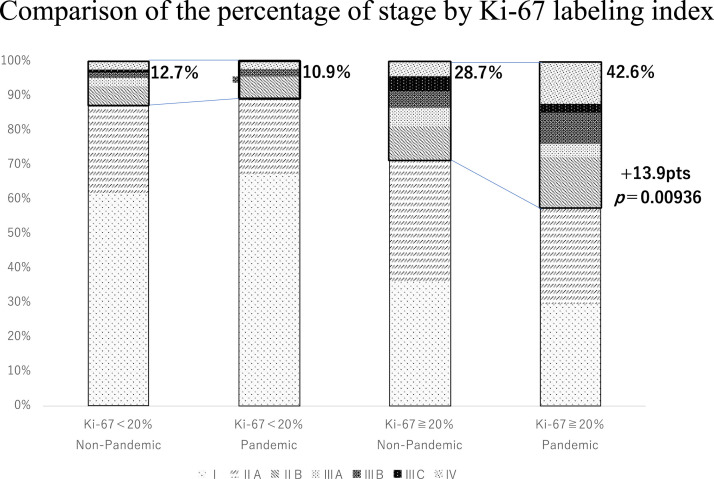
Results...Pandemic-related disruption decreased the number of breast cancer cases from296 to 249 during both 7-month periods. The percentage of patients with stage IIB or higher disease was significantly higher in the pandemic group than in the non-pandemic group (22.0% vs. 31.3%, P = 0.0133). The percentage of cases with a Ki-67 labeling index higher than 20% tended to be higher in the pandemic group than in the non-pandemic group (62.2% vs. 54.4%). The estimated 10-year survival rate was lower in the pandemic group than in the non-pandemic group (83.9% vs. 87.9%, 95% confidence interval of the difference: 0.87-8.8, P > 0.05).
We found more aggressive and advanced disease afterthe suspension of breast cancer screening services owing to the COVID-19 pandemic. This may have affected the long-term clinical outcomes of patients with breast cancer.
由于 2019 年冠状病毒病(COVID-19)大流行,乳腺筛查服务暂停了数月。我们利用长期全球观察结果来估计对乳腺癌死亡率的潜在影响。然而,这种影响的大小可能因国家而异;因此,我们对日本的这种影响进行了分析和建模研究。
我们比较了非大流行组(2019 年 4 月 1 日至 2019 年 10 月 31 日)和大流行组(2020 年 4 月 1 日至 2020 年 10 月 31 日)之间乳腺癌的临床病理特征。我们还根据临床分期和部位的 10 年生存率加权平均值(2004-2007 年)比较了两组的估计 10 年生存率。
结果……在这两个 7 个月期间,与大流行相关的中断使乳腺癌病例数从 296 例减少到 249 例。大流行组中疾病分期为 IIB 或更高的患者比例明显高于非大流行组(22.0%比 31.3%,P=0.0133)。大流行组中 Ki-67 标记指数高于 20%的病例比例也高于非大流行组(62.2%比 54.4%)。大流行组的估计 10 年生存率低于非大流行组(83.9%比 87.9%,差异的 95%置信区间:0.87-8.8,P>0.05)。
我们发现,由于 COVID-19 大流行,乳腺癌筛查服务暂停后,出现了更具侵袭性和更晚期的疾病。这可能影响了乳腺癌患者的长期临床结局。