Division of Renal Medicine, Baxter Novum, Department of Clinical Science, Intervention and Technology, Karolinska Institute, M99, Karolinska Hospital University Hospital Huddinge, 14186, Stockholm, Sweden.
Post-Graduate Program in Nutrition, Department of Nutrition, Federal University of Santa Catarina, Florianopolis, Brazil.
J Nephrol. 2023 Apr;36(3):895-910. doi: 10.1007/s40620-022-01553-0. Epub 2023 Jan 31.
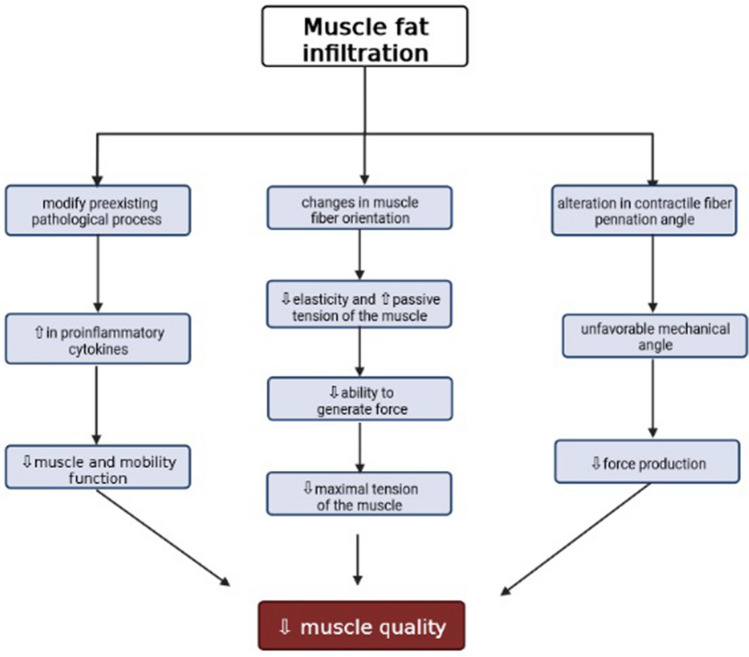
Muscle fat infiltration (MFI) also known as myosteatosis refers to any deposit of lipids found in the skeletal muscle. MFI is preferably assessed by image-based methods like computed tomography (CT), magnetic resonance image (MRI) and ultrasound, normally from muscle groups located in the legs, arms and in the trunk. MFI is understood as a marker of muscle quality, where a muscle with higher fat deposition has lower contraction power and capacity to produce force per unit of muscle mass. This concept supports the hypothesis that a decrease in muscle strength is not always explained by a decrease in muscle mass, but also by other factors, including lipid deposition in the muscle. In the general population, MFI is associated with older age, physical inactivity and with insulin resistance and inflammation. In chronic kidney disease (CKD), MFI has been associated with a decrease in muscle strength and impaired muscle quality as well as with metabolic abnormalities, cardiovascular disease and increased mortality. Interventions aimed at reducing MFI in CKD are incipient, but it seems that guided exercise can ameliorate muscle quality in patients on hemodialysis. The aim of this narrative review about MFI in CKD is to draw attention to a still not often addressed complication in CKD. We conclude that more studies are warranted to investigate mechanisms and factors promoting MFI in CKD. Thus, clinical trials aimed at understanding the type, frequency and intensity of exercise that can diminish MFI and improve the clinical condition of the patients are needed.
肌肉脂肪浸润(MFI)又称肌脂肪变性,是指在骨骼肌中发现的任何脂质沉积。MFI 最好通过基于图像的方法进行评估,如计算机断层扫描(CT)、磁共振成像(MRI)和超声,通常来自位于腿部、手臂和躯干的肌肉群。MFI 被理解为肌肉质量的标志物,其中脂肪沉积较高的肌肉收缩力较低,单位肌肉质量产生力量的能力较低。这一概念支持这样一种假设,即肌肉力量的下降并不总是由于肌肉质量的下降所解释,还包括其他因素,包括肌肉中的脂质沉积。在普通人群中,MFI 与年龄较大、身体活动不足以及胰岛素抵抗和炎症有关。在慢性肾脏病(CKD)中,MFI 与肌肉力量下降和肌肉质量受损以及代谢异常、心血管疾病和死亡率增加有关。针对 CKD 中 MFI 的干预措施还处于初期阶段,但似乎有针对性的运动可以改善血液透析患者的肌肉质量。本综述关于 CKD 中 MFI 的目的是引起对 CKD 中一种尚未经常涉及的并发症的关注。我们得出结论,需要更多的研究来探讨促进 CKD 中 MFI 的机制和因素。因此,需要进行临床试验以了解可以减少 MFI 并改善患者临床状况的运动类型、频率和强度。