Joseph Gabby B, Akkaya Zehra, Sims Wynton M, McCulloch Charles E, Nevitt Michael C, Lynch John A, Lane Nancy E, Link Thomas M
Department of Radiology and Biomedical Imaging, University of California, San Francisco, 185 Berry St, Suite 350, San Francisco, CA, 94158, USA.
Department of Radiology, Faculty of Medicine, Ankara University, Ankara, Turkey.
Sci Rep. 2025 Feb 20;15(1):6188. doi: 10.1038/s41598-024-75005-z.
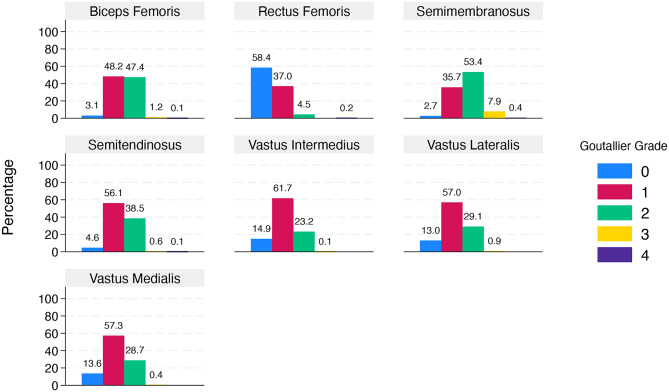
The degree of thigh intramuscular fat in individuals without OA is fundamental for distinguishing natural variations in intramuscular fat from pathological changes. The goals of this study were to estimate the degree of thigh intramuscular fat in individuals without radiographic OA or frequent pain and assess the associations of age, sex, and BMI with the degree of intramuscular fat. Individuals without knee or hip radiographic OA, without total knee/hip arthroplasty, and without frequent knee/hip pain were selected from the OAI database (n = 710). Goutallier Grades (GGs) of the quadriceps and hamstring muscles were assessed based on 3 T MR images on a scale from 0 (normal muscle) to 4 (more fat than muscle). The associations between demographic variables and GG outcomes were evaluated using mixed effects models. The most prevalent GGs among the muscles were Grades 1 and 2; Grade 4 was infrequent (< 1%). Greater BMI (p < 0.001) and age (p < 0.001) were each associated with greater GG. Women had greater GG than men (greatest difference in the vastus medialis: coeff. = 0.214, p < 0.001). At lower BMI, women had greater intramuscular fat than men; at higher BMI, men had greater intramuscular fat than women (p = 0.029 for BMI-sex interaction). While individuals without radiographic OA or frequent pain generally had low thigh intramuscular fat, higher BMI and age were associated with greater intramuscular fat, and GGs were greater in women than men. The relationship between BMI and intramuscular fat was sex-dependent. Thus, demographic variables must be considered when evaluating intramuscular fat.
对于没有骨关节炎(OA)的个体而言,大腿肌内脂肪的程度对于区分肌内脂肪的自然变化与病理变化至关重要。本研究的目的是估计没有影像学OA或频繁疼痛的个体的大腿肌内脂肪程度,并评估年龄、性别和体重指数(BMI)与肌内脂肪程度之间的关联。从骨关节炎倡议(OAI)数据库中选取了没有膝关节或髋关节影像学OA、没有全膝关节/髋关节置换术且没有频繁膝关节/髋关节疼痛的个体(n = 710)。基于3T磁共振成像,按照从0(正常肌肉)到4(脂肪多于肌肉)的量表评估股四头肌和腘绳肌的古塔利耶分级(GGs)。使用混合效应模型评估人口统计学变量与GG结果之间的关联。肌肉中最常见的GGs是1级和2级;4级很少见(<1%)。较高的BMI(p < 0.001)和年龄(p < 0.001)均与较高的GG相关。女性的GG高于男性(股内侧肌差异最大:系数 = 0.214,p < 0.001)。在较低BMI时,女性比男性具有更多的肌内脂肪;在较高BMI时,男性比女性具有更多的肌内脂肪(BMI - 性别交互作用的p = 0.029)。虽然没有影像学OA或频繁疼痛的个体通常大腿肌内脂肪较低,但较高的BMI和年龄与更多的肌内脂肪相关,且女性的GG高于男性。BMI与肌内脂肪之间的关系存在性别差异。因此,在评估肌内脂肪时必须考虑人口统计学变量。