Department of Radiology and Research Institute of Radiological Science and Center for Clinical Image Data Science, Severance Hospital, Yonsei University College of Medicine, Seoul, Korea.
Department of Radiology, Dankook University Hospital, Cheonan, Chungnam Province, Republic of Korea.
JAMA Netw Open. 2023 Jan 3;6(1):e2253820. doi: 10.1001/jamanetworkopen.2022.53820.
Dual-energy chest radiography exhibits better sensitivity than single-energy chest radiography, partly due to its ability to remove overlying anatomical structures.
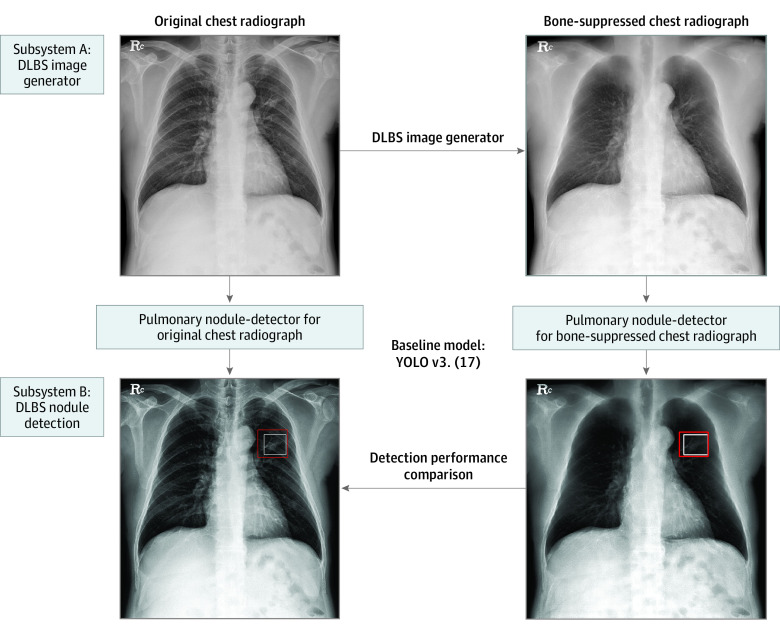
To develop and validate a deep learning-based synthetic bone-suppressed (DLBS) nodule-detection algorithm for pulmonary nodule detection on chest radiographs.
DESIGN, SETTING, AND PARTICIPANTS: This decision analytical modeling study used data from 3 centers between November 2015 and July 2019 from 1449 patients. The DLBS nodule-detection algorithm was trained using single-center data (institute 1) of 998 chest radiographs. The DLBS algorithm was validated using 2 external data sets (institute 2, 246 patients; and institute 3, 205 patients). Statistical analysis was performed from March to December 2021.
DLBS nodule-detection algorithm.
The nodule-detection performance of DLBS model was compared with the convolution neural network nodule-detection algorithm (original model). Reader performance testing was conducted by 3 thoracic radiologists assisted by the DLBS algorithm or not. Sensitivity and false-positive markings per image (FPPI) were compared.
Training data consisted of 998 patients (539 men [54.0%]; mean [SD] age, 54.2 [9.82] years), and 2 external validation data sets consisted of 246 patients (133 men [54.1%]; mean [SD] age, 55.3 [8.7] years) and 205 patients (105 men [51.2%]; mean [SD] age, 51.8 [9.1] years). Using the external validation data set of institute 2, the bone-suppressed model showed higher sensitivity compared with that of the original model for nodule detection (91.5% [109 of 119] vs 79.8% [95 of 119]; P < .001). The overall mean of FPPI with the bone-suppressed model was reduced compared with the original model (0.07 [17 of 246] vs 0.09 [23 of 246]; P < .001). For the observer performance testing with the data of institute 3, the mean sensitivity of 3 radiologists was 77.5% (95% [CI], 69.9%-85.2%), whereas that of radiologists assisted by DLBS modeling was 92.1% (95% CI, 86.3%-97.3%; P < .001). The 3 radiologists had a reduced number of FPPI when assisted by the DLBS model (0.071 [95% CI, 0.041-0.111] vs 0.151 [95% CI, 0.111-0.210]; P < .001).
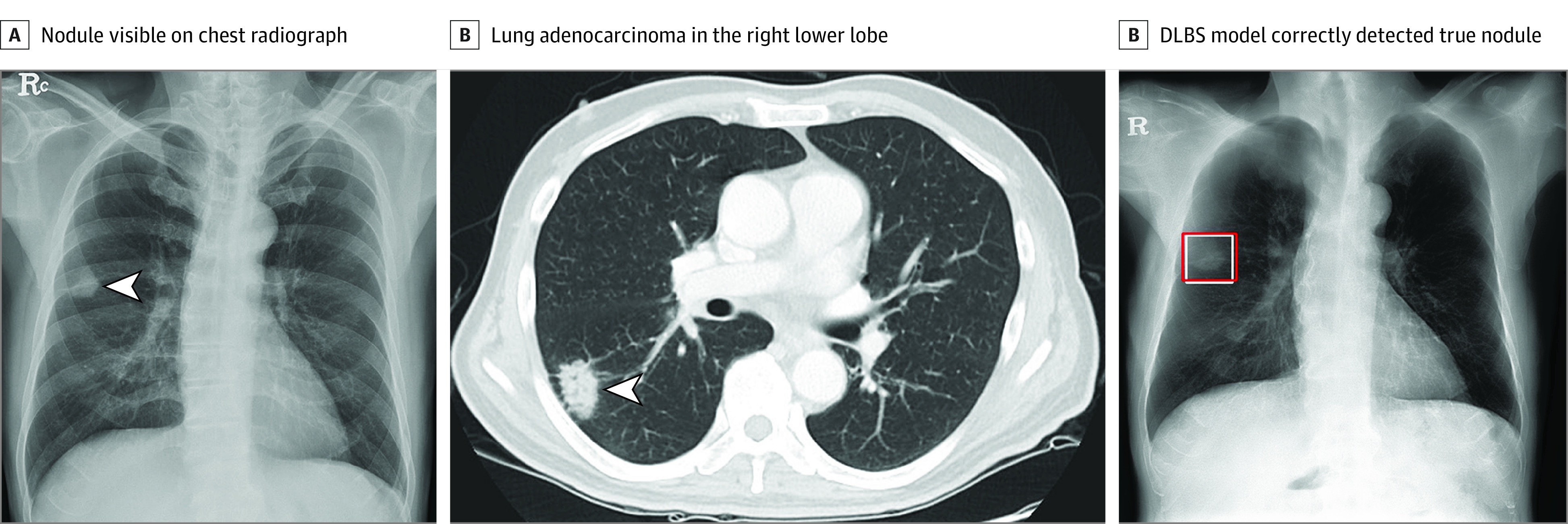
This decision analytical modeling study found that the DLBS model was more sensitive to detecting pulmonary nodules on chest radiographs compared with the original model. These findings suggest that the DLBS model could be beneficial to radiologists in the detection of lung nodules in chest radiographs without need of the specialized equipment or increase of radiation dose.
双能胸部 X 射线摄影比单能胸部 X 射线摄影具有更好的敏感性,部分原因是它能够去除重叠的解剖结构。
开发和验证一种基于深度学习的合成骨抑制(DLBS)结节检测算法,用于胸部 X 射线摄影中的肺结节检测。
设计、设置和参与者:这项决策分析模型研究使用了 2015 年 11 月至 2019 年 7 月期间来自 3 个中心的 1449 名患者的数据。DLBS 结节检测算法是使用单中心数据(机构 1)中的 998 张胸部 X 射线片进行训练的。DLBS 算法使用 2 个外部数据集(机构 2,246 名患者;机构 3,205 名患者)进行验证。统计分析于 2021 年 3 月至 12 月进行。
DLBS 结节检测算法。
比较了 DLBS 模型与卷积神经网络结节检测算法(原始模型)的结节检测性能。通过 3 名胸部放射科医生进行读者性能测试,协助或不协助 DLBS 算法。比较了敏感性和每张图像的假阳性标记数(FPPI)。
训练数据包括 998 名患者(539 名男性[54.0%];平均[标准差]年龄,54.2[9.82]岁),2 个外部验证数据集包括 246 名患者(133 名男性[54.1%];平均[标准差]年龄,55.3[8.7]岁)和 205 名患者(105 名男性[51.2%];平均[标准差]年龄,51.8[9.1]岁)。使用机构 2 的外部验证数据集,与原始模型相比,骨抑制模型在结节检测方面具有更高的敏感性(91.5%[119 例中的 109 例]vs 79.8%[119 例中的 95 例];P < .001)。与原始模型相比,整体平均 FPPI 降低(0.07[246 例中的 17 例]vs 0.09[246 例中的 23 例];P < .001)。对于使用机构 3 数据的观察者性能测试,3 名放射科医生的平均敏感性为 77.5%(95%[置信区间],69.9%-85.2%),而在 DLBS 建模协助下,敏感性为 92.1%(95%CI,86.3%-97.3%;P < .001)。当使用 DLBS 模型时,3 名放射科医生的 FPPI 数量减少(0.071[95%CI,0.041-0.111]vs 0.151[95%CI,0.111-0.210];P < .001)。
这项决策分析模型研究发现,与原始模型相比,DLBS 模型对胸部 X 射线摄影中的肺结节检测更敏感。这些发现表明,DLBS 模型可能有助于放射科医生在不使用专门设备或增加辐射剂量的情况下检测胸部 X 射线中的肺结节。