Department of Genetics, Evolution, Microbiology and Immunology, Institute of Biology, University of Campinas-UNICAMP, Campinas, SP, 13083 862, Brazil.
Department of Animal Production and Preventive Veterinary Medicine, School of Veterinary Medicine and Animal Sciences, São Paulo State University-UNESP, Botucatu, SP, 18618 681, Brazil.
Curr Microbiol. 2023 Feb 1;80(3):89. doi: 10.1007/s00284-023-03191-6.
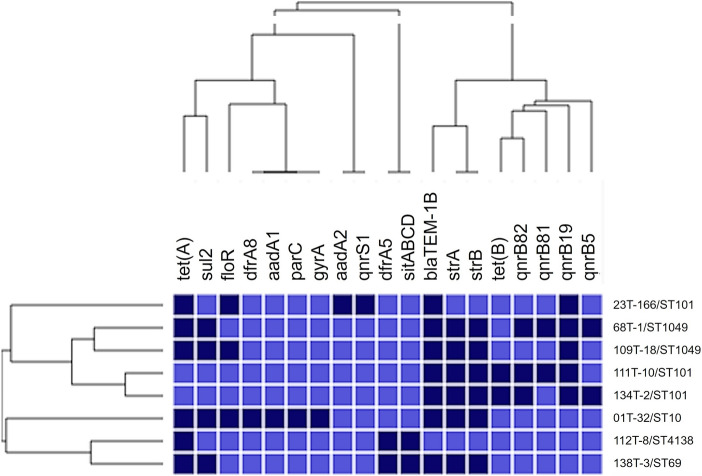
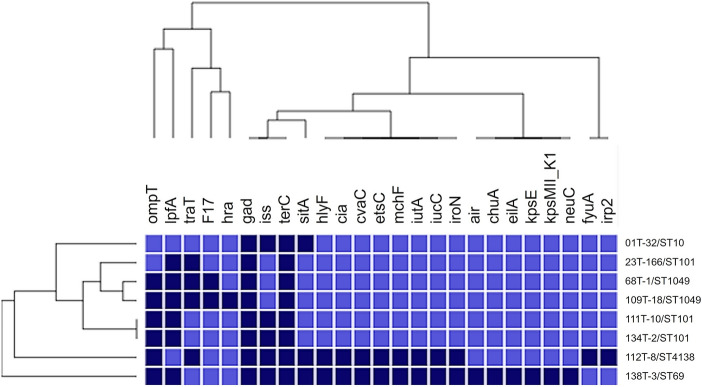
Mastitis occurrence in dairy cows is a broad topic that involves several sectors, from antimicrobial resistance and virulence of strains to economic implications and cattle management practices. Here, we assessed the molecular characterization (antimicrobial resistance determinants, virulence genes, sequences type, serotypes, and plasmid types) of 178 Escherichia coli strains isolated from milk samples from cows with clinical mastitis using a genome-based k-mers approach. Of these, 53 (29.8%) showed multidrug resistance by disc diffusion. We selected eight multidrug-resistant mastitis-associated E. coli for whole-genome sequencing and molecular characterization based on raw data using k-mers. We assessed antimicrobial resistance genes, virulence factors, serotypes, Multilocus Sequence Typing (MLST), and plasmid types. The most antimicrobial resistance gene found were bla (7/8), tetA (6/8), strA (6/8), strB (6/8), and qnrB19 (5/8). A total of 25 virulence factors were detected encoding adhesins, capsule, enzymes/proteins, increased serum survival, hemolysin, colicins, and iron uptake. These virulence factors were associated with Extraintestinal Pathogenic E. coli. Three pandemic clones were found: ST10, ST101, and ST69. Two E. coli were assigned in the O117 serogroup and one in the O8:H25 serotype. The most common plasmid groups were IncFII (7/8) and IncFIB (6/8). Our findings contribute to the knowledge of virulence mechanisms, epidemiological aspects, and antimicrobial resistance determinants of E. coli strains obtained from clinical mammary infections of cows.
奶牛乳腺炎是一个涉及多个领域的广泛话题,包括抗菌药物耐药性和菌株毒力,以及经济影响和牛群管理实践。在这里,我们使用基于基因组的 k-mers 方法评估了从患有临床乳腺炎的奶牛牛奶样本中分离的 178 株大肠杆菌的分子特征(抗菌药物耐药决定因素、毒力基因、序列类型、血清型和质粒类型)。其中,53 株(29.8%)通过圆盘扩散显示出多药耐药性。我们根据 raw data 使用 k-mers 选择了 8 株与多药耐药性乳腺炎相关的大肠杆菌进行全基因组测序和分子特征分析。我们评估了抗菌药物耐药基因、毒力因子、血清型、多位点序列分型(MLST)和质粒类型。发现的最多的抗菌药物耐药基因是 bla(7/8)、tetA(6/8)、strA(6/8)、strB(6/8)和 qnrB19(5/8)。共检测到 25 种毒力因子,编码黏附素、荚膜、酶/蛋白、增加血清存活、溶血素、大肠菌素和铁摄取。这些毒力因子与肠外致病性大肠杆菌有关。发现了 3 个大流行克隆:ST10、ST101 和 ST69。2 株大肠杆菌被分配到 O117 血清群,1 株分到 O8:H25 血清型。最常见的质粒群是 IncFII(7/8)和 IncFIB(6/8)。我们的研究结果有助于了解从奶牛临床乳房感染中获得的大肠杆菌菌株的毒力机制、流行病学方面和抗菌药物耐药决定因素。