Anne Rowling Regenerative Neurology Clinic, The University of Edinburgh, Edinburgh, UK.
Euan MacDonald Centre for Motor Neuron Disease Research, The University of Edinburgh, Edinburgh, UK.
BMJ Open. 2023 Feb 1;13(2):e064169. doi: 10.1136/bmjopen-2022-064169.
Motor neuron disease (MND) is an incurable progressive neurodegenerative disease with limited treatment options. There is a pressing need for innovation in identifying therapies to take to clinical trial. Here, we detail a systematic and structured evidence-based approach to inform consensus decision making to select the first two drugs for evaluation in Motor Neuron Disease-Systematic Multi-arm Adaptive Randomised Trial (MND-SMART: NCT04302870), an adaptive platform trial. We aim to identify and prioritise candidate drugs which have the best available evidence for efficacy, acceptable safety profiles and are feasible for evaluation within the trial protocol.
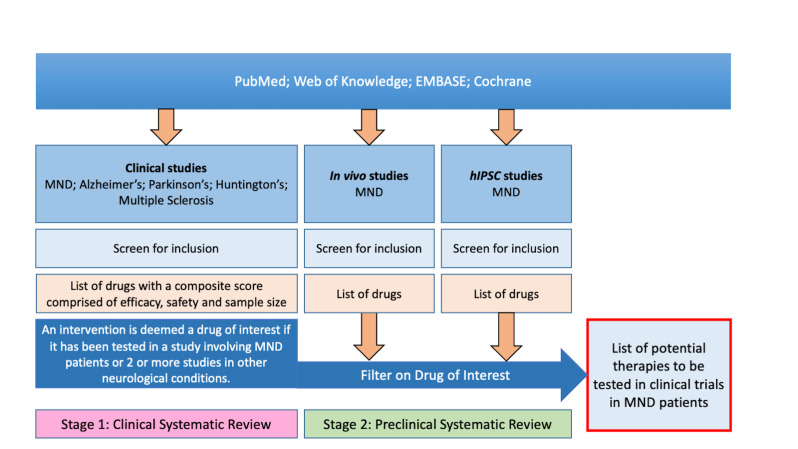
We conducted a two-stage systematic review to identify potential neuroprotective interventions. First, we reviewed clinical studies in MND, Alzheimer's disease, Huntington's disease, Parkinson's disease and multiple sclerosis, identifying drugs described in at least one MND publication or publications in two or more other diseases. We scored and ranked drugs using a metric evaluating safety, efficacy, study size and study quality. In stage two, we reviewed efficacy of drugs in MND animal models, multicellular eukaryotic models and human induced pluripotent stem cell (iPSC) studies. An expert panel reviewed candidate drugs over two shortlisting rounds and a final selection round, considering the systematic review findings, late breaking evidence, mechanistic plausibility, safety, tolerability and feasibility of evaluation in MND-SMART.
From the clinical review, we identified 595 interventions. 66 drugs met our drug/disease logic. Of these, 22 drugs with supportive clinical and preclinical evidence were shortlisted at round 1. Seven drugs proceeded to round 2. The panel reached a consensus to evaluate memantine and trazodone as the first two arms of MND-SMART.
For future drug selection, we will incorporate automation tools, text-mining and machine learning techniques to the systematic reviews and consider data generated from other domains, including high-throughput phenotypic screening of human iPSCs.
运动神经元病(MND)是一种无法治愈的进行性神经退行性疾病,治疗选择有限。因此,迫切需要创新,以确定可进入临床试验的治疗方法。在这里,我们详细介绍了一种系统和结构化的循证方法,以告知共识决策,从而选择前两种药物进行 Motor Neuron Disease-Systematic Multi-arm Adaptive Randomised Trial(MND-SMART:NCT04302870)评估,这是一项适应性平台试验。我们的目标是确定和优先考虑具有最佳疗效证据、可接受安全性且可在试验方案内进行评估的候选药物。
我们进行了两阶段系统评价,以确定潜在的神经保护干预措施。首先,我们回顾了 MND、阿尔茨海默病、亨廷顿病、帕金森病和多发性硬化症的临床研究,确定了至少有一篇 MND 文献或两篇或更多其他疾病文献描述的药物。我们使用评估安全性、疗效、研究规模和研究质量的指标对药物进行评分和排名。在第二阶段,我们回顾了药物在 MND 动物模型、多细胞真核模型和人诱导多能干细胞(iPSC)研究中的疗效。一个专家小组在两轮提名和一轮最终选择中审查候选药物,考虑系统评价结果、突破性证据、机制合理性、安全性、耐受性和在 MND-SMART 中的评估可行性。
从临床综述中,我们确定了 595 种干预措施。有 66 种药物符合我们的药物/疾病逻辑。其中,有 22 种具有支持性临床和临床前证据的药物在第一轮中被提名。有 7 种药物进入第二轮。专家组达成共识,评估美金刚和曲唑酮作为 MND-SMART 的前两个试验臂。
对于未来的药物选择,我们将在系统评价中纳入自动化工具、文本挖掘和机器学习技术,并考虑来自其他领域的数据,包括人 iPSC 的高通量表型筛选。