
细胞衰老相关的长链非编码核糖核酸:预测肝细胞癌的预后。
Cellular senescence-related long noncoding ribonucleic acids: Predicting prognosis in hepatocellular carcinoma.
机构信息
Department of Hepatopancreatobiliary Surgery, The Second Hospital of Tianjin Medical University, Tianjin, China.
出版信息
Cancer Rep (Hoboken). 2023 Apr;6(4):e1791. doi: 10.1002/cnr2.1791. Epub 2023 Feb 1.
BACKGROUND
Due to their inherent role in cell function, long non-coding ribonucleic acids (lncRNAs) mediate changes in the microenvironment, and thereby participate in the development of cellular senescence.
AIMS
This study aimed to identify cellular senescence-related lncRNAs that could predict the prognosis of liver cancer.
METHODS AND RESULTS
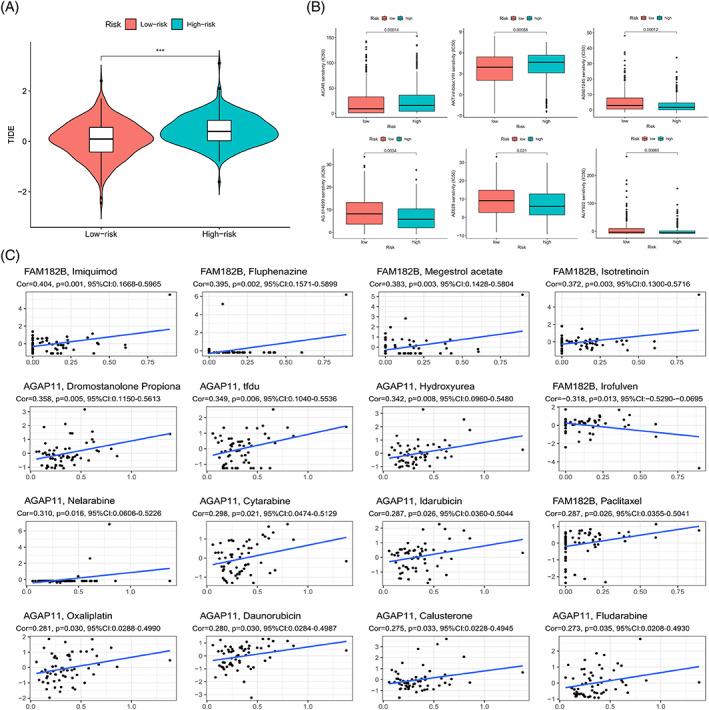
Gene expression and clinical data were downloaded from the UCSC Xena platform, ICGC, and TCGA databases. Cox regression and LASSO regression were used to establish a cellular senescence-related lncRNA model. ROC curves and Kaplan-Meier survival curves were then constructed to predict patient prognosis. Cox regression analysis and clinical characteristics were used to evaluate the capability of the model. Tumor mutational burden and tumor-infiltrating immune cell analyses were subsequently performed in the risk subgroups and the samples in the entire cohort were reclustered. Finally, potential small molecule immune-targeted drugs were identified based on the model. The cellular senescence-related prognostic model that was constructed based on AGAP11 and FAM182B. Along with the results of Cox regression and Lasso regression, the risk score was found to be an independent factor for predicting overall survival in cohorts. In the subgroup analysis, the prognosis of the low-risk group in each cohort was significantly higher than that of the high-risk group; the area under temporal ROC curves and clinical ROC curves were all greater than 0.65, respectively. C-index shows that the risk scores are greater than 0.6, showing the stability of the model. The high-risk group demonstrated lower tumor microenvironment and higher tumor mutational burden scores, further verifying the reliability of the model grouping results. Analysis of tumor-infiltrating immune cells indicated that CD8+ and γδ T cells were more abundant among patients in the low-risk group; cluster reorganization indicated that the two groups had different prognoses and proportions of immune cells. The p value of potential drugs predicted based on the expression of model lncRNAs were all less than .05, demonstrating the potential of model lncRNAs as therapeutic targets to some extent.
CONCLUSION
A prognostic model based on cellular senescence-associated lncRNAs was established and this may be used as a potential biomarker for the prognosis assessment of liver cancer patients.
背景
长链非编码 RNA(lncRNA)因其在细胞功能中的固有作用,介导微环境的变化,从而参与细胞衰老的发生。
目的
本研究旨在鉴定与细胞衰老相关的 lncRNA,以预测肝癌的预后。
方法和结果
从 UCSC Xena 平台、ICGC 和 TCGA 数据库下载基因表达和临床数据。使用 Cox 回归和 LASSO 回归建立细胞衰老相关 lncRNA 模型。然后构建 ROC 曲线和 Kaplan-Meier 生存曲线来预测患者预后。使用 Cox 回归分析和临床特征评估模型的能力。在风险亚组和整个队列的样本中进行肿瘤突变负担和肿瘤浸润免疫细胞分析,并重新聚类。最后,根据模型鉴定潜在的小分子免疫靶向药物。基于 AGAP11 和 FAM182B 构建的细胞衰老相关预后模型。与 Cox 回归和 Lasso 回归的结果一起,风险评分被发现是预测队列中总生存的独立因素。在亚组分析中,每个队列中低风险组的预后均明显高于高风险组;时间 ROC 曲线和临床 ROC 曲线下面积均大于 0.65,分别。C 指数表明风险评分大于 0.6,表明模型的稳定性。高风险组的肿瘤微环境评分较低,肿瘤突变负担评分较高,进一步验证了模型分组结果的可靠性。肿瘤浸润免疫细胞分析表明,低风险组患者中 CD8+和 γδ T 细胞更为丰富;聚类重组表明两组具有不同的预后和免疫细胞比例。基于模型 lncRNA 表达预测的潜在药物的 p 值均小于.05,表明模型 lncRNA 具有一定程度的治疗靶点潜力。
结论
建立了基于细胞衰老相关 lncRNA 的预后模型,该模型可作为肝癌患者预后评估的潜在生物标志物。



 Zotero 插件