Dufour-Gaume Frédérique, Frescaline Nadira, Cardona Venetia, Prat Nicolas J
Institut de Recherche Biomédicale des Armées (IRBA), Bretigny surOrge, France.
Institut Pasteur, Paris, Île-de-France, France.
Front Physiol. 2023 Jan 16;13:999011. doi: 10.3389/fphys.2022.999011. eCollection 2022.
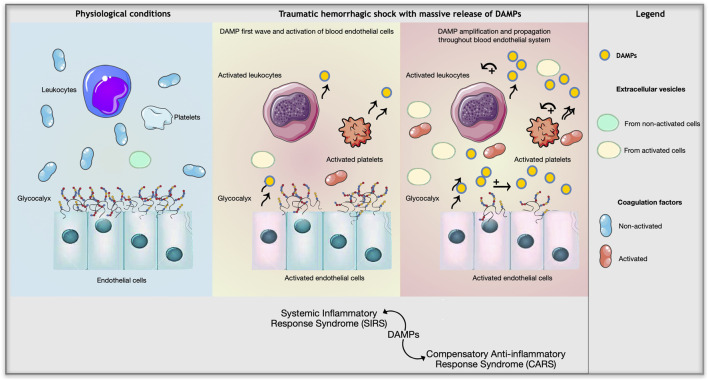
Hemorrhage is the leading cause of death in severe trauma injuries. When organs or tissues are subjected to prolonged hypoxia, danger signals-known as damage-associated molecular patterns (DAMPs)-are released into the intercellular environment. The endothelium is both the target and a major provider of damage-associated molecular patterns, which are directly involved in immuno-inflammatory dysregulation and the associated tissue suffering. Although damage-associated molecular patterns release begins very early after trauma, this release and its consequences continue beyond the initial treatment. Here we review a few examples of damage-associated molecular patterns to illustrate their pathophysiological roles, with emphasis on emerging therapeutic interventions in the context of severe trauma. Therapeutic intervention administered at precise points during damage-associated molecular patterns release may have beneficial effects by calming the inflammatory storm triggered by traumatic hemorrhagic shock.
出血是严重创伤性损伤的主要死因。当器官或组织长期处于缺氧状态时,危险信号(即损伤相关分子模式,DAMPs)会释放到细胞间环境中。内皮细胞既是损伤相关分子模式的靶点,也是其主要来源,这些分子模式直接参与免疫炎症失调及相关组织损伤。尽管损伤相关分子模式的释放早在创伤后就开始了,但这种释放及其后果在初始治疗后仍会持续。在此,我们回顾一些损伤相关分子模式的例子,以说明它们的病理生理作用,重点关注严重创伤背景下新兴的治疗干预措施。在损伤相关分子模式释放的精确时间点进行治疗干预,可能通过平息创伤性失血性休克引发的炎症风暴而产生有益效果。